
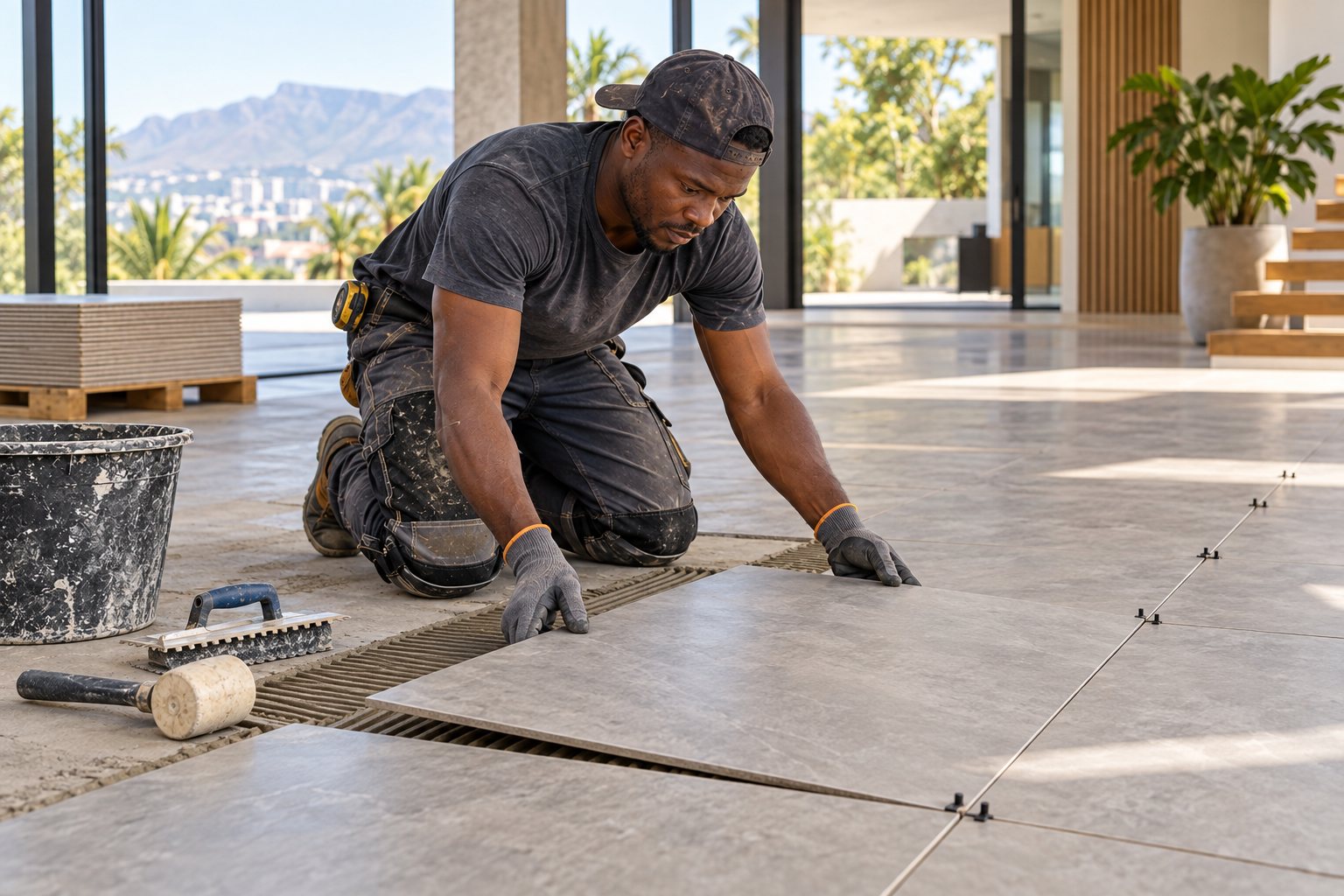
Choosing a tile is the easy part — the colour, the size, the look. The tiler, meanwhile, looks at what lies beneath. A tiled surface is a stack of four layers — the substrate, the adhesive or mortar, the tile, the grout — and each can make the others fail. The tiler works them from bottom to top; defects, for their part, appear in the reverse order. We will take them in the tiler’s order.
The substrate: what lies under the tile
A cement screed, a concrete slab, an old tiled floor, a wall render, a lightweight partition, a terrace floor exposed to rain: every substrate has its requirements, and the tiler begins by checking it. Is it flat? A flatness defect is amplified under a large format. Is it dry? A screed still damp, a wall drawing up water, make the adhesive let go. Is it stable and clean? A crumbling screed, flaking paint, site dust prevent any bond. Are there cracks, expansion joints to respect, falls to create towards a drain?
The tiler who finds an unsuitable substrate says so before starting: levelling compound, bonding primer, screed repair, tanking under the tiles in a shower or on a terrace, or refusal to lay until the substrate is dry. Laying on a doubtful substrate “because the customer is in a hurry” guarantees a callback within the year.
Adhesive and mortar: the choice that cannot be seen
Ready-mixed tile adhesive, cement-based adhesive to mix, traditional mortar, specific adhesive for large formats, for outdoors, for wet rooms, for tiling over old tiles: the product is chosen according to the substrate, the tile, the place and the use. Each product has its manufacturer’s instructions — preparation, open time, drying time before grouting and before foot traffic — which the tiler follows to the letter, because they vary from one product to another and from one climate to another. There is no “right” universal mix nor a drying time valid everywhere; there is the instruction on the bag.
Spreading itself has its rules: single or double buttering according to format, the right notched trowel, adhesive spread over an area that can be covered before it skins. A tile laid on adhesive that has started to dry holds for a few months.
The tile: format, layout, cuts
The tile brings its own constraints: its size, its flatness, its porosity, its thickness, the regularity of its edges. Before laying, the tiler sets out the layout — drawing the distribution of tiles in the room so that cuts fall in the right places, joints line up from one room to the next, the pattern is centred where it will be seen. A layout approved with the customer avoids discovering, the next day, a three-centimetre strip along the main wall.
Cuts are made with a tile cutter or a wet saw, with goggles and, for dry cuts, protection against silica dust. Tiles from the same batch are mixed to spread the shade variations; a different batch mid-way shows in raking light forever.
The grout: the finish that makes the tiling
Grout fills the space between tiles, absorbs small movements and stops water getting through. Its width depends on the tile and the place, its product on the use — cement grout, epoxy grout for heavily used or wet areas —, its colour on the look wanted. It is applied after the adhesive’s drying time, cleaned off before it hardens on the tile, and completed, at corners and junctions, by flexible joints that absorb expansion. Tiling without expansion joints over a large area or on a sun-exposed terrace lifts its tiles the first summer.
Wet rooms and outdoors: two cases apart
A bathroom, a walk-in shower, a restaurant kitchen, a terrace, a pool are not tiled like a living room. Water passes through, stands, sometimes freezes at night at altitude, dries in the sun; the tiler adds a layer the customer will never see — tanking under the tiles, turned up the walls, connected to the drains — and falls that lead the water where it must go. They choose tiles suited to the use — slip resistance, frost resistance, porosity — and grouts that withstand moisture. A shower tiled without tanking leaks into the neighbour below; a terrace tiled without falls or expansion joints lifts. In both cases, the tiler who agrees to “keep it simple” to meet a budget already knows they will be back.
The site, the dust, the knees
The tiler works on their knees, cuts materials that produce harmful dust, handles heavy bags and chemical products. The ILO code of practice on safety and health in construction and its ergonomic checkpoints give the measures: knee pads, alternating postures, organised handling, wet or extracted cutting, ventilation, gloves for adhesives and grouts. WHO recalls that chemical safety is a public-health matter; for a tiler, epoxy resins, primers and some cleaners are part of it, and are handled with the protection their labels indicate.
The estimate, surface by surface
A tiling contractor’s estimate is expressed in areas — floors, walls, skirtings — and separates substrate preparation, the supply of tiles or laying only, adhesive and grout, cuts and finishes, tanking where necessary, removal of rubble. It states the tile format, because laying a large format or a mosaic does not cost the same time, and the laying pattern — straight, diagonal, with a motif. It says what is not included: removal of the old covering if not priced, repair of a defective screed discovered mid-site, tiles lost to a demanding pattern.
The price depends on the place, the substrate, the tile and the complexity; the tiler announces no “price per square metre” that would apply to everything. They announce a method of calculation, and apply it.
Complaints: reading a defect
A tile that sounds hollow, a joint that cracks, a tile that lifts, a shade that varies, a fall that sends water the wrong way: the tiler knows how to read these defects and name their cause — substrate, adhesive, timing, tile, use. They distinguish what is their responsibility, what stems from a substrate they were asked to accept, and what stems from use — furniture dragged, impact, aggressive product. A contractor that values its reputation comes back, explains, and makes good what is theirs — and it keeps, for every job, a written record of the substrate condition observed before laying, because that document is what will make it possible, a year later, to say whose defect it is.
In the African context
What sets this trade apart on the continent begins with the substrate: in many constructions, the screed is poured by the mason with an approximate mix, without enough drying time, sometimes on a slab that draws up damp from the ground; the tiler arrives on a substrate whose age and composition they do not know, and it is the tiler who will bear the complaint if the tiles come loose. Checking the flatness, moisture and cohesion of the screed before laying — and saying so in writing — is, here, half the trade.
Climate comes next: heat that speeds the setting of adhesives and shortens the laying time, rainy-season humidity that slows drying, terraces and courtyards exposed to temperature swings that expand the tiling. Manufacturers’ instructions, written for other climates, are not always enough; the tiler adapts — working in the cool hours, adhesive with a longer open time, expansion joints closer together — relying on what they have seen hold.
It should be added that tiling is a sign of social success and one of the first investments of a household that builds; the market is immense and the trade largely informal, learnt on the job. The contractor that stands out is the one that prepares the substrate, sets out the layout with the customer, respects drying times and hands over a written estimate — and accepts losing a job rather than laying on a screed still damp.
What the customer sees six months on
On delivery day, the customer sees a pattern, clean joints, a shiny surface. Six months on, they see what the tiler did with the invisible layers: a floor that does not sound hollow, joints that do not crack, a shower that does not leak into the downstairs neighbour’s ceiling, a terrace that got through the hot season without lifting a tile.
The tile was the customer’s choice; the substrate, the adhesive and the time were the tiler’s trade. It is the second that decides what the first is worth.