
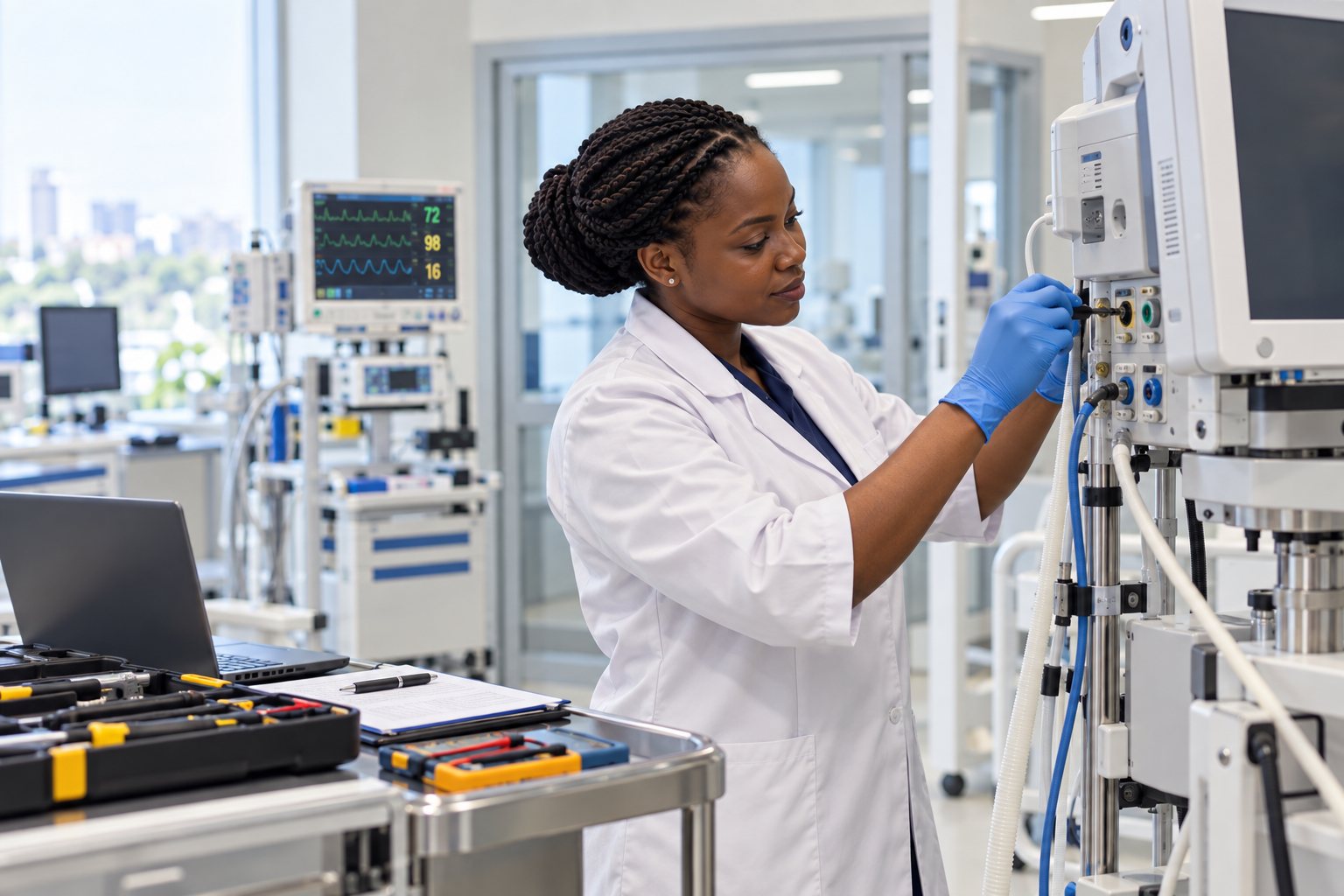
A district hospital owns a few hundred pieces of equipment: monitors, syringe pumps, suction units, oxygen concentrators, operating tables, electrosurgical units, ultrasound scanners, autoclaves, centrifuges, laboratory analysers, incubators, lamps, blood pressure monitors, scales. Each was bought, donated or inherited at a different time, with or without a manual, with or without training, with or without spare parts. The biomedical maintenance department or contractor is responsible for keeping that fleet available, safe and accurate. Those are three distinct requirements, and the third — accuracy — is the one most often forgotten, because an inaccurate device does not announce itself.
The inventory: you only maintain what you know
Every maintenance programme begins with an inventory: each piece of equipment identified by a number, with its type, make, model, serial number, location, commissioning date, condition, the availability of the manual and accessories, and its criticality level — an intensive care device does not have the same priority as a consulting-room scale. The World Health Organization, in its technical series on medical devices, places this inventory at the foundation of all equipment management: without it, one can neither plan preventive maintenance, nor track breakdowns, nor decide on purchases.
In many facilities, the inventory does not exist, or dates from an old audit. The technician’s first job is therefore often to walk the wards with a label printer and a spreadsheet, and to discover devices nobody remembered — sometimes new, still in their crate.
Preventive maintenance: the calendar rather than the emergency
Preventive maintenance means intervening before the breakdown, on a schedule set by the manufacturer and adjusted to actual use: cleaning, replacement of consumables and wear parts (filters, batteries, seals, sensors, lamps), lubrication, checking of safety features, software updates where possible. For an oxygen concentrator, that means replacing the filters and checking the concentration delivered; for an autoclave, checking the seals, the relief valve and the sterilisation cycle; for a syringe pump, verifying the flow rate and the occlusion alarms.
The WHO reference document on medical equipment maintenance programmes describes this organisation: planning by criticality and workload, written procedures by device type, traceability of every intervention. Preventive maintenance costs technician time and consumables; it prevents breakdowns that cost care.
Performance and safety testing: the part nobody sees
This is where the trade differs from electrical troubleshooting. After every intervention, and at regular intervals, the technician verifies that the device does what it claims: a patient simulator for a monitor, a flow analyser for a syringe pump, a reference oximeter for a concentrator, an electrical safety tester for leakage currents, a calibrated probe for an autoclave or an incubator. A device that “works” but delivers 87 % oxygen instead of 93 %, or displays a pressure offset by 15 mmHg, is more dangerous than a broken one: people rely on it.
These tests require test instruments that are themselves calibrated, and training in their use. A maintenance service that owns none cannot say that a device is safe; it can only say that it switches on.
Repair: diagnose, repair, test, document
Corrective maintenance follows a sequence: collect the description of the fault from the users, reproduce the defect, diagnose (often a power supply, a battery, a connector, a sensor, a fuse, an accessory — many medical device “breakdowns” are worn accessories or user errors), repair or replace, test performance and safety, then document: what was found, what was done, with which parts, by whom, and the date of the next check.
The technician also knows what they do not repair: components subject to manufacturer approval, radiation sources, certain modules whose repair would void the device’s certification or expose the patient. They then escalate to the manufacturer or its representative, and say so clearly to the facility, with costs and lead times.
Parts, consumables and counterfeits
A large share of idle equipment is idle for want of a part or a consumable: a specific battery, a saturation sensor, a cuff, a filter, an endoscope lamp. The technician keeps a stock of common parts for critical devices and identifies, for each model, a reliable source of supply. They are wary of parts and accessories of doubtful provenance: the WHO regularly warns about substandard and falsified medical products, and a counterfeit sensor that gives a false reading is a falsified medical product in the same way as a fake medicine.
User training and avoidable errors
A share of reported breakdowns comes from misuse: alarm disabled, accessory wrongly connected, cleaning with a product that attacks plastics, battery never charged, device transported carelessly. The biomedical technician trains users — nurses, midwives, laboratory technicians — in daily use, cleaning, pre-use checks, and how to report an anomaly. That training is the most cost-effective intervention in the programme: it prevents breakdowns that should never have existed.
Decommissioning and disposal
A device reaches end of life when it is no longer repairable at a reasonable cost, when its parts no longer exist, or when it is no longer safe. The technician documents the decommissioning proposal and the facility decides. Disposal is not trivial: batteries, screens, electronic components, radioactive sources, contaminated elements go through separate channels. Badly managed waste electrical and electronic equipment — the WHO documents this in its fact sheet — exposes informal recyclers, and often children, to toxic substances. A decommissioned medical device that ends up in an open dump is not a hospital problem solved; it is a public health problem displaced.
In the African context
The starting fact, on the continent, is the share of medical equipment out of service in public facilities: WHO studies and many national audits estimate that a substantial proportion of the devices installed in low-resource hospitals do not work, or work without anyone knowing whether they measure correctly. The causes are known: donated equipment unsuited to the power grid, the climate or the consumables available; no manual and no training at delivery; no maintenance budget planned at purchase; no technician on site; parts unobtainable. Biomedical maintenance is, on the continent, as much a question of how purchases are organised as of screwdrivers.
Hence a first particular skill: knowing how to say no to a donation. A device offered without a manual, without locally available consumables, without parts, without training and without a maintenance commitment will cost more than it brings. A biomedical technician who takes part in acquisition decisions — to check electrical compatibility, consumable availability, the maintenance contract, the planned training — provides a service worth years of troubleshooting.
The power grid then imposes its rules: outages, surges, poorly regulated generators. A large share of the power supply failures they see comes from there, and electrical protection — UPS units, regulators, surge protectors, earthing — is part of their work as much as repair. Heat, humidity and dust, for their part, clog filters and degrade batteries and seals faster than manufacturers’ schedules anticipate; preventive maintenance intervals have to be shortened accordingly.
Technician training is the third factor: biomedical engineering courses are developing in several countries, but technicians in post are often electricians or electronics technicians who learnt on the job, with whatever manuals they could find. Manufacturers and their representatives train on their own devices, rarely on others; exchanges between technicians of neighbouring facilities, online resources and training supported by health partners fill part of the gap. A facility that invests in its technician’s training reduces its dependence on external contractors, often based in the capital and charging for travel.
The private market is structuring itself around clinics, medical laboratories and imaging centres, which buy more recent equipment and can pay for a maintenance contract. Independent contractors find their clientele there, and increasingly offer public hospitals contracts covering a whole fleet rather than one-off repairs. Remote maintenance — remote diagnosis, video assistance, monitoring of connected devices — is advancing where connectivity allows, without dispensing with the visit for performance checks.
The place of consumables and accessories must be added: in many hospitals the device exists, the technician exists, but the sensor, the cuff, the electrode or the reagent is missing. A technician who manages a small stock of critical accessories and knows where to source them reliably prevents more downtime than one who can repair a circuit board.
Starting a biomedical maintenance business
The activity requires solid technical training (electronics, electrical engineering, mechanics, applied IT), knowledge of the most common devices, a set of calibrated test instruments — electrical safety tester, patient simulator, flow analyser, reference oximeter, reference thermometer and pressure gauge —, suitable tools, a vehicle, insurance and rigorous documentation. It also requires knowing how to say what one does not do, and to whom one escalates.
The contractor’s website should state the device families covered, the makes on which they are trained, their test instruments, the form of their contracts (preventive, corrective, whole fleet), their response times and their area. A hospital that reads “performance test after every intervention, report handed to the ward” knows it is not buying only a repair.
The report the patient will never read
A technician had returned an oxygen concentrator to service in a paediatric ward. He could have stopped at the green light. He measured the concentration delivered: 82 %. He changed the sieve beds, measured again: 93 %. He wrote it on the record, with the date of the next check. Nobody on the ward noticed the difference. That is exactly the point.