
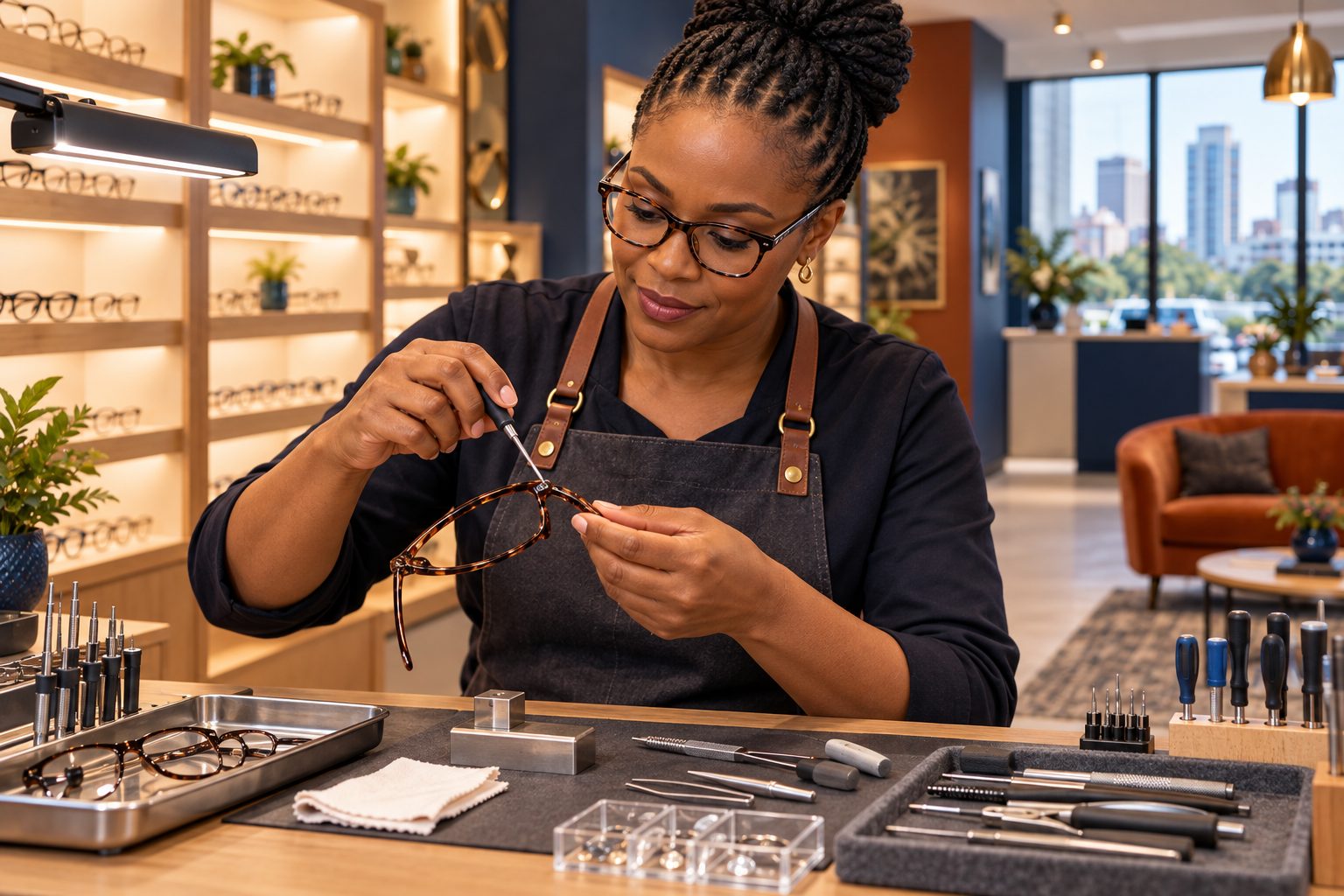
Between the practice that prescribes and the face that will wear the glasses, there is a workshop. That is where the dispensing optician works: they receive a prescription, advise on a frame, order or cut lenses, mount them, fit the pair, repair it and guarantee it. An optical store is therefore at once a shop, a workshop and a point of contact with the health system, and its customers do not always know which of the three faces they are calling on. This article follows the object itself — the prescription, the lenses, the frame, the mounting, the fitting, the after-sales service — because a skill, and sometimes a misunderstanding, hides in each of these parts.
The prescription: the starting point the shop does not replace
A pair of corrective glasses begins with a prescription issued by a professional entitled to prescribe under the country’s rules — most often an ophthalmologist, an optometrist where the law allows it. The dispensing optician reads it, checks its consistency, its date and the details needed for mounting, and asks the questions it leaves open: main use of the glasses, working distance, permanent or occasional wear. They do not alter the prescribed correction on their own initiative; if they notice an inconsistency or an unexplained discomfort, they refer back to the prescriber.
Many optical stores also offer a sight test in the shop. It must be clear what that is: a check or an aid to choosing, framed by local law, not a diagnosis. A sudden loss of vision, a red eye, pain, double vision are not settled at the counter, whatever the quality of the measuring device; the store that recognises them and sends the customer to a physician is doing its job. WHO notes that uncorrected refractive errors are the leading cause of avoidable vision impairment worldwide; that is the reason optical stores exist, but it does not make them medical practices.
The lenses: what is really being bought
The lens is the most technical and least visible part of the object. It comes in several materials, several geometries — single vision, progressive, degressive —, several treatments — anti-reflective, hardened, filtering, photochromic — and several thinning indices. Each option affects vision, appearance, weight and price, and the optician’s advice consists of matching those options to the prescription, the use and the budget. A high-end progressive lens is not “better” for someone who only needs distance correction; a very thin lens is only worthwhile for a strong correction.
The optician explains what they propose and why, and writes the exact reference of the lenses on the estimate — material, geometry, treatments, manufacturer when known. That is what lets the customer compare two estimates, and another optician remake the pair identically. A store that refuses to specify what it sells is selling an object no one will be able to check.
The frame: the visible choice, and what it constrains
The frame is what the customer sees, touches, tries on; it is also what determines part of what the lenses can be. A strongly curved, very large or very small frame imposes constraints on cutting and centring; some shapes do not suit some progressive lenses; a child’s frame must withstand a use an adult’s never sees. Advice therefore covers the face, taste and compatibility with the prescription — in that order, or the reverse, but never on the sole argument of the brand.
Where the frame comes from is a subject in itself. An optical store knows the origin of its frames, what the manufacturer’s guarantee covers, and what it can repair itself. It does not present a frame of unknown origin as a branded product, and does not sell sunglasses without being able to say what their lenses actually filter.
Mounting and centring: the part that requires a workshop
Two identical lenses mounted by two opticians do not give the same vision. Centring — the exact position of each lens’s optical axis in front of each pupil — depends on measurements taken on the customer with the chosen frame: pupillary distance, height, angle, distance between lens and eye. A badly centred progressive lens means dizziness, a reading zone that cannot be found, glasses the customer ends up leaving in a drawer. Cutting then fits the lens to the exact shape of the frame without weakening it.
This work is done in the workshop, with measuring instruments, an edger and mounting tools, or at a subcontractor when the store is not equipped. In both cases the optician checks the pair before handing it over: correction matching the prescription, centring matching the measurements, no visible defect. That check is what separates an optician from a reseller.
Fitting and adaptation: what decides whether the glasses will be worn
A technically perfect pair can be abandoned within a week because it slips, pinches, marks the nose or sits crooked. Fitting — nose pads, temples, tilt, spread — is done on the face at handover, then again a few weeks later if needed, without charging for that return. The optician also explains what an adaptation period is, particularly for a first progressive lens, and distinguishes the normal discomfort of the first days from a centring or correction problem that must be redone.
It is also the moment when the customer learns to care for their glasses: cleaning, storage, what not to do. A store that gives time to the handover sees its customers come back; one that pushes the case across the counter sees the complaints come back.
Price, estimate, guarantee and after-sales service
The price of a pair is made up of the lenses, the frame, the mounting and sometimes separate services; the estimate sets them apart, so that the customer knows what they pay for and can replace one element without buying everything again. The United Nations guidelines for consumer protection, carried by UNCTAD, call for clear information before purchase and accessible remedies afterwards; in an optical store, that means a detailed estimate, an invoice that repeats the references, and a written policy for breakage, scratches, the manufacturer’s guarantee and the cases where the lenses do not suit.
A serious store displays no “single price” that would hide what it contains, nor a tariff supposedly valid everywhere: the price depends on the chosen lenses, the frame, the place and any insurance cover the customer has. It does state what is included — fittings, small repairs, replacing a nose pad — and what is not.
Where the optical store stops
It does not diagnose an eye disease and does not prescribe treatment: that is the physician’s role. It does not alter a prescription. It announces neither vision “like before” nor a pair that will certainly suit without an adaptation period. It does not sell contact lenses without the skills and equipment their fitting requires, nor without a prescription where regulation demands one. It does not present a sight test in the shop as a medical examination. Each of these limits is also a protection for the business itself: a store that oversteps them takes on liability on ground that is not its own.
In the African context
Two out of three people who need glasses have no access to them in low-income countries, according to WHO. For an African optical store, that gap between need and access is the first fact of the trade; WHO’s SPECS 2030 initiative aims precisely at effective coverage of refractive errors, with quality, affordable, people-centred services. For an African optical store, that outlines an immense market — and a responsibility: the entry price of a simple pair decides whether a schoolchild reads the board or not.
Then comes the supply chain. Lenses and frames are, in most countries of the continent, imported; lead times, customs duties and the availability of a particular lens weigh on delivery time and price, and the store that announces a handover date without knowing its supplier’s lead time promises what it does not control. Conversely, a shop with a stock of common lenses and an edging workshop can hand over a simple pair within days, which, for a customer who has travelled far, changes everything.
Then there is the street: frames and sunglasses sold on the pavement, without a suitable corrective lens or without a real filter, put the store in a teaching position: explaining what a corrective lens does, why a sun lens without a filter is worse than no glasses, and why a pair bought without a prescription does not correct failing sight. That explanatory role, played shop after shop, is a real part of the trade.
The questions to ask before paying
What is the exact reference of the lenses, and is it on the estimate? What does the guarantee cover, and for how long? Are fittings after handover included? What happens if the lenses do not suit? Does the test done in the shop replace a prescription — the honest answer is no? And, more simply: can I leave with a document that says what I bought?
An optical store that answers these questions without hesitating has understood that its product is a medical object sold in a shop, and not the other way round.