
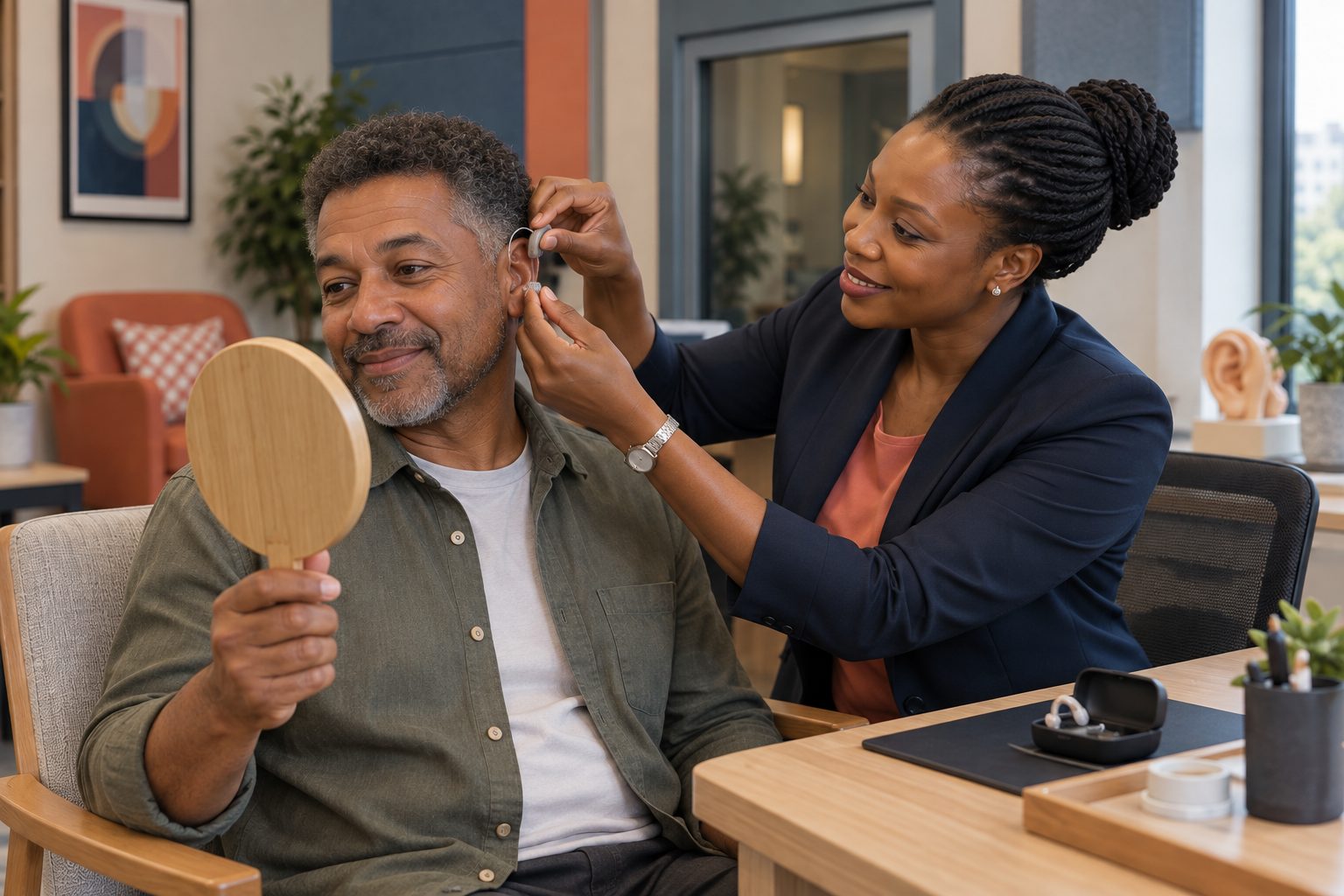
Hearing loss cannot be seen, settles in slowly, and the person affected is often the last to admit it. When they push open the door of a hearing centre, they arrive with a difficulty — conversations in groups, a television too loud for everyone else, words they ask to have repeated — rather than with a request for a device. The hearing-aid specialist’s trade begins there, and it does not end on the day of the fitting: it stretches over months, because a hearing aid is adjusted to a life, not to a curve. This article follows that calendar, from the first visit to lasting follow-up.
Before anything else: has the ear been examined?
A hearing centre assesses hearing; it does not diagnose the cause of deafness. A drop in hearing may come from a wax plug, an infection, damage to the middle or inner ear, a treatment, noise exposure, age — and some of these causes are treated medically, sometimes urgently. That is why fitting a device is done, under most regulatory frameworks, after a medical examination of the ear and on prescription. The centre that receives someone without a prior examination first refers them to a physician, especially in the face of sudden loss, pain, discharge, a marked difference between the two ears or recent tinnitus.
WHO estimates that, by mid-century, nearly one person in four worldwide will live with some degree of hearing loss and that hundreds of millions will need hearing rehabilitation. The hearing centre is one of the places for that rehabilitation; it is not its medical entry point.
The first visit: measuring and listening
Assessment at the centre includes an in-depth conversation — history of the difficulty, hard situations, daily sound environment, expectations, general health — and measurements: pure-tone audiometry, which gives hearing thresholds at different frequencies for each ear, speech audiometry, which measures understanding of speech, sometimes further tests depending on the equipment. The booth or room must be quiet enough for the results to mean something; a centre that measures in an office open to the street is measuring the street.
This first visit ends with an explanation: what the measurements show, what a device can bring in the situations described, what it will not bring, and what the path will be. It does not end with a sale. A person who leaves to think it over with a written report is a person who will come back with confidence.
Choosing the device: the person first
The choice of a device is made from the measurements, but also from the person’s dexterity, eyesight, way of life, the humidity and dust of their environment, their budget and the availability of after-sales service. Behind-the-ear, in-the-ear, rechargeable or battery-powered, one ear or both: each option has practical consequences the specialist explains. They generally propose several solutions at different price levels, and write down what each includes.
A hearing aid is a medical device, and WHO points out that access to quality, affordable and appropriate health products is indispensable; in concrete terms, the centre knows where its devices come from, what the manufacturer’s guarantee covers, and it does not sell a device whose adjustments and upkeep it will not be able to provide.
Many centres offer, before the final purchase, a trial period with the programmed device: the person goes home, wears it in their real situations — the market, the family gathering, the car journey — and comes back to say what worked and what did not. That period is not a commercial favour; it is the only way to check that a device chosen on measurements suits a life. The centre writes down the terms of the trial: length, any deposit, what happens if the person decides against it.
The fitting and the first weeks: adaptation
On fitting day the device is programmed from the measurements, checked in the ear, and the person learns to put it in, take it out, change the battery or recharge it, clean it. Then begins the most important period of the trade: the first weeks. The brain must relearn forgotten sounds — the rustle of clothes, the dishes, one’s own voice — and that relearning is uncomfortable before it is useful. The specialist warns, plans closely spaced appointments, adjusts the settings according to what the person reports, and distinguishes normal discomfort from an adaptation problem that must be corrected.
A centre that hands over the device and books the next appointment six months later has not done its job; the number of adjustment appointments included in the price is one of the most useful pieces of information on an estimate.
Afterwards: follow-up, maintenance, repair
Once adaptation has stabilised, the relationship continues. Hearing changes, needs too, and the device wears: settings are reviewed at regular intervals, hearing is measured again, ear tips, filters and tubes are replaced, breakdowns are handled — at the centre where possible, at the manufacturer otherwise, with a loan device when the centre has one. The person knows whom to call, what consumables cost, what the guarantee covers and what remains at their expense.
The centre keeps a file per person: successive measurements, settings, interventions. It is that file which makes it possible, after several years, to say whether the device should be renewed and why.
Price, estimate and what is not included
The price of a fitting includes, depending on the centre, the device itself, ear tips, adaptation appointments, a follow-up period, the guarantee. The estimate details these elements, separates the two ears, and states what is billed apart: batteries or charger, consumables, out-of-guarantee repairs, follow-up beyond the included period. Where an insurer or a public scheme contributes, the centre states what remains payable and the steps to take.
The centre publishes no price presented as that of “a hearing aid” in general: the price depends on the device, the level of technology, the number of ears fitted, the follow-up included and the person’s cover. It explains how the price is made up and leaves time to compare.
Prevention and safe listening
A hearing centre does not only compensate a loss; it speaks about it upstream. WHO has published a global standard for safe listening in venues and events, and warns of the risk of avoidable hearing loss linked to listening habits among young adults. The centre that advises hearing protection for workers exposed to noise, for musicians, for people who frequent loud places, and that explains what a reasonable listening volume is, practises its trade in the full sense — even when no device follows.
In the African context
A battery that cannot be found in town is enough to silence the most sophisticated device. A hearing aid depends on batteries or charging, consumables, adjustments and repairs, and the question a centre on the continent must ask before selling is: will this person, where they live, be able to keep this device alive? A high-technology device with no batteries available in town, no remote adjustment and no repairer within a day’s travel becomes a useless object within months. The centre that chooses with the person a sturdy model, rechargeable where electricity allows, resistant to humidity and dust, and that organises follow-up by telephone or grouped visits, adapts the trade to its ground.
Medical care upstream raises another question. WHO notes a heavy burden of hearing loss and unevenly available ear-care services; in many cities, ear specialists are rare and the hearing centre receives people who have never been examined. The centre cannot replace that examination — a chronic ear infection or a wax plug is not fitted with a device — but it can organise referral, work with hospital departments and screening campaigns, and refuse to fit what must first be treated.
And there is the child. Their hearing loss is, on the continent as elsewhere, an emergency apart: it compromises language and schooling if not addressed early. The centre that can screen a child, refer them without delay and work with the school and the family fulfils a role its sign does not mention.
Impossible promises, possible commitments
It cannot promise hearing “like before”: a device amplifies and processes sound, it does not give back the original ear. It cannot promise effortless listening in noise, nor the disappearance of tinnitus, nor an adaptation period identical for everyone. It cannot diagnose the cause of deafness nor decide that a medical examination is unnecessary. It cannot guarantee that a device will last a given number of years, nor that it will never break down.
What it can promise, and write down: measurements taken in proper conditions, an explained choice, as many adjustments as needed, organised follow-up, and referral to a physician whenever the ear requires it. That is less spectacular than a promise of a miracle, and it is exactly what a person who hears poorly needs to hear.