
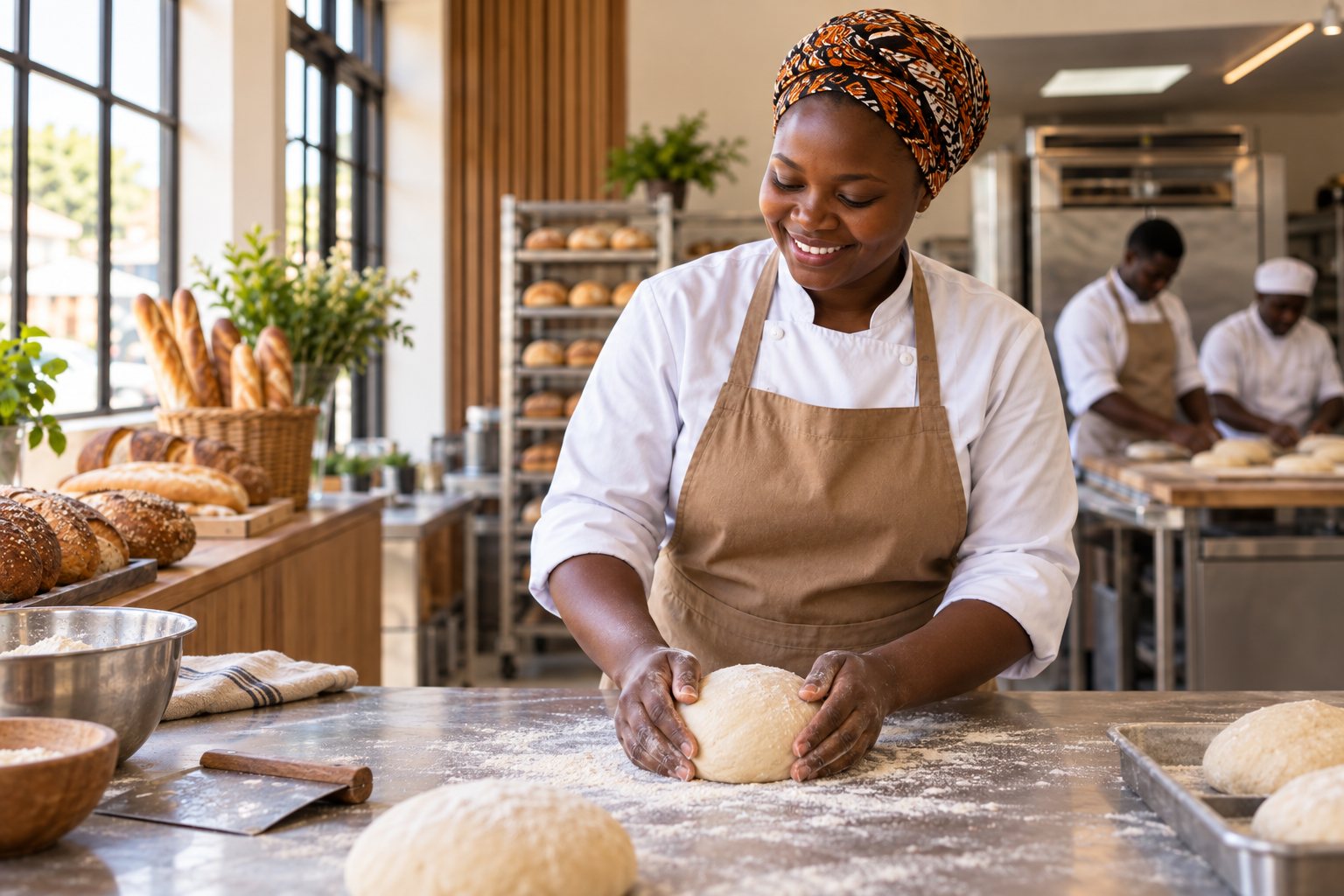
The bakery is one of the most everyday businesses there is: people go there every day, often twice, for a product whose price everyone knows and everyone discusses. That familiarity hides a demanding organisation. Four ingredients — flour, water, salt, yeast or sourdough — and one variable that does not appear on the label: time. The baker who controls time — fermentation, resting, baking, but also flour orders, delivery rounds and staff rotation — makes a consistent bread. The one who is at its mercy makes a different bread every day, and loses customers one by one.
Flour: the raw material that decides everything
A bakery depends on its flour more than on anything else. Its strength, extraction rate, moisture, freshness and consistency from one bag to the next decide hydration, rise, crumb and crust. The baker chooses one or two suppliers, knows the characteristics of each flour, stores it dry, on pallets, protected from insects and rodents, and manages stock on a first-in, first-out basis. A damp or infested bag cannot be rescued; it is thrown away, and the cost of that bag is the price of an intake inspection that was not done.
The other ingredients demand the same attention: clean water at a controlled temperature, dry salt, yeast kept cold and used before its date, fats and sugars stored away from heat. A supplier who delivers a different flour under the same name, without warning, is a supplier to replace.
The process: mix, ferment, shape, bake
Mixing develops the gluten network that will hold the gas of fermentation; too short, the dough lacks strength, too long, it heats up and oxidises. Fermentation — first in bulk, then a second time after shaping — is what gives bread its crumb, its aromas and its keeping quality; it depends on dough temperature, yeast quantity and time, and the baker compensates every day for ambient heat with the water temperature. Shaping gives form and tension; baking, in an oven whose hot and cool zones the baker knows, sets the crust and the colour.
At every step, a production sheet — quantities, temperatures, durations — makes it possible to reproduce yesterday’s bread, and to understand why today’s is different. A baker who works “by eye” sometimes makes an excellent bread; they cannot explain to their worker how to make it again, nor find out what went wrong on the day the crumb came out tight and the crust pale.
Hygiene: flour can be seen, micro-organisms cannot
The bakehouse looks clean because it is white with flour; it is only clean if it is cleaned. The World Health Organization sums up the basic rules in five keys — cleanliness, separation, cooking, temperature, safe ingredients — and they apply to the bakehouse as to any kitchen: hand washing, work-only clothing, worktops and mixers cleaned every day, closed containers, control of the insects and rodents that flour attracts, separation between production and sales areas, tested water. For filled products — cream pastries, sandwiches, cakes —, the cold chain and display times become critical control points in the sense of the Codex Alimentarius standards, because those products are not protected by a final baking.
Allergens deserve particular attention: gluten, eggs, milk, tree nuts, sesame, peanuts go into many recipes, and the allergic customer has the right to know what is in what they buy. An ingredient list per product, displayed or available at the counter, is an obligation in many countries and a mark of seriousness everywhere.
Night work and the team’s safety
A bakery runs while others sleep. Night work, the heat of the oven, handling sacks, repetitive movements, burns, cuts and flour dust — responsible for a significant share of occupational respiratory disease in the trade — make the bakehouse a workplace with risks. The International Labour Organization’s WISE programme, designed to improve working conditions in small businesses at low cost, applies directly: worktop height, storage at waist height, trolleys for sacks, ventilation, lighting, organised breaks, suitable gloves and sleeves. A team that lasts is the condition of a consistent bread, because the person who knows how the dough behaves in this bakehouse, in this heat, is the one who has been there long enough to learn it.
Costs, price and waste
The price of bread is often regulated, debated or expected by customers; the margin is therefore won on costs. Flour, oven energy, wages and rent are the main items, and the baker who knows them per loaf knows what they actually earn on each product — often less on the baguette than on pastries, speciality breads or sandwiches. Waste is the hidden item: unsold evening bread is a dead loss, and planning quantities by day of the week, by season and by event — market days, festivals, back-to-school — is a skill in its own right. Yesterday’s bread is turned into breadcrumbs, bread pudding or organised donations; it is not resold as today’s bread.
Selling: the counter, the round, the order
A bakery sells at the counter, but also increasingly through shop deposits, deliveries to restaurants, hotels, schools and company canteens, and on order for events. Each channel has its hours and its requirements: a six o’clock delivery imposes a four o’clock bake, a cake order imposes a deposit and a lead time. The counter, for its part, is where loyalty is built: a welcome that recognises regulars, a clean display, products named with prices shown, and the constancy of the bread — the same at seven and at noon, on Monday and on Saturday.
In the African context
Bread occupies, in the continent’s cities, a place its history had not planned: the baguette and the sandwich loaf, inherited from colonial periods, have become staples of breakfast and of the street, sold on every neighbourhood corner, often with an accompaniment — omelette, beans, sardines, peanut paste. That massive demand rests on wheat flour that is almost entirely imported, whose price follows world markets and exchange rates, while the price of bread is, in many countries, fixed or monitored by the authorities. The baker lives between those two constraints, and the margin is won on the exact weight of the loaf, on energy and on higher-value products.
The second reality is that of local flours: millet, sorghum, maize, cassava, sweet potato, fonio, partly blended into wheat flour to reduce imports and add value to national crops. Several countries encourage or impose a blending rate; the baker must then adapt the process — those flours have no gluten and change hydration, rise and keeping — and convince customers attached to the taste and colour of wheat bread. Those who succeed create distinctive products less dependent on world prices.
The oven is the third point: wood- or gas-fired in most neighbourhood bakeries, electric in large urban units, with power cuts that interrupt a bake, and a cost of wood or gas that weighs on every batch. The baker compares the real cost of each energy per kilo of bread, maintains the oven — a badly insulated oven consumes twice as much — and organises batches so as not to heat empty.
The health framework exists, with authorisations and inspections, but its enforcement is uneven, and many small neighbourhood bakeries operate outside any control, with hygiene conditions that depend on the owner alone. The difference between a bakery one chooses and one one puts up with then shows in details: the cleanliness of the bakehouse visible from the counter, the way bread is handled and wrapped, the storage of flour. Customers look, and talk.
Working conditions must be added: large, young teams, often trained on the job, working at night for low wages, with rapid turnover. The bakery that trains its workers, registers them, organises shifts and rest keeps its people — and its bread keeps its taste.
Opening a bakery
The project requires premises suited to the bakehouse and to sales, an oven and a mixer sized for the target volume, a proofing room or a temperate space, storage equipment, a reliable energy source and access to clean water; then health authorisations, one or two flour suppliers, and a team. A baker starting out gains from beginning with a short, consistent range rather than thirty products they cannot sustain every day.
The bakery’s website should state the products and their prices, the real opening hours and the times batches come out, ordering and delivery options, the allergen list per product and, where relevant, the share of local flour. A photo of a clean bakehouse, taken this month and not five years ago, is worth more than a slogan.
Ten to six
A regular customer arrived one morning at ten to six, before opening, and saw through the bakehouse door the worker wiping down the worktop before taking out the first batch. He told his neighbours. The bakery had changed nothing about its bread; it had only shown what it was already doing. Bread is decided the night before, and so is reputation.