
In a tailors’ neighbourhood, the sewing machine repairer is as well known as the fabric supplier: they are the one called when the stitch skips, when the thread breaks, when the motor hums without driving, when the overlocker tears instead of cutting. Their trade draws at once on precision mechanics — timing, clearances, tensions —, on electricity, and on teaching, because a large share of faults comes from use. Rather than following a typical job, this article goes through their customers, because it is the customer who decides what a good repair is.
The dressmaker working alone
One machine, sometimes two, a home workshop or a stall, orders from private customers: for her, a stopped machine is a stopped income. She expects a quick intervention, a price known in advance and an explanation. The repairer who travels or receives at the shop begins by watching the machine sew — or fail to sew —, listens to what the dressmaker describes, then looks in order: needle, threading, tension, bobbin, hook, feed, before dismantling anything. Most “breakdowns” are lost settings, an unsuitable needle or a clogged part, and saying so avoids a useless invoice.
They leave having shown: how to thread correctly, which needle for which fabric, when to oil, what must not be forced. A dressmaker who understands her machine calls back less often — and that is what the good repairer seeks. They also note, in a logbook or a simple message, what they adjusted and why, so that the next intervention starts from there and not from scratch.
The garment workshop
Ten, twenty, fifty machines — lockstitch, overlock, buttonhole, coverstitch — running all day, on varied fabrics, with operators whose experience varies. Here the repairer no longer sells a repair but availability: a maintenance contract with regular visits, a list of wear parts to keep in stock — needles, plates, feed dogs, belts, hooks, bobbins —, a fast response when a machine stops, and a replacement machine where possible.
The workshop also has risks the lone dressmaker does not: the noise of dozens of motors, fibre dust, poor lighting, repeated postures. The ILO’s ergonomic checkpoints — table height, seat, lighting of the stitching point, layout of the workstation — and its WISE programme for improving working conditions in small enterprises give simple measures; the repairer who knows them advises the workshop on the workstation as much as on the machine, because a badly placed machine breaks more often.
The sewing school and the training centre
Machines used by beginners, often old, often donated, often mishandled: the school needs a fleet that works on the day of the class, a repairer who explains to the trainers the gestures that damage, and a tight budget. The repairer does preventive maintenance there — cleaning, lubrication, settings — more than heavy repair, restores donated machines so that they serve, and sometimes trains the trainers themselves. It is the customer that brings in the least and does the most for a repairer’s reputation: today’s students are tomorrow’s workshops. The repairer who accepts an adapted school rate, in exchange for a fleet maintained regularly rather than at breakdown, gains years of clientele.
The industrial garment unit
Specialised machines, high speeds, stitch-quality requirements, electronic motors, sometimes controllers: the industrial unit demands a wider technical skill — electronics, pneumatics, fine settings — and organisation: interventions scheduled outside production, documentation per machine, original or identified compatible parts, a record of every intervention. The repairer works with the production manager and the line supervisor there, and knows when a machine is a matter for the manufacturer or for a specialist they are not.
The motor, the electrics and the grid
Industrial machines and a growing share of household machines are motorised: clutch motor, electronic motor driven by a pedal, sometimes a built-in drive. A significant share of interventions therefore concerns neither the needle nor the hook but the power supply: a tired starting capacitor, a slack motor belt, a pedal whose rheostat overheats, a control board burnt by a mains surge. The repairer who touches this part switches off and unplugs before opening, checks the earthing and the condition of the cables — a bare wire under a sewing table is an accident waiting to happen —, and advises a surge protector or a regulator where the grid regularly damages motors. They do not return to service a machine whose wiring is unsafe, even if it sews.
What is adjusted, what is replaced, what is refused
The timing between needle and hook, thread tensions, feed-dog height, presser-foot pressure, take-up lever travel: these are settings, and they are made methodically, one at a time, testing on fabric. A damaged hook, a scored plate, a split belt, a motor capacitor, a switch: these are replacements, with parts whose origin and compatibility the repairer knows — a cheap compatible part on an industrial machine may last a week. What is refused: “making do” with a mechanism worn to the point of breaking the next day, returning to service a machine whose electrical wiring is dangerous, or promising on an old machine a reliability it no longer has.
The estimate, the lead time, the guarantee
The diagnosis is announced — free or charged — before opening. The estimate separates labour, parts and travel, states the lead time according to parts availability, and says what the repair guarantees: the fault dealt with, for a written period. It does not guarantee the other components of an old machine, nor the behaviour of a machine the operator keeps forcing. When a machine is no longer worth it, the repairer says so before billing, and helps choose the next one — second-hand, overhauled, or new — according to the workshop’s real work. The price depends on the type of machine, the fault and the part; there is no “sewing machine repair” tariff valid for all, and the repairer does not let anyone believe there is.
The repairer’s workshop
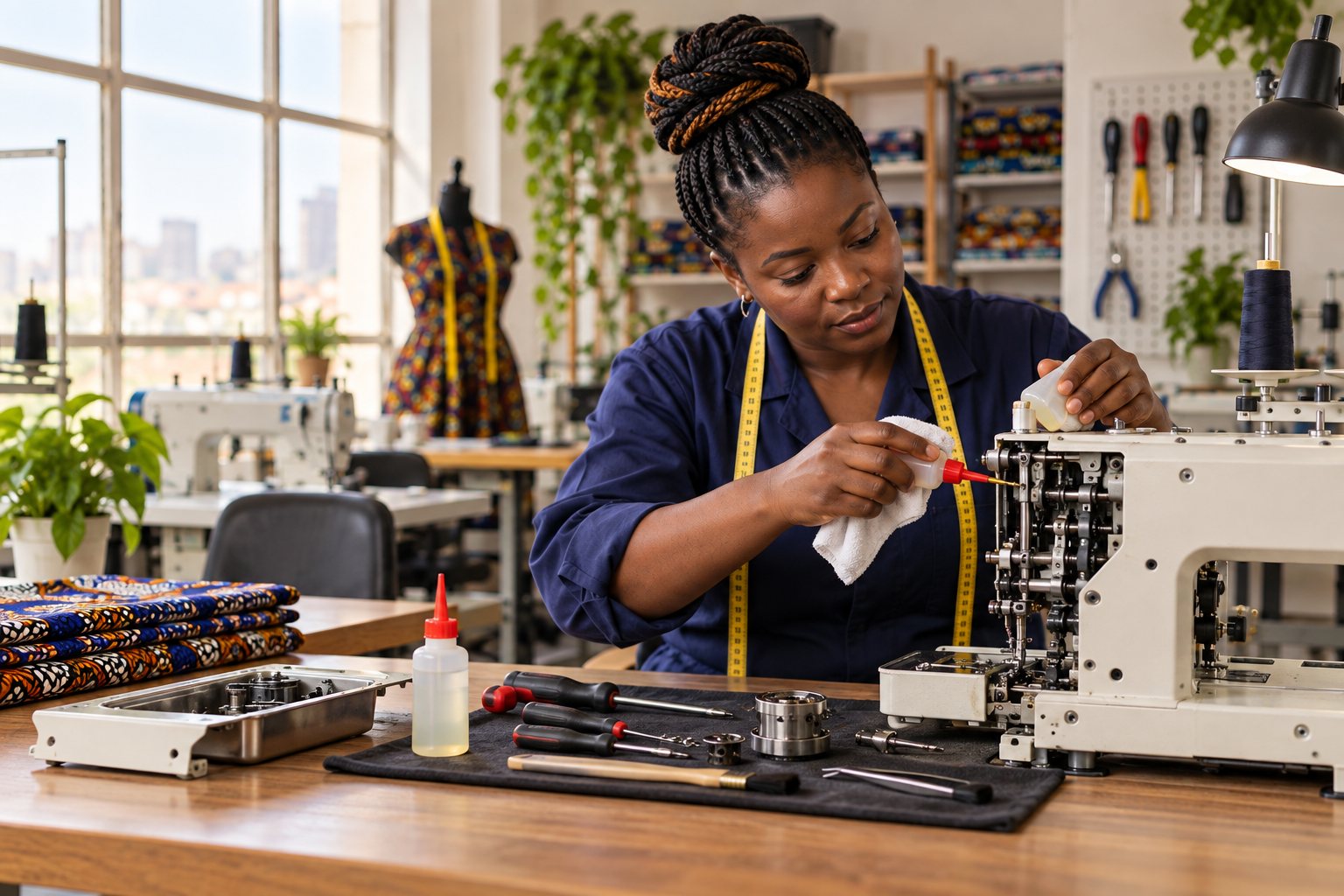
A bench, good lighting, suitable screwdrivers and spanners, gauges, appropriate oils and greases, a stock of the most common parts, a logbook in which every machine received is described with its fault, its condition on receipt and what was done. Machines deposited and never collected are kept for an announced period; used parts are sorted — motors and boards do not go into the ordinary bin. The workshop also serves as a test bench: a repaired machine sews there on several fabrics, at several speeds, before being returned, because a setting that holds on light cotton may give way on heavy canvas. That half-hour of testing is what separates a repair from a return.
In the African context
Sewing is, in many cities of the continent, one of the first independent trades, and one of the most informal: the ILO notes, in its statistics on the informal economy, that Africa is the region where the share of informal employment is highest, and sewing workshops are a daily example. For the sewing machine repairer, that means an immense, scattered clientele with limited means, expecting fast, inexpensive and lasting repairs — and often paying in instalments. The repairer who can keep an old mechanical machine alive, without original parts, renders an economic service on which thousands of incomes depend.
A sewing machine is often the dressmaker’s only capital — bought second-hand, on credit, or received from a mother or an aunt — and its repair is decided like an investment: the repairer is consulted before the purchase, to say whether a given machine is worth its price, and afterwards, to make it last. They sometimes remake an unobtainable part with the neighbourhood turner, or salvage a hook from a dead machine; they say so, because the dressmaker who knows what she paid for comes back.
As for transmission, it happens in the workshop: many repairers learnt from an elder, without a school, and train apprentices in turn. The repairer who writes down their settings, explains why and not only how, and teaches apprentices to diagnose before dismantling, builds a skill that training centres, often focused on sewing itself, hardly teach.
Maintaining rather than repairing
The best repairer is the one their customers call less and less for breakdowns, and more and more for maintenance. Cleaning, oiling, adjusting, changing the needle in time, using the right thread, not forcing a thickness the machine does not sew: these gestures, shown at every intervention, extend a machine by several years.
A repairer who sells breakdowns lives poorly and briefly. A repairer who sells maintenance and training lives on the trust of a whole neighbourhood of tailors — and that is a trade.