
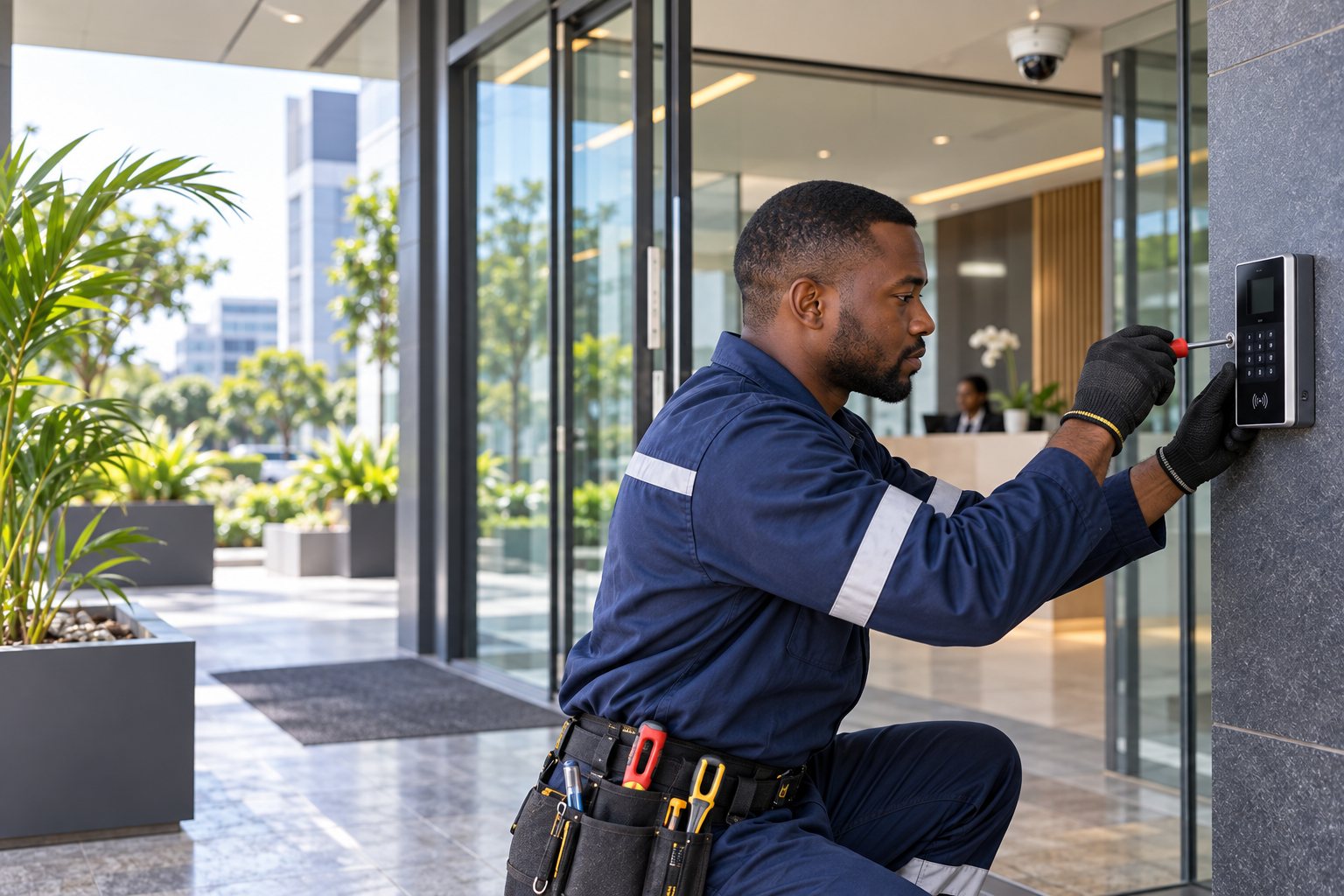
A customer calls because they have been burgled, or because their neighbour has, or because an insurer or a landlord requires it. They ask for “cameras”. The electronic security installer who answers “how many?” has not understood their trade; the one who answers “to see what, and who will be watching?” has. An electronic security system prevents nothing by itself: it detects, records, alerts, locks, and everything depends on what a human being does with those signals. The trade consists of designing that system, installing it properly, making it last and framing its use. The sections that follow are the questions an installer worthy of the name asks before pricing.
Against what, and to protect whom?
A shop fears shoplifting, a warehouse night-time intrusion, a school unauthorised access, an apartment block antisocial behaviour in common areas, a company internal fraud, a family break-ins while they are away. Each of these risks calls for a different system — visible or discreet cameras, door and motion detectors, access control by badge, code or fingerprint, smoke detection, siren, remote alert — and a site survey that identifies entrances, sensitive areas, blind spots, hours and flows. The installer listens first, visits next, proposes last; they do not size a system from a catalogue. Their written proposal says what the system will cover and what it will not — the back yard without a camera, the window without a detector — so that the customer decides knowingly, rather than discovering the gaps after an incident.
Who is watching?
This is the question customers forget. A camera records; it does not react. If no one watches live, the system serves to understand after the fact, which is useful but different. If someone must react — a guard, a monitoring company, the customer on their phone —, it must be said who, at what hours, with what instructions, and what they do on an alert: call, go on site, notify the police. The installer supplies neither the guard nor the response; they install what alerts them, and say so clearly, because electronic security and human guarding are two trades that complement each other without replacing each other.
Where does the footage go, and for how long?
A camera filming an entrance films people. The African Union Convention on Cyber Security and Personal Data Protection and the African Union Data Policy Framework set principles that apply here: specified purpose, informing the persons, data security, limited retention. In real terms, the installer explains to the customer what their country’s law requires — signage, any declaration, retention period, access to footage —, configures the recorder to erase automatically beyond the chosen period, and helps the customer write down who has access to the footage and for what.
They keep no copy of the footage themselves, set up no remote access for their own benefit, and hand all credentials to the customer at the end of the installation. An installer who keeps an access “just in case” without a written mandate creates a weakness, not a service.
What happens without electricity?
A security system that goes off with the power goes off at the worst moment. The survey plans backup power — batteries, UPS, sometimes solar — for the recorder, the cameras, the alarm panel and the locks, with an announced and tested autonomy, and it plans what must happen when the autonomy is exhausted: should an access-controlled door open or stay locked? The answer depends on the place — an emergency exit is never locked — and is decided before fitting.
Who may enter, and who decides?
Access control is a list of authorised people, embodied in badges, codes or fingerprints. The installer fits the readers and the locks; the customer keeps the list. The trade consists of giving them the means to keep it — add, remove, trace — and warning them of the classic mistakes: a code shared by everyone, a badge never deactivated after a departure, a single administrator whose password no one knows. Biometric data, where the system uses it, is particularly sensitive data and is treated as such.
How is it fitted?
A camera placed too high shows the tops of heads, too low gets torn off, against the light shows nothing; a motion detector aimed at a window triggers at every passing car; a cable run without protection is the first point of sabotage. Fitting is a trade in itself: the height and angle of each camera checked on screen before fixing, cables sheathed and run out of reach, power supply and recorder in a locked room, siren placed where it can be heard, every element tested one by one then all together, by day and by night. The installer hands over a layout plan with the reference of each device and a photo of what it sees: that document is what makes it possible, years later, to know what was fitted and why there.
Is the system itself protected?
Cameras, recorders and panels are now connected equipment, often reachable from outside for remote viewing. They become a doorway into the customer’s network if they are delivered with factory passwords, updates never applied and ports open to the internet. The NIST cybersecurity framework, which organises protection around simple functions — identify, protect, detect, respond, recover —, applies to a security system as to any other: the installer changes default passwords, isolates the system from the rest of the network where possible, enables updates, restricts access and documents all of it in the file handed to the customer.
How is it paid for, and what is not included?
The estimate separates the survey, the equipment, the fitting, the cabling, the configuration, the training and, if offered, the maintenance contract. It states the origin and guarantee of the equipment, and what is not included: the subscription to a monitoring service, the internet line, any declaration fees, consumables, call-outs outside the contract. The installer presents no “all-inclusive” price that would hide a subscription to come, and announces no supposedly standard tariff: the price depends on the site, the risk, the technology and the level of service.
Who maintains it, and how often?
A dirty camera, a dead battery, a detector that has come unstuck, a full recorder: an unmaintained system fails without anyone noticing, until the day someone looks for footage that does not exist. The maintenance contract provides visits, tests of every element, battery replacement, updates and a report; between visits, the customer knows which signals should alert them and whom to call. The installer who delivers without offering maintenance delivers a system they know will not last; the one who offers a contract writes down its content, the rhythm of visits and the price, separate from the installation.
In the African context
A system that does not work during load-shedding does not work. That sentence, trivial elsewhere, is on the continent the first design criterion: demand for electronic security is growing fast there — shops, banks, residences, schools, industrial sites, administrations — on unstable electricity and internet networks that put every system to the test. The installer designs backup power and continuity as the heart of the system, not as an option.
The legal framework for footage and data is the other reality. Personal data protection laws are being put in place at different paces from one country to another, notably under the impetus of the African Union Convention on Cyber Security; the installer who tells their customer what their national law requires — or what it does not yet require, and what prudence nonetheless demands — protects the customer from misuse of footage and protects themselves.
And electronic security everywhere sits alongside human guarding, very present on the continent. The good installer does not sell cameras against guards; they design the system with them — where they are, what they see, how to alert them, how to trace their rounds — and make the equipment a tool for the people who actually keep watch.
The installation that serves no purpose
It exists, and the installer recognises it from afar: cameras fitted without a survey, whose footage no one watches, on a recorder that stopped working at the first power cut, with the factory password, without signage, without maintenance, sold “all-inclusive” to a customer who discovers the subscription later. Each of the questions in this article is a way of not delivering it.
A well-designed electronic security system is boring: it records, it alerts, it locks, it holds on battery, its footage is erased on the planned date and its access rights are up to date. That is what the customer pays for.