
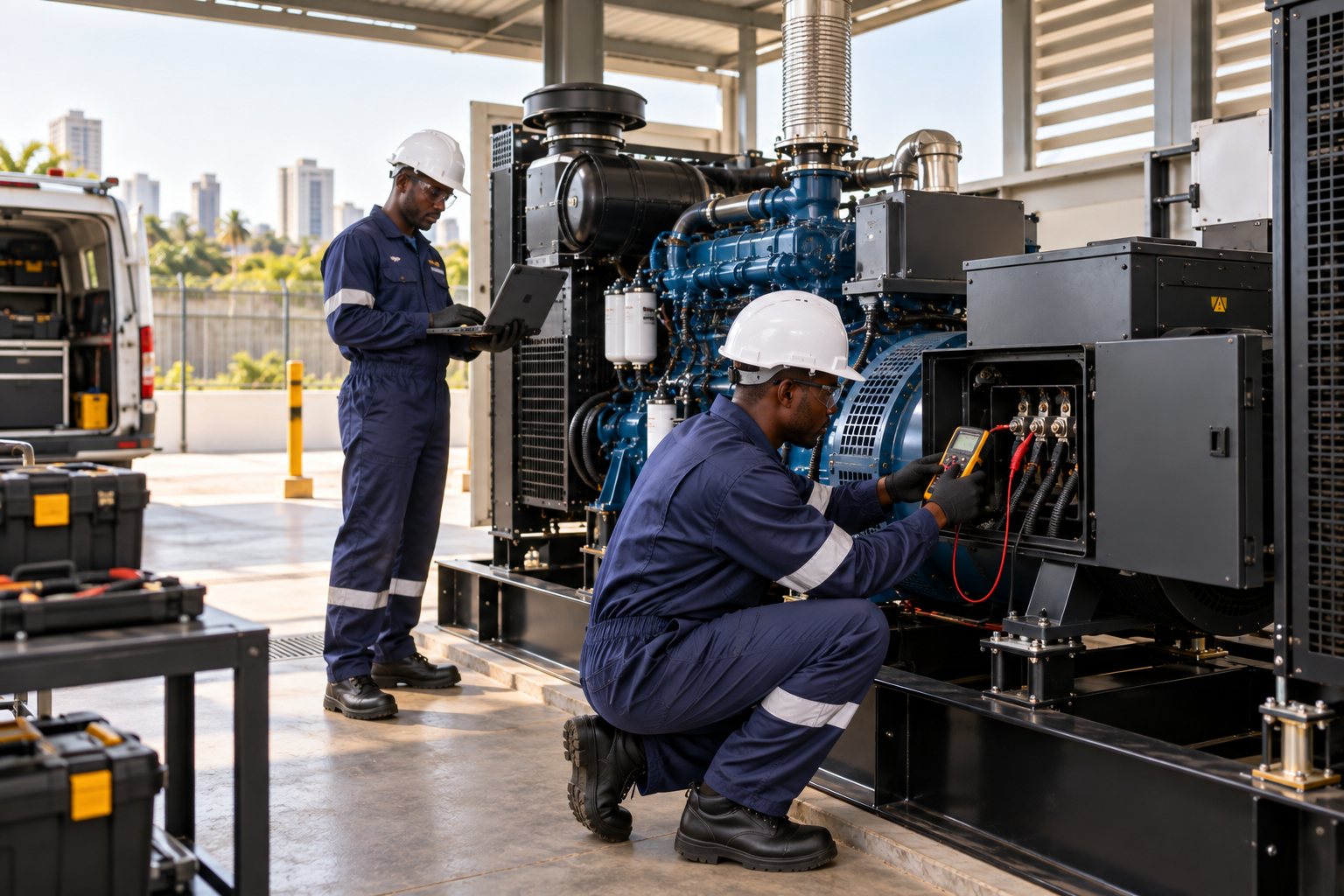
The generator set is the most paradoxical machine on a site: it costs a lot, runs little, and one only learns it has failed at the moment it is needed. A clinic during a procedure, a bank at closing time, a hotel at dinner, a factory in full production, a building whose pumps stop: it is when the grid goes down that one finds out whether maintenance was done. The generator technician therefore works against the clock in reverse — before the breakdown, on a machine that shows nothing — and the trade is told through the four moments at which they intervene: at installation, at every visit, at the breakdown, at end of life.
At installation: what decides everything else
A badly installed generator will be badly maintained. The technician who takes part in the installation, or who takes over a generator already in place, first checks the essentials: sizing against the loads actually supplied — a generator too small stalls, one too large runs under-loaded and fouls up —, location, exhaust routing, ventilation, fuel supply, connection to the switchboard and the device that prevents the generator and the grid from feeding the installation at the same time.
Location is a matter of life and death. A combustion engine produces carbon monoxide, an odourless and deadly gas; a generator running in a closed room, a garage, a basement or under an open window kills, and it happens every year during prolonged outages. The technician requires an outdoor location or a ventilated room with the exhaust ducted outside, and refuses anything else. WHO recalls that air pollution, of which engine exhaust is one source, causes millions of premature deaths a year; at the scale of a site, a generator’s exhaust is directed away from air intakes and from places where people breathe.
At every visit: the maintenance plan
The heart of the trade is the preventive visit, at intervals set by running hours and elapsed time — a generator that does not run ages too. The technician checks and replaces according to the manufacturer’s plan: oil and oil filter, fuel and air filters, coolant, belts, starter battery and its charger, electrical connections, alternator, voltage regulation, safety devices — shutdown on overheating, on oil pressure, on overspeed —, tightness of the fuel circuit, condition of the tank. They run the generator under load, measure voltage, frequency and current, listen, look for leaks, and write everything down.
That “write everything down” is the product delivered. The maintenance logbook — paper or digital — records every visit, every measured value, every part replaced, every anomaly found and what was done about it. It is what makes it possible to see a drift before the breakdown, to prove what was done in the event of a claim, and to hand the generator over to another technician without starting from scratch.
Fuel, oils, waste
A generator burns fuel and oil, and discharges both as waste. The technician checks fuel quality — water, impurities, fuel aged in a rarely used tank — because a large share of starting failures comes from there, and advises on storage: clean, closed, sheltered tanks, with stock rotation. Used oils, filters, coolant and dead batteries are hazardous waste; they are collected in closed containers and handed to a channel where one exists, never poured into a gutter. ILO Convention No. 170 on chemicals frames the handling of these substances at work: labelling, safety data sheets, protection of workers. The technician knows what they handle and protects themselves accordingly.
At the breakdown: diagnosing under pressure
The generator did not start, or stopped, and the site is in the dark. The technician who arrives works under pressure, and that is where method protects: safety first — cut off, lock out, make sure no one re-energises during the intervention —, then diagnosis in order of probability and simplicity: starter battery, fuel, tripped safety, sensor, then only mechanics or alternator. They do not “force” a start by neutralising a safety: an oil-pressure shutdown that is bypassed is paid for with a destroyed engine.
Recommissioning is done under load, with measurements, and ends with an explanation to the customer: what happened, why, what was done, what must change so it does not happen again. A call-out without an identified cause is not finished.
The maintenance contract, line by line
A maintenance contract states the frequency of visits, what they include, which consumables are included or not, the response time in case of breakdown, the possible availability of a replacement generator, and what remains outside the contract: major parts, correction of a faulty installation, damage caused by contaminated fuel or by the customer’s handling. The price depends on the generator’s power, its running hours, distance, accessibility and level of service; the technician does not present a tariff as valid for every generator.
What the contract does not promise: that a generator will never break down. It promises that avoidable causes will have been dealt with, that an anomaly will have been seen before becoming a breakdown, and that in the event of a breakdown someone will come within a written time.
At end of life: replacing, reconditioning, parting
A generator ages: consumption rises, starting becomes temperamental, major parts — injection, alternator, cylinder head — reach the end of the road, and repairs come closer together. The technician is best placed to say, with the logbook’s figures in hand, from when maintaining costs more than replacing, and to distinguish a generator worth a heavy overhaul from one that should be withdrawn. They advise replacement on the basis of the actual loads measured over the visits, not the power of the old generator, which is often oversized. The withdrawn generator is neither abandoned in a yard nor sold as new: its fluids are drained, its battery and filters follow the hazardous waste channel, and if it is sold second-hand, it goes with its logbook, so the buyer knows what they are buying.
Noise, safety and the people around
A generator is loud, hot, and runs near people who are not technicians. The technician advises on sound insulation and on location relative to the neighbourhood, checks that hot and rotating parts are guarded, that the room is closed to unauthorised people, that start and stop instructions are displayed, and that the site operator — guard, caretaker — knows what to do and not to do. The ILO recalls that a safe and healthy working environment is a fundamental right; around a generator, that concerns the technician as much as those who live next to it.
In the African context
A generator designed for a few hundred hours a year that does several thousand: that is the first fact of maintenance on the continent, where the generator is often not a backup but a main source, or the other half of a supply shared with a grid that cuts out every day. Running hours accumulate fast, and the manufacturer’s maintenance plan, designed for standby use, must be tightened. The technician who applies the “standard” interval to a generator running eight hours a day lets a breakdown settle in.
Fuel, next. Variable quality, water contamination, prolonged storage, irregular supply: a significant share of failures comes from the tank, and the African technician spends as much time advising on buying and storing fuel as on changing filters. Spare parts follow the same logic: filters, belts, sensors and regulation boards often come by import, and the technician who keeps a stock of common consumables for the generators they look after makes the difference on the day of the breakdown.
The generator also sits, more and more often, alongside solar and batteries: many sites combine all three, and generator maintenance becomes part of managing a hybrid supply, where one must know when the generator should start and when it should not. The technician who understands the whole — and not only the engine — is the one sites keep.
The generator’s logbook
The whole trade fits in a logbook, and the customer should be able to read it: the generator’s power and location, the date and content of every visit, the hours on the meter, the values measured under load, the parts replaced with their reference, the anomalies seen and what was done about them, the breakdowns, their cause and their remedy, the operating instructions, and the name of the person who signed.
A generator with a kept logbook almost always starts. A generator without one is a lottery, and it is on the day of the power cut that the result is known.