
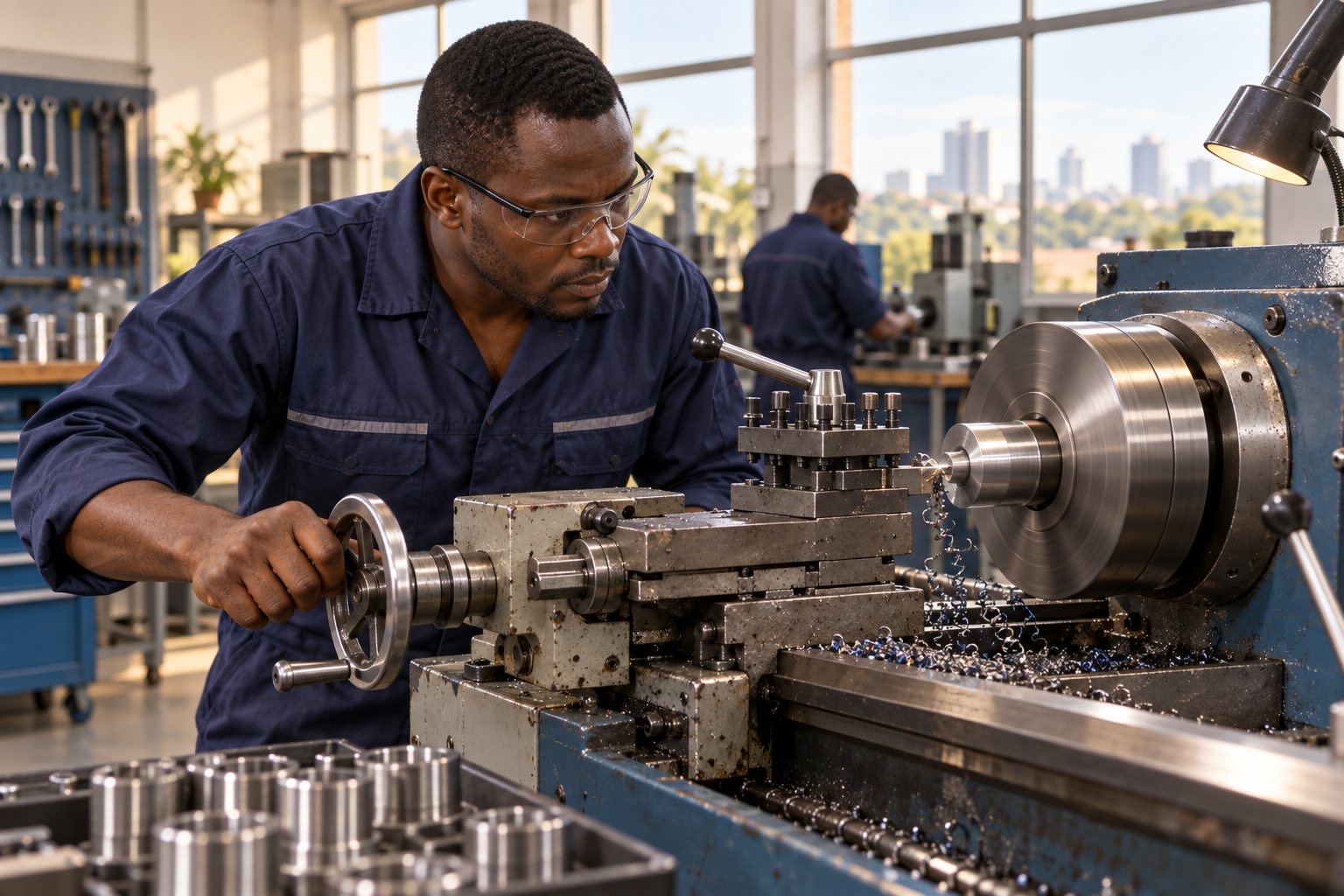
The customer of a machine shop arrives with one of two objects: a drawing, dimensioned and toleranced, or a part — broken, worn, or to be reproduced — without the slightest sketch. In the first case the shop must make exactly what is drawn; in the second it must first understand what the part did, measure it, derive a drawing, then make it. Turning, milling, drilling, grinding and fitting are the means; the end is a part that assembles and works in the machine waiting for it. Everything is organised around the drawing, and it is the drawing we will follow.
When the drawing exists: read before cutting
A machining drawing states dimensions, tolerances — the permitted deviation around each dimension —, surface finishes, a material and sometimes a heat treatment. The machinist reads it fully before programming or setting anything: a tight tolerance on a bore changes the machine to use, the number of operations and the price; a particular material changes the tool and the cutting speed; a heat treatment changes the order of operations. An incomplete drawing — missing dimension, absent tolerance, unspecified material — goes back to the customer with questions, never with assumptions.
The shop also says what it cannot do: a tolerance none of its machines holds, a material it does not machine, a dimension beyond the travel of its milling machine. Accepting a drawing one cannot honour means delivering a wrong part.
When the drawing does not exist: measuring the sample part
The broken part is the most frequent request. The machinist measures it — callipers, micrometer, dial gauge, gauges —, reconstructs the functional dimensions from the surfaces that work — bearing seats, threads, bores, keyways —, identifies or estimates the material, and draws a plan. They ask the customer questions: in which machine, under what load, what mating part, what caused the failure. A part that failed from fatigue is not remade identically without asking why.
That survey is billable work, and the shop says so: the customer pays for a part, but also for the drawing that will allow it to be remade next time.
Turning, milling, drilling, grinding
The lathe produces shapes of revolution — shafts, bushes, spindles, threads; the milling machine flat surfaces, slots, pockets, positioned holes; the grinder precise surfaces and fine finishes; fitting does the rest by hand. Conventional and numerically controlled machines coexist in many shops, and the choice depends on quantity, complexity and the precision required: a one-off is often quicker on a conventional lathe, a batch of fifty on a programmed machine.
Each operation is carried out with suitable tools, speeds and feeds chosen for the material, lubrication, and constant attention to swarf, vibration and heating. The machinist who forces a cut to save time produces a wrong dimension or a broken tool.
Chips, chucks and sleeves: the risks of the lathe
A lathe or a milling machine can catch a garment, a sleeve, hair; a hot chip burns or injures the eye; a badly clamped part becomes a projectile. The ILO recalls that a safe and healthy working environment is a fundamental principle and right, and its ergonomic checkpoints give simple measures for workstations: lighting, working height, handling of heavy parts, organisation of tools. In the shop, that means goggles worn at all times, close-fitting clothing, machine guards in place, parts clamped and checked before starting, a machine stopped to measure, and apprentices trained before being left alone at a lathe. The ILO’s WISE programme shows that these improvements are within reach of a small shop.
Restoring to size: repairing rather than remaking
Between the new part and the condemned part lies restoring to size: a shaft whose bearing seat is worn is built up by welding or metal spraying then re-machined; an ovalised bore is re-bored and fitted with a bush; a damaged thread is recut or replaced with an insert. This repair often costs less than a new part and gets the machine back sooner, but it has limits the machinist knows: a part too fatigued, a crack, an area already built up once are not reworked. The shop tells the customer what it proposes — repair, remake or give up — and why, and does not present a restored part as a new one.
Checking before delivery
A machined part is only finished once it has been measured against the drawing: every toleranced dimension, every bore, every thread, the surface finish where specified. The shop uses instruments it knows to be accurate — a wrong micrometer measures everything wrong — and records the values on an inspection report, handed over with the part when the customer asks. When the part must assemble with another, the shop asks for the mating part and checks the fit.
That check protects the customer, but also the shop: a part delivered with its inspection report is not argued over three weeks later.
Material, origin, treatments
Structural steels, alloy steels, cast irons, bronzes, aluminiums, engineering plastics: the shop buys bars and blocks whose grade it knows, because a part machined from an approximate material breaks or wears. It tells the customer which material it uses, distinguishes new from salvaged, and does not machine a safety part — drive shaft, lifting pin — from a steel whose grade it does not know. Heat or surface treatments, where necessary, are done by a specialist or in the shop if it has the means, and appear on the estimate.
Estimate, lead time, batch
The estimate separates the survey or study, the material, machine time, fitting, inspection and treatments. It states the lead time — which depends on material availability and machine load —, payment terms, and what the shop guarantees: conformity with the approved drawing. It does not guarantee the life of a part in a machine whose real conditions it does not know, nor the proper working of an assembly of which it made only one element.
For a batch, the shop makes and has a first part approved before launching the rest; that is when the customer checks that what they drew is what they wanted. The price of a part in a batch is not the price of a one-off divided by the quantity: tooling, setting and inspection are spread out, and the shop explains how. It also states what happens if a part in the batch is out of tolerance — rework, replacement, or acceptance by the customer under a written concession — because a batch without a sorting rule produces disputes at assembly.
In the African context
On the continent, the machine shop is first of all a repair shop. Original parts for machines — agricultural, mining, industrial, construction, transport — arrive by import, with lead times of several weeks and prices that immobilise an operation; remaking a shaft, a bush, a pinion, a flange, a worn bore locally is often the only way to restart a machine within the week. The machinist is therefore a link in production continuity, and their value lies in the ability to measure up a part without a drawing, find an equivalent material and deliver quickly — without sacrificing inspection.
Material is the next constraint. Precise grades are not always available; the shop makes do with what the market offers, sometimes salvage — shafts, bars, blocks from demolition —, and must tell the customer what it used and what that changes for the life of the part. A safety part remade from an unknown steel is a risk the shop names rather than buries.
The machine park, too, is particular: many lathes and milling machines in service are old, conventional, maintained by their users, and numerical control remains rare outside the major centres. That does not make the shops outdated places — an experienced turner on a well-adjusted conventional machine holds tolerances many would not suspect — but it makes training, transmission and machine maintenance decisive. The shop that documents its surveys, its drawings and its settings passes on a capital the market does not supply.
The inspection report
At delivery, the machinist hands over the part, the drawing it was made from — drawn by them or by the customer — and, for any toleranced part, the report of the measured dimensions. The customer knows what they receive; the shop knows what it delivered; and the day the part has to be remade, someone will know from what.
It is a sheet of paper. It is also the difference between a shop that makes parts and a shop that makes accurate parts.