
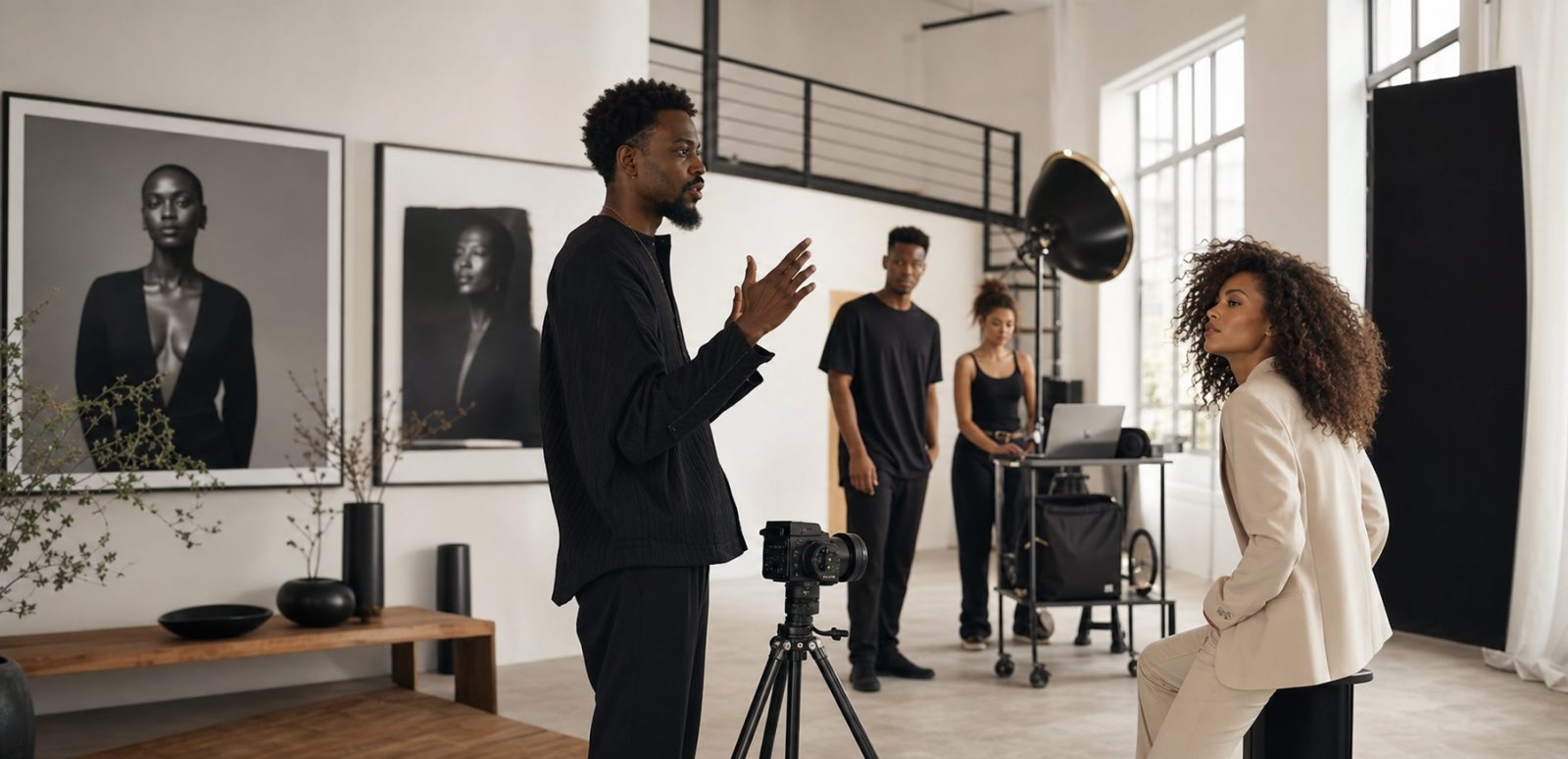
People often think a photographer's job is to press a shutter. That is the visible part, and by far the shortest. The real work happens before — in preparation and in conversation with the client — and afterwards, at a screen, sorting, adjusting and delivering.
What a photographer actually does
A photographer produces images intended for a specific use. That destination governs everything else: a wedding photograph, a product shot for an online store and a portrait for a professional profile are not prepared, taken or retouched in the same way.
The work therefore begins with understanding a need, then building the technical and human conditions that will meet it: light, framing, timing, and the attitude of the people being photographed.
It is also a legally framed activity. The World Intellectual Property Organization explicitly lists photographs among the artistic works protected by copyright, with two families of rights: economic rights, which allow the author to derive financial reward from the use of their work, and moral rights, which protect their non-economic interests — notably the right to claim authorship. WIPO notes that under the Berne Convention this protection is obtained automatically, with no registration formality.
Very different fields
Few professions cover such varied realities. A photographer usually specialises in one or two areas:
- portraiture, personal or professional, where the challenge is to put at ease someone who often dislikes being photographed;
- events — weddings, ceremonies, graduations, corporate gatherings — where a shot can never be taken again;
- corporate photography: teams, premises, working environments, internal reportage;
- product photography, highly technical and directly in service of selling;
- reportage and documentary, which demand time and a narrative intention;
- architecture and real estate, where control of perspective and light is decisive;
- fashion and creative work, often as part of a team with stylist, make-up artist and art direction.
These fields require neither the same equipment, nor the same client relationship, nor the same organisation. That is why a photographer who says "I do everything" often ends up less legible than one who states their specialisms clearly.
Before the shoot
Preparation is the most underestimated part of the profession.
It starts with a conversation: what does the client want, for what use, for which audience, by when, within what budget? That exchange prevents most later misunderstandings.
Then comes the recce — available light depending on the hour, constraints of the location, any permissions needed — followed by equipment and logistics: travel, duration, who will be present, and a fallback if the weather or the venue changes.
An experienced professional also plans for what can go wrong. In event work, where nothing can be replayed, that anticipation makes all the difference.
During the session
On location, the work is simultaneously technical and relational.
Technically, it means handling light, framing, depth and movement, and adapting continuously to what changes. Humanly, it means directing without rushing, reassuring, creating a situation in which people stop holding themselves in front of a lens.
That is where the difference lies between a technically correct image and an image that is right. Many clients cannot explain why they prefer one photographer's work to another's; the answer often lies in this quality of running a session.
Afterwards: selection and post-production
A session produces a great many images. The next task is to keep very few.
Selection is a professional act in its own right: choosing what serves the intended use, discarding what is redundant, building overall coherence. Then comes post-production — adjustments to light, colour and framing, retouching as agreed — followed by export in the expected formats and delivery.
To this are added invisible but decisive tasks: backing up files, archiving, managing the usage rights granted to the client. A photographer who loses the files from a wedding has not made a technical error: they have destroyed their business.
Post-production almost always takes longer than the shoot itself. Clients often discover this when they ask for the photographs "for tomorrow".
Equipment: a means, not the subject
Equipment matters, of course. Camera bodies, lenses, lighting, accessories, storage and backup represent a real investment, to be renewed and maintained.
But it does not define the professional. The same camera, in two different pairs of hands, does not produce the same result. What a client pays for is a way of seeing, a working method, reliability, and the ability to deliver what was promised.
A professional does, on the other hand, have every reason to carry enough equipment never to be stranded: a second body, spare cards, batteries, a back-up lighting solution.
The client relationship
This is often what separates a business that lasts from one that fades.
A good client relationship rests on simple things: a clear quotation, a defined scope, an announced deadline that is met, explicit conditions of use for the images, and fluid communication throughout the project.
The question of rights deserves particular attention. What the client is buying — a use, a duration, a medium — should be written down. The applicable rules vary by country, but the principle is the same everywhere: whatever was not clearly agreed will sooner or later cause a problem.
The portfolio as a working tool
In this profession, you do not convince by describing: you show.
An effective portfolio is not an accumulation. It is a tight selection, consistent with what the photographer wants to do more of. Showing thirty wedding photographs when you want to develop corporate work means choosing your clientele backwards.
A good portfolio is also organised by use — portrait, corporate, event, product — so a visitor immediately finds what concerns them. And it ages: keeping it current is part of the job.
Digital changed the profession, not its value
Photography has become universal. Everyone carries a camera and produces images constantly. One might have expected this to make the profession disappear.
In several fields the opposite happened: the sheer number of images has made differences in quality more visible. An online store with poor product photographs pays for it immediately. A company whose team portraits are approximate shows it to every visitor.
Digital did, however, transform the economics of the work: intangible delivery, distribution on social platforms, wider competition, expectations of speed. It also shifted part of the value towards what cannot be copied — the relationship, reliability, the ability to run a session, the consistency of a style.
These changes take place within a substantial sector: UNESCO estimates that 6.2% of workers worldwide are employed in the cultural and creative sectors, which account for 3.1% of global GDP.
An activity that has to be structured
The other side is well documented: UNESCO notes that 40% of workers in the cultural and creative industries earn less than their national minimum wage, and that informality, precarity and gender disparities remain deeply entrenched in the sector. It also points to the gap between training curricula and the actual demands of the industry.
That global observation says something useful: technical skill alone is not enough. Pricing a job, contracting, invoicing, managing deadlines and rights are as much part of the profession as mastering light.
The African context
Across the African continent, professional photography occupies a real place: portraits, ceremonies, weddings, online commerce, corporate communication, press and documentary work.
UNESCO documents more broadly the potential of African cultural and creative industries, while pointing to recurring obstacles: informality, insufficient training, weak professional frameworks. Its 1980 Recommendation concerning the Status of the Artist — which explicitly places photography among the visual arts — calls on States to improve the professional, social and economic status of creators.
Situations vary widely between countries, and nothing allows anyone to describe a single African market. One trend does stand out: where many professionals work without any clear presentation of their activity, the one who is identifiable, reachable and whose work can be seen gains an immediate advantage.
Presenting yourself as a professional
A client looking for a photographer always asks the same questions: what exactly do they do? what does their work look like? where do they operate? what does it cost, at least roughly? how does a session unfold? how do you get in touch?
Answering clearly — specialisms, past work, coverage area, how a session runs, delivery times, contact details — is not advertising. It is what lets someone move from "I like these photographs" to "I am going to contact them".
In a profession where what is bought first is trust, a clear, current online presence consistent with the work shown does a good part of the job.
In summary
The photographer builds images for a specific use, through a sequence of preparation, session and post-production of which only the middle part is visible. It is a profession of vision, method and relationship, practised within a copyright framework whose details vary by country.
Its success depends as much on the quality of the images as on the clarity with which the activity is presented.
Are you a photographer? Find out how to present your work online: your specialisms, your past projects, your coverage area and how to reach you.