
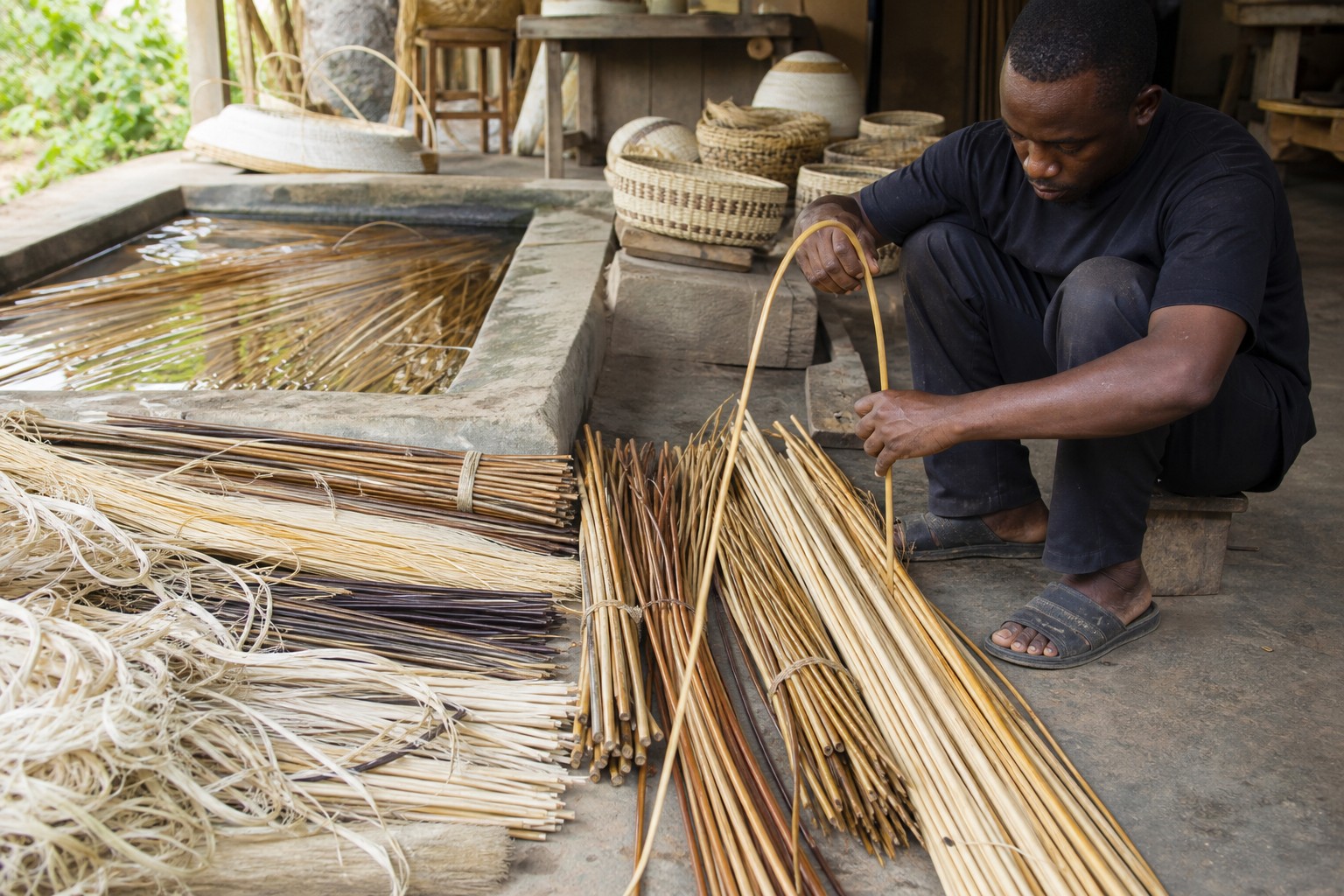
Two similar baskets, set side by side, can have lifespans that bear no relation: one will last ten years, the other will break in its second season. The difference is not in the visible weave. It is in the preparation of the fibre — soaking, drying, sorting — done beforehand in the workshop, and which nothing on the finished piece allows anyone to check. The weaver therefore works on an invisible value, and has to be able to explain it.
What a basket weaver sells
The client is a household buying a basket or hamper, a decorator ordering a series of pendant lamps for a project, a restaurant or hotel wanting woven lighting or furniture, a shop looking for consistent pieces. All of them buy a fibre piece; none of them buys the same thing. The decorator buys coherence between pieces; the hotel buys endurance over time; the household buys an object that will not deform at first use.
What the weaver sells, precisely, is a piece whose fibre was prepared for the intended use, woven at an even pitch, and finished where pieces give way first. None of those three things can be told at first glance from a piece made fast.
The fibre: provenance, sorting and preparation
Rattan, raffia, palm fibre, bamboo depending on the region: each fibre has its harvesting areas, its seasons, its grades. A weaver knows where what they weave comes from, often from harvesters they know, and that direct link decides the regularity of their supply as much as its quality.
Preparation is the invisible heart of the trade. Fibre is sorted, soaked, dried before being worked; the durations depend on the fibre, its thickness and the climate, and do not copy from one workshop to another. The principle is constant: fibre worked too dry breaks, fibre worked too wet slackens as it dries and deforms the piece.
No fibre is universally better. Rattan withstands ambient humidity but not direct rain; raffia is supple and fragile to abrasion. The choice is made by use — a plant cover does not face an armchair's constraints — and the weaver proposes another fibre when the stated use does not suit the one requested.
The order, and what is shown before weaving
A workshop piece is sold as it is. A made-to-measure order or a series begins with a conversation about use and place — indoors, covered terrace, outdoors —, then with a reference piece: an existing model, a sketch with dimensions, or a prototype for a series.
The prototype is what protects both parties: the decorator sees the form, the pitch of the weave, the shade of the fibre and the rim finish before twenty or forty pieces are launched. It is charged or deducted as agreed. What is not negotiable is that a series is launched on an approved reference, and that the pieces that follow will resemble one another without being identical — which is said on the quotation.
When a client brings a photograph of a model seen elsewhere, the weaver says frankly whether the technique is within reach and whether the result will be close or merely inspired. Reproducing identically a piece someone else designed is not the trade.
The price: time is the variable
The price of a woven piece is made up of the fibre, its preparation, weaving time, finishing and, for lighting, the frame and assembly. Time dominates: at equal dimensions, a fine weave doubles the working time compared with a loose one. The quotation names that time rather than announcing a figure, and no tariff holds from one workshop to another.
A series costs more to prepare and less per piece; it also ties up fibre and space for weeks, which weighs on a small workshop's cash flow. Deposit, lead time and conditions for returns go on the quotation, not down the phone.
Weaving without forcing
Weaving itself follows a rule the trade repeats: the fibre imposes its form, you go along with it, you do not force it. Forced fibre does not break at once; it breaks later, often after the sale, and it is the weaver who gets the blame.
This article teaches no weaving technique. The trade is judged by the regularity of the pitch — a tight, even weave holds its shape without a frame, and that cannot be made up with varnish or glue — and the order of work: preparing all the fibre for a piece before starting, not interrupting a weave halfway, checking symmetry at every round.
Rim finishing is the last act and the most decisive: the rim is the first area to give way. Doubling it, even on the simplest pieces, is what distinguishes a workshop piece from a market piece — and what explains a price difference a client understands on seeing the rim.
The workshop, less dangerous but not risk-free
A basketry workshop is less dangerous than a metal one; it still has its risks: blades for splitting and trimming fibre, prolonged sitting, dust and mould on badly stored fibre, damp from soaking basins. Tidy, air, store fibre dry and sheltered, alternate postures. Lighting adds one precise question: the frame and electrical fitting belong to a qualified person, never to a workshop improvisation.
Delivering, caring, repairing
A woven piece is delivered with simple instructions: what it withstands, what it does not, where not to leave it. A rattan armchair on an uncovered terrace will not last, and the weaver says so beforehand rather than noting it afterwards.
Repair is part of the trade: redoing a rim, replacing strands, re-tensioning a seat. Repairing a mother's armchair rather than selling a new one builds a clientele better than a sale. Some pieces cannot be repaired — fibre too dry, a broken structure — and the honest answer is to say so before starting.
Fibres, boundaries and regulated materials
A plant fibre that travels is a material subject to rules. The International Plant Protection Convention, hosted by the FAO, sets phytosanitary standards meant to limit the spread of pests through trade in plant products, and raw fibres are among them. A weaver who ships remotely or imports a fibre checks the applicable framework before, not after. Some species are also protected depending on the country; a professional workshop uses none whose lawful provenance it cannot establish.
In the African context
Everything starts with a harvesting basin. Rattan from forest zones, raffia, palm, reeds and grasses from dry zones: every fibre has its regions, its seasons and its harvesters, and a basketry workshop is defined first by the fibre it has access to. Depending on the country and the season, that fibre arrives steadily or in fits and starts, at a price that follows the rainy season and the state of the tracks; it is then stored away from damp, which takes space.
Uses run from everyday object to urban decorative furniture, and workshops with them: domestic weaving sold on markets, neighbourhood workshops, structures supplying decorators, hotels and restaurants with prototypes, series and lead times. Lighting and furniture add a dependence on metal frames and electrical fittings, whose quality varies from one market to the next.
Many of these workshops work outside any formal framework — the International Labour Organization points to the weight of informal employment in many countries. UNESCO's 2003 Convention also recognises the skills linked to traditional craftsmanship as a domain of intangible cultural heritage; that makes no basket a certified object, and assigns no technique to a whole country.
What a decorator or a hotel pays for, in the city, is precisely the invisible stage: fibre properly soaked and dried, a doubled rim, a series woven on a prototype. A workshop that can explain why its basket costs twice the market one — and show it by turning the rim over — is selling something other than a basket.
The question to ask a basket weaver
A client who wants to know who they are dealing with has only one question to ask: how was the fibre prepared? A professional weaver answers without hesitating — where it comes from, how long it soaked, how it dried — because that is where the piece's lifespan is decided, and because they know it cannot be seen.
That same weaver will promise neither two identical pieces in a series, nor a rattan armchair that withstands rain, nor the identical reproduction of a model seen elsewhere, nor a lead time they have not written down. They will leave the fitting of a lamp to the electrician and the design of the whole to the decorator. But they will commit to a fibre chosen and prepared for the use, an even weave, a doubled rim, a prototype approved before any series — and a frank answer when the fibre requested does not suit.