
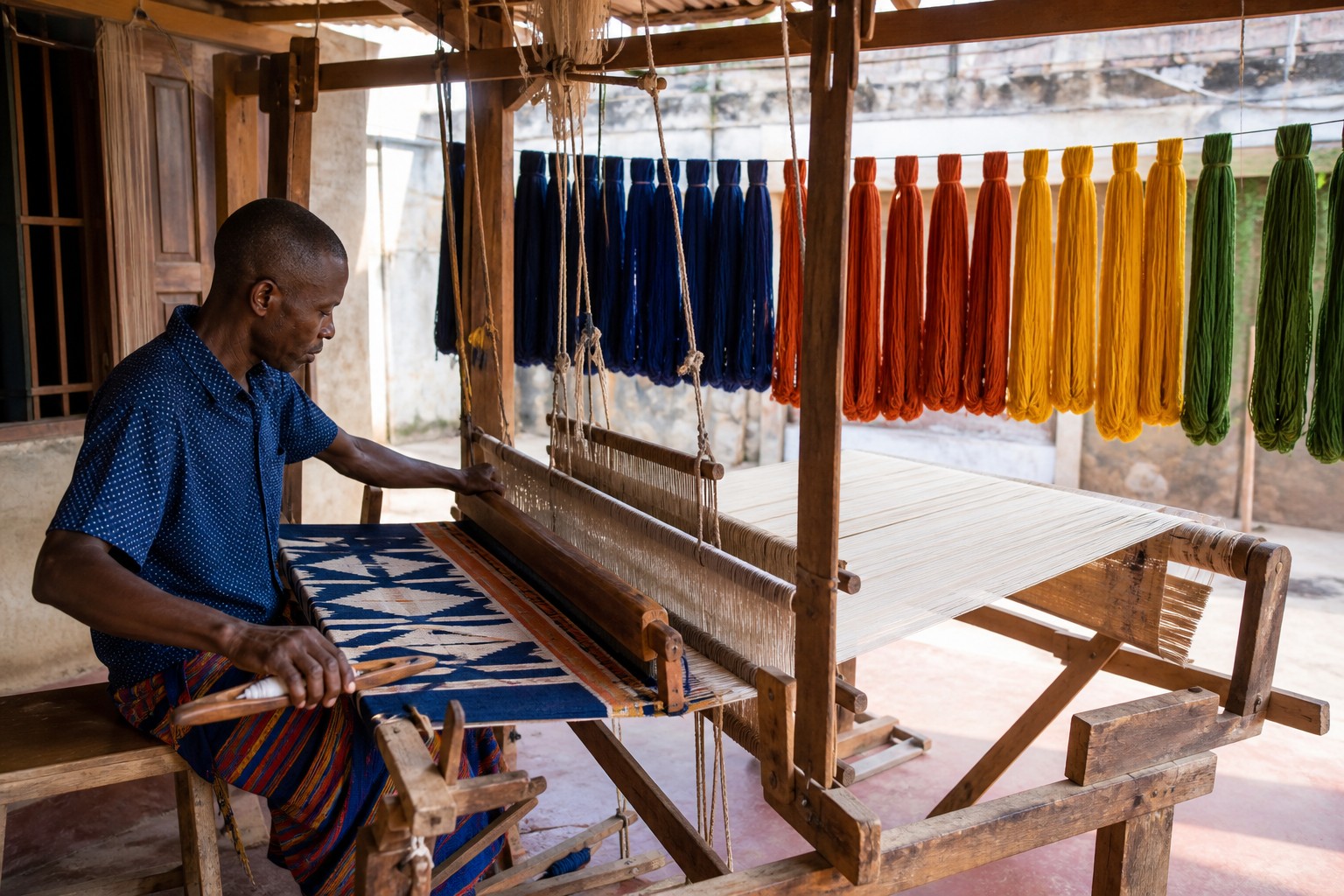
A decorator orders twelve metres of cloth for headboards. Before a single centimetre is woven, several hundred threads will have been tensioned one by one on the loom, and a sample will have been woven, dyed, washed and approved. That is the whole logic of the trade: what is decided when the warp is set holds for the full length of the piece, and a mistake at that stage shows over twelve metres.
Cloth, not a garment
The weaver produces cloth: furnishing fabric by the metre, stoles, table runners, decorative pieces, in cotton, raffia or the fibres available locally. Their client is a decorator composing an interior, a household wanting cushions or a stole, a guesthouse ordering a pattern in its colours, a shop looking for consistent pieces.
The boundary with clothing is sharp and deserves stating: the weaver makes the material, not the sewn object. Turning cloth into a dress or a jacket is the tailor's trade, which belongs to another sector and other skills — cutting, pattern-making, fitting. A weaver selling by the metre to a tailor does not make the garment; they supply its cloth.
The thread: fibre, provenance, dyeing
Everything starts with thread. Industrially or hand-spun cotton, prepared raffia, local fibres: the provenance and regularity of the thread decide how the cloth holds up. Irregular thread gives an irregular weave, which may be sought or suffered; the difference is knowing beforehand.
Dyeing is a stage of the trade when the weaver dyes their own thread. It follows a rule serious workshops apply: every bath is tested on a strand before being applied to a whole skein, then the strand is washed to check the colour holds. A red that runs at the first wash ruins an entire piece — and the cushion it was sewn onto.
This article gives no dye recipe: no product, no mordant, no dose, no temperature. Dyes, fixatives and solvents are chemicals, and the International Labour Organization's convention on chemicals sets out the principle of identifying and labelling them and informing those who handle them. A workshop reads the data sheets, ventilates, protects hands and eyes, and stores them apart.
The sample: the only moment to change one's mind
For every order, a sample is woven at the agreed dimensions, with the real pattern and colours, then submitted to the client. That is when you discover that a blue is too dark beside the intended wall, that a pattern too tight tires the eye over a large surface, that a colour does not survive washing.
The sample is charged or deducted as agreed; what is not negotiable is that it precedes setting the full warp. Once approved it becomes the order's reference, and the warping record — number of threads, colour order, density — is kept: that is what allows the same piece to be remade months later, with the honest reservation that a dye bath may differ slightly from the previous one.
Setting the warp: the real heart of the trade
The warp is the set of threads tensioned on the loom; the weft is what passes between them. Setting the warp often takes longer than weaving, and it determines everything: the width — limited by the loom —, the density, the pattern. Once the warp is set, changing the pattern means taking everything down.
The weaver therefore works the other way round from the client: the client sees the finished cloth, the weaver first sees an invisible, decisive operation. That is why warping is charged separately, once per order, whatever length is then woven — and why a long piece costs proportionally less than a short one.
This article does not teach warping or weaving. The trade lies in the check at every stage — counting threads, checking tension, weaving a few centimetres and looking before continuing — because a warping error shows over the full length.
The price: warping, density, length
The quotation itemises thread, dyeing when done in the workshop, warping, weaving time and finishing. Density is the main time variable: a tight weave takes twice as many passes as a loose one for the same length. No tariff holds from one workshop to another; the quotation names what it counts.
Width is limited by the loom. Beyond it, two widths are joined by a flat seam the weaver places in a hollow of the pattern — and says so on the quotation, because a client who discovers a seam in the middle of their hanging was not warned.
Pattern, inspiration, and what belongs to whom
A weaver composes patterns: contemporary compositions for decorators, patterns from regional traditions, dedicated patterns — composed from a client's logo or colours, without the piece looking like an advertisement. That composition work has value, and it raises questions of rights worth knowing about.
The World Intellectual Property Organization notes that the ornamental aspect of an object can be protected as an industrial design, and that traditional cultural expressions — including handicrafts and designs — are the subject of international work on their protection, linked to the identity of the communities that carry them. The exact rules depend on the country. The practical line is clear: drawing on a regional repertoire is a trade; reproducing identically another workshop's composition is copying; composing a pattern for a client from their brand assumes the client has the right to use that brand.
What a weaver composes belongs to them. Photographing pieces, keeping warping records and signing cloth protect that work better than any speech.
Finishing, delivering, caring
Cloth is finished at the selvedges and ends, washed or cleaned according to the fibre before delivery where that is planned, folded or rolled for transport. It is delivered with simple, honest care instructions: what cotton withstands, what raffia does not, what a hot wash will do to the colours.
A rework is possible for a weaving fault; it is not for a pattern matching the approved sample, nor for a shade of dye announced in advance, nor for care contrary to what was said.
In the African context
Weaving has, depending on the region, very different histories, fibres and pattern repertoires — cotton, raffia, local fibres; narrow strips joined together or wide looms; patterns specific to precise regions and contemporary compositions. Reducing that to an indistinct "African fabric" is a commercial error as much as a historical one: a workshop supplying decorators and guesthouses sells cloth to order, with samples, warping records and lead times.
Thread supply is the first constraint, and it varies by country: local or imported cotton thread, batch regularity, availability of dyes and their data sheets. The loom itself — its width, its condition, whether it was made locally or not — decides what a workshop can weave. Energy matters less here than in other trades; space, light and time matter more.
The question of patterns is more sensitive here than elsewhere. Regional repertoires have been copied, industrially printed and sold under names that no longer had anything to do with their origin; a workshop that genuinely weaves a pattern from its region has every reason to say so, document it and sign it. UNESCO's 2003 Convention recognises the skills linked to traditional craftsmanship as a domain of intangible cultural heritage — which certifies no cloth and assigns no pattern to a whole country.
Outlets exist and are unevenly spread: hotel and guesthouse decoration in large cities, decorators seeking furnishing fabrics that do not come from a catalogue, remote orders on a photographed sample, designer boutiques. None guarantees an order. Professionalism, though, rests on concrete things: a sample approved before every warp, a warping record kept, a dye tested and washed, a quotation that names the warping and the density.
Before ordering cloth
If you order cloth from a weaver, expect to be asked to wait: the time to weave a sample, dye it, wash it and put it in your hands. That delay is not slowness; it is the only moment when you can still change a colour without it costing twelve metres.
Expect them to refuse certain things too — changing the pattern once the warp is set, guaranteeing a shade exactly reproduced from one bath to the next, weaving a width their loom does not allow, copying another workshop's composition. They will not sew your garment, design your interior or print patterns by the kilometre. What they owe you is more precise: a sample approved before the full warp, a tested dye, a warping record kept, and cloth matching what they showed you.