
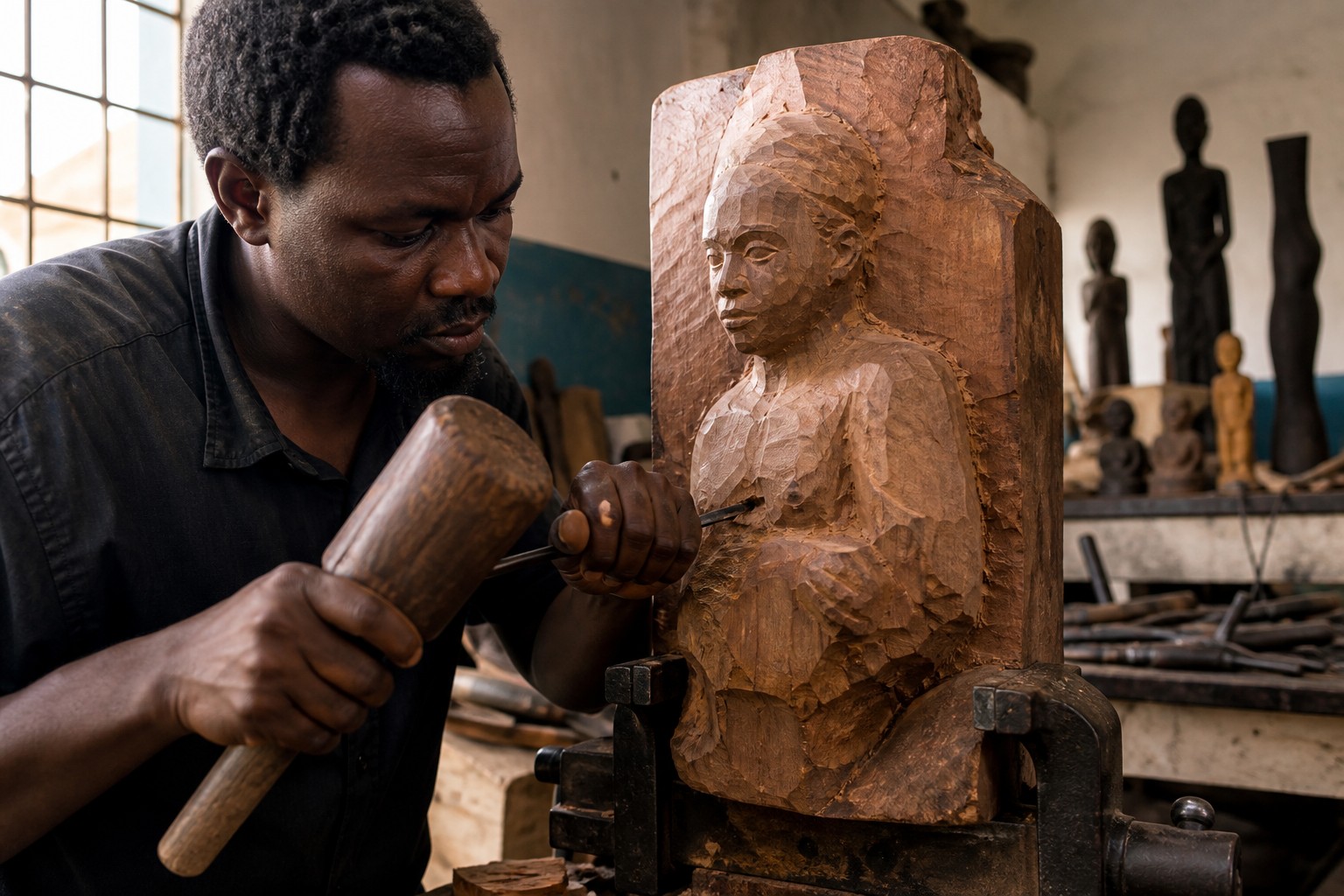
Modelling adds material, carving removes it. That difference, trivial to state, organises the whole life of a wood and stone carving workshop: since what has been removed is never put back, everything that can be decided must be decided beforehand, and everything that can be shown to the client must be shown on a support where minds can still be changed.
A trade in which correction does not exist
A sculptor's client is rarely the same from one commission to the next: a family wanting a bust, a hotel commissioning a piece for its lobby, a collector buying a studio work, a local authority or company commissioning a monumental piece for a garden or public space.
What they buy is a form that does not exist yet, inside a block that already does. The constraint is twofold: the block has its grain, its veins, its hidden flaws; the form must settle into it without contradicting them. That is why the sculptor does not choose the block after deciding on the subject — both are chosen together.
This article does not say how to carve. It says how a workshop organises itself so that carving, when it begins, has no open question left.
Choosing the block, and telling the client
Timber and dimension stone are not ordered from a catalogue. Every block is unique, and its choice commits the piece: grain running across a bust's face, a vein cutting an important line, an invisible inclusion revealed halfway through.
Provenance is part of the choice. The FAO, which tracks the production and trade of wood products, notes that forest management balances economic, social and environmental interests; for a workshop that means knowing where a block comes from and under what framework it was cut. Wood that is insufficiently dry will split after the sale — the principle is constant, the time depends on the species, the section and the climate — and a sculptor would rather refuse a deadline than deliver a piece that will open up.
The client can be brought into that choice: seeing the block, understanding why the form will follow this grain and not another. It takes an hour and saves months of misunderstanding.
The maquette: the only moment when everything can still change
For every commission, a scale maquette is modelled — in clay, wax or a material that accepts revision — then submitted to the client. This is the heart of the method: on the maquette you add, you remove, you turn the head three degrees, you thicken a shoulder. On the block, none of those requests is possible.
Approval is formalised. The client signs or confirms in writing that the maquette matches what they expect; photographs from several angles are kept. After that, carving begins and the conversation changes nature: it is about progress, not about form.
A sculptor who agreed to start without an approved maquette would alone carry the risk of a disagreement halfway through the block — that is, a lost piece and lost material.
The price, and why material weighs so heavily in it
A sculpture's price breaks down into three parts: the block, carving time and finishing, plus, for a monumental commission, the anchoring study, transport and installation. None of those items has a universal amount: hard stone is carved more slowly than soft wood, a large-section block costs out of all proportion to a studio piece.
What sets this quotation apart is the weight of the material and its irreversibility. A commission cancelled after carving has begun leaves a started block of no use for anything else: deposit and cancellation terms, agreed in writing when the maquette is approved, take that into account. They are not assumed; they are read on the quotation.
Carving: the organisation, not the technique
Once the maquette is approved, work advances by roughing out, placing the masses, then progressively approaching the fine forms. What is the trade's own, rather than a manual's, is the discipline around those stages: measuring often, comparing with the maquette, stopping before rather than after, and accepting that the block sometimes imposes an inflection.
The workshop itself is a place of ordinary risks: sharp tools, wood and stone dust, noise, heavy loads to move. The International Labour Organization offers small enterprises an approach to improving working conditions based on simple, low-cost solutions. Translated to the workshop: ventilate, protect, tidy, lift with suitable means, and bring in a qualified person for electrics or machinery. No setting, no dangerous procedure and no cutting method is passed on here in writing.
Finishing without concealing
A sculpture's finish is not a layer added on: it is what decides whether the material stays legible. Progressive sanding, a finish that lets the wood or stone show, rather than a thick varnish that hides them. The natural checks of dried wood are treated and are part of the piece; that is said in advance, because an unwarned client sees a defect.
The final check compares the piece with the approved maquette and its photographs. What departs from it was decided during carving and explained to the client; what was not explained is a failing.
Delivering, anchoring, and answering over time
A studio piece is handed over signed and, where the workshop numbers its works, numbered. A monumental commission changes scale: it requires a study of the site, an anchoring calculated by whoever has the competence when the load demands it, organised transport and on-site installation. The sculptor attends; they do not stand in for the engineer on anything that is a structural calculation.
Responsibility continues after delivery: wood that moves, a fixing that loosens, a finish that deteriorates are reported and examined. A rework is possible for what belongs to manufacture; it is not for exposure contrary to what was recommended.
Work, commission and rights
A sculpture is a work, and that has concrete consequences. The World Intellectual Property Organization notes that copyright protects works and gives their author economic and moral rights; the exact regimes depend on the country. For a workshop that means two simple things: what a sculptor creates belongs to them until they dispose of it otherwise in writing, and reproducing someone else's work — from a photograph, a catalogue, a piece seen in a lobby — is not inspiration.
The question also runs the other way: a client commissioning a bust from photographs brings images they must have the right to use. The sculptor asks.
In the African context
Wood and stone carving have, depending on the region, long and very different histories, and part of those histories was lastingly reduced, from outside, to an indistinct "African art" sold to visitors. A contemporary workshop works against that reduction: it produces commissioned busts, pieces for hotel lobbies, monumental works for institutions, studio sculptures for local collectors — a clientele that is neither solely tourist nor solely foreign.
Material conditions vary widely. Depending on the country, timber species are abundant or regulated, and their export subject to rules a workshop checks before accepting a remote commission; dimension stone depends on accessible quarries; wood is air-dried over periods the climate lengthens or shortens. The cost of transporting a heavy piece, the state of the roads and the reliability of power for electric tooling weigh on what a workshop agrees to undertake.
Opportunities are real and unevenly spread: commissions from hotels and companies in large cities, public-space programmes, collectors living abroad ordering remotely from maquette photographs, and — where they exist — art schools and collective workshops that structure transmission. None of those routes is a given, and none dispenses with a written quotation.
What makes a sculpture workshop professional does not depend on its size: a maquette approved before every commission, photographs kept, a quotation that names the block and its origin, a signature on every piece, and the ability to refuse a deadline the wood does not allow.
What a sculptor does not promise
Back to the opening scene: a client asks for a change once the block has been started. The honest answer is no — and the only way never to have to give it is to have had everything approved on the maquette. That, and not the stroke of the gouge, is what distinguishes a professional workshop.
So a sculptor guarantees neither a correction after carving, nor a deadline the wood's drying does not allow, nor that solid wood will never move, nor a price before the block has been chosen. They leave the anchoring calculation to the engineer, the historic piece to the heritage conservator, the bronze to the founder, objects for use to the artisan. Within those limits they commit to an approved maquette, a named block, a piece matching what was shown, and a signature.