
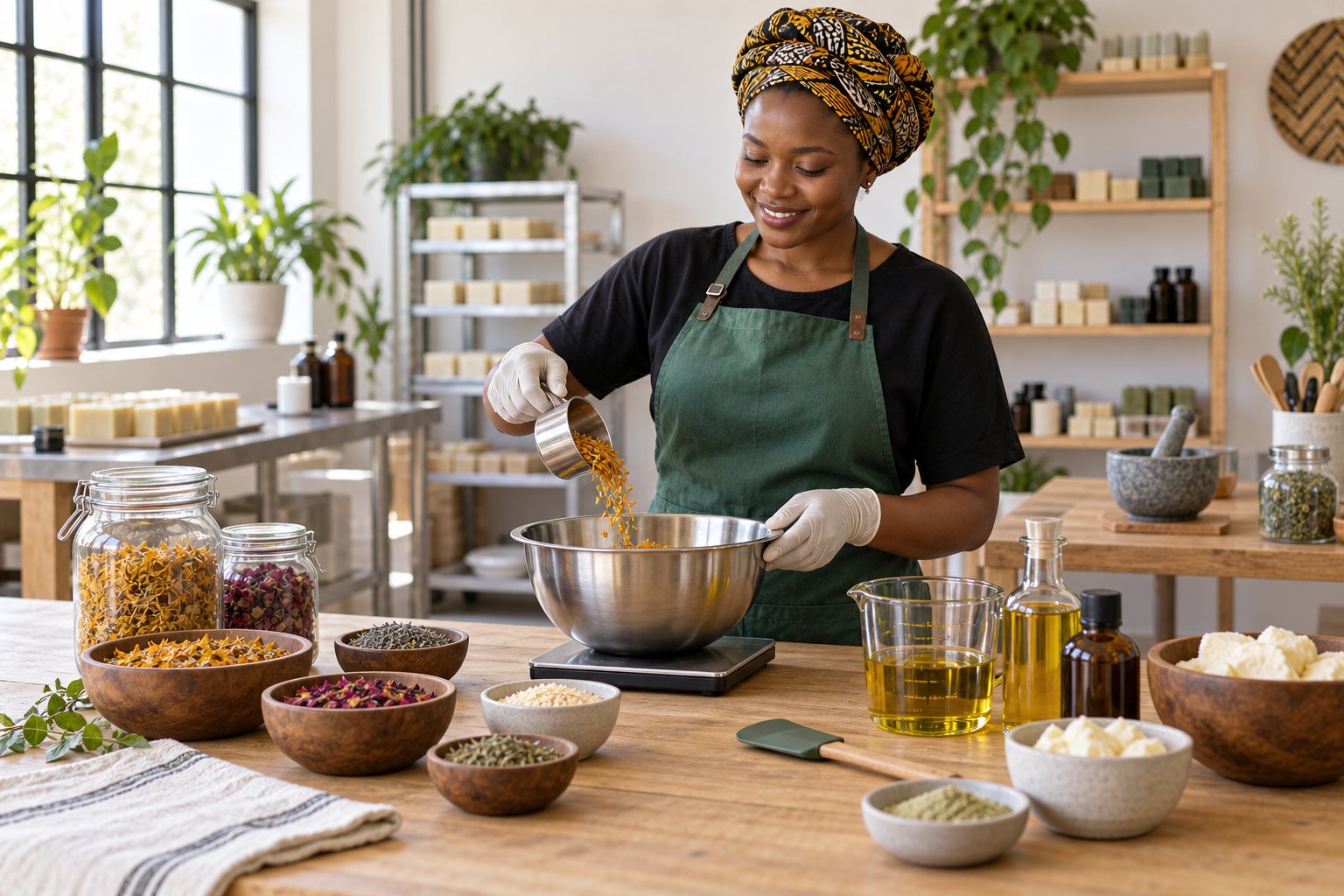
A workshop soap looks like a simple object. It is the result of a chemical transformation carried out in a room where things are weighed, gloves are worn and everything is written down. That contrast defines the trade: the finished product is gentle, the making is not, and traceability is what links the two. This article describes how a soapmaking business organises itself; it gives no recipe, no proportion and no procedure.
A product applied to the skin: what that changes
A soapmaker's client is a household buying for its own use, a shop or market stall reselling, a guesthouse or hotel ordering soap in its colours, a company or association placing a gift order, an institution looking for a regular supplier. All of them buy soap; none of them buys the same thing. The hotel buys regularity and presentation; the household buys a product whose composition it wants to know; the reseller buys a compliant label.
What the soapmaker sells, precisely, is a product intended for the skin. In most countries that brings it under regulation — cosmetic or equivalent — whose exact content varies: ingredient list, mandatory mentions, a file to keep, a declaration or registration. A professional soapmaker finds out about their own country's framework before selling, not after a complaint.
Making in batches: the unit that makes everything traceable
The batch is the unit of work and responsibility. A batch is weighed, made, cut, checked and numbered together; it shares the same materials, the same date and the same actions. If a problem appears on one bar, the batch number makes it possible to find all those made with it, and the materials that went into it.
That organisation requires a manufacturing record per batch: materials and their batches of origin, quantities weighed, date, who made it, observations, cutting date, date put on sale. Without that record a soap is an anonymous object; with it, it is a product one can answer for.
Materials: provenance, data sheets, storage
A soapmaker uses fats — vegetable oils and butters, sometimes animal fats depending on tradition and market —, an alkaline agent that makes the transformation possible, water, and additions: fragrances, colourants, clays, dried plants. Every material has a provenance, a grade and an information sheet that gets read.
The provenance of oils counts twice: for the quality of the soap and for what can be said about it. Oil bought in bulk with no indication of origin or batch makes traceability impossible. Fragrance and colour additions are the ones that most often raise questions of allergy or compliance; that is why the ingredient list is not a label ornament but information owed to the client.
No material is "natural, therefore safe". A rancid vegetable oil, a badly dried plant, a fragrance not intended for skin contact are real risks. A soapmaker does not call products hypoallergenic, non-toxic or "organic" unless those words match a definition and a control applicable in their country.
Workshop safety: what this article does not say, and why
The alkaline agent used in soapmaking is a corrosive product. Handling it requires protection, ventilation, a precise order of mixing and actions learned from someone who masters them — never from a general text. This article therefore describes neither the process, nor the proportions, nor the temperatures, nor the order of operations. That silence is deliberate: a reader learning soapmaking here would put themselves in danger.
What the trade can say, on the other hand, is how it organises safety. The International Labour Organization's convention on chemicals sets out the principle of identifying, labelling and informing about substances used at work. The World Health Organization, for its part, treats chemical safety as a public health matter that begins with knowing the products handled. Translated to the workshop: materials labelled and stored separately, under lock for the most dangerous; data sheets read and available; gloves, goggles and dedicated clothing; ventilation; an accessible water point; written instructions for anyone working in the room; no child and no animal in the manufacturing space.
Small structures do not need heavy equipment for that. The approach to improving working conditions the ILO proposes to small enterprises rests on simple solutions: tidiness, separation of zones, protection, information. A soapmaker who applies them has nothing to envy a factory on that point.
Cutting, curing and checking
After making, a soap goes through a resting time — the cure — during which it completes its transformation and loses water. Its length depends on the formulation and the climate; it does not copy from one workshop to another, and a soap put on sale too early is not finished. Cutting happens at a precise point in that process, and the regularity of the bars is a matter of jig and hand.
Checking covers every batch before sale: appearance, smell, hardness, absence of defects, and — depending on the workshop's means — whatever verifications the formulation and the applicable framework require. A doubtful batch is not sold at a discount: it is withdrawn. That protects both the client and the workshop's reputation.
Label, batch number and packing
The label is the most-read document in a soapmaking business. Depending on the country's framework it carries the product name, the ingredient list, the weight, the maker's identity, the batch number and the required mentions. A client with an allergy must be able to read what they are looking for; a reseller must be able to present it without adding anything by hand.
Packing answers two requirements: protecting the soap — from humidity, from contact, from a neighbouring fragrance — and presenting it as the client ordered, from a single box to a carton for a hotel. A personalised order — soaps in a guesthouse's colours, marked with a name — is prepared on an approved sample, and a bar marked for a client is not taken back.
The price of a soap
The price is made up of materials, making time apportioned to the batch, cutting and finishing time, the cure — which ties up space and cash —, packaging and, for an order, personalisation and delivery. An institutional order changes the economics without changing the act: it requires materials bought in one go, batches planned ahead and a regularity check that retail sale does not demand. No tariff holds from one workshop to another; the quotation names what it counts rather than announcing a figure.
In the African context
The first fact, for a soapmaking business, is that the applicable framework changes from one country to another: registration of the activity, mandatory mentions on the label, product control — all of that exists or not, in different forms, and a workshop finds out about its own before selling. A large share of workshops operates in the informal economy, which the International Labour Organization describes as a major component of employment in many countries; the batch record and the complete label are, for them, the first step towards formalisation, and they cost nothing.
The second fact is the supply of fats. Depending on the country and the season, oils are produced locally or imported, with variations in quality and price that carry through to every batch; the alkaline agent and fragrances are bought from suppliers whose data sheets have to be checked, and their regularity varies from one market to another. Water, electricity and a ventilated space condition what a workshop can reasonably produce.
Soap has many histories — soaps based on local oils made for a long time in some areas, recent urban workshops producing fragranced ranges for boutiques and hotels, women's cooperatives structuring a shared production, small units selling on markets. These are batch productions, with distinct materials, labels and clients, not an indistinct "African soap".
Mobile payment, where it exists, eases the deposit on a hotel or company order; it replaces neither the invoice nor the batch record. And a dangerous material stored under lock remains, everywhere, the act that distinguishes a soapmaking workshop from a kitchen.
What a soap does not say, and what a label must say
A soap treats nothing, cures nothing, heals nothing: claiming otherwise would tip the product into another regulatory framework, and most often into a false claim. It is not "safe for every skin", nor "natural" in the sense of a guarantee, nor "organic" without an applicable certification — and a soapmaker who writes that on the label takes responsibility for words they cannot stand behind. What they can write, and must, fits on the same label: the complete ingredient list, the weight, the batch number, their identity. Behind those mentions, a batch weighed and recorded, materials identified and stored safely, a check before sale, and a refusal to sell what they are not sure of. The chemist formulates, the laboratory analyses, the health professional advises on fragile skin; the soapmaker, for their part, makes a batch they can answer for.