
A leather craftsman's first act in front of a client is not to show a finished bag. It is to turn a hide over and show its back — where quality is seen, not on the face. The whole trade sits in that inversion: what gives a piece its value is what cannot be seen, and the professional has to make it visible before the sale, because afterwards only use will reveal it.
What a leather craftsman sells, and why it costs more
The client is a household ordering a bag or satchel, a person bringing an object to repair, a company ordering gifts in a small series, sometimes a shop looking for consistent pieces. All of them buy stitched leather; none of them buys the same thing. The household buys a piece for their use; the company buys regularity; the one who repairs buys the extension of an object they care about.
The question of price comes quickly, and it deserves a full answer. A hand-stitched piece takes hours of work that a machine reduces to minutes; top-grade leather costs several times the price of split leather. The difference does not show in a shop — it shows in use, when a machine seam runs at the first broken thread and a saddle stitch, with two needles, does not come undone.
The hide: showing the back before cutting
Leather arrives as hides, and every hide is different. Its provenance — country, tannery, type of tanning — determines its behaviour: vegetable-tanned leather darkens and develops a patina over time, another tanning keeps its colour and flakes more. A leather craftsman knows which hide each piece comes from and says so; they do not promise a colour that will not change if the leather they use is not of that kind.
This article describes no tanning process: those are chemical tannery operations, with their products and their rules, which do not belong in a leather workshop. What belongs in the workshop is choosing the hide for the use, storing it flat and sheltered, and knowing its flaws before marking out.
Cutting is an irreversible decision. A hide is read first: firm areas, supple areas, scars, marks. Placing the templates decides what becomes a handle — under constant strain — and what becomes a lining. A cutting mistake is paid for in lost leather, and leather is the largest cost after time.
The order: use, measurement, personalisation
A made-to-measure piece begins with a conversation about use: what to carry, how often, in what conditions, with which pockets and which closure. A satchel for a laptop and a travel bag share neither dimensions nor reinforcements. The craftsman proposes, draws or shows a reference piece, and the client approves before cutting.
Personalisation — engraving, hot stamping — is agreed at that stage. It makes the piece final: a piece marked with someone's initials is not taken back and cannot be resold. That is said beforehand. When a company orders a series marked with its logo, one more question arises: the craftsman is reproducing a mark that belongs to that client, and to no one else.
The price is built on time
The quotation itemises the hide, cutting and stitching time, hardware — thread, buckles, closures — and finishing. Time is the main item, and it is counted honestly: a bag takes hours the quotation names. No tariff transfers from one workshop to another, and a serious quotation says what it counts rather than announcing a figure.
Terms — a deposit covering the hide, lead time, conditions for returns — are agreed in writing at the order. The real lead time depends on what is already under way in the workshop, and a hurried order does not jump ahead of an accepted one.
A series changes the economics without changing the act. Forty card holders stamped for a company call for a uniform hide bought in one go, templates fixed once and for all and a regularity check a unique piece does not require; they also tie up cash for weeks. A unique piece sells finished, with no commitment to reproduce it. A workshop that takes both says so on the quotation, and organises its calendar accordingly.
Hand stitching: the act, not the tutorial
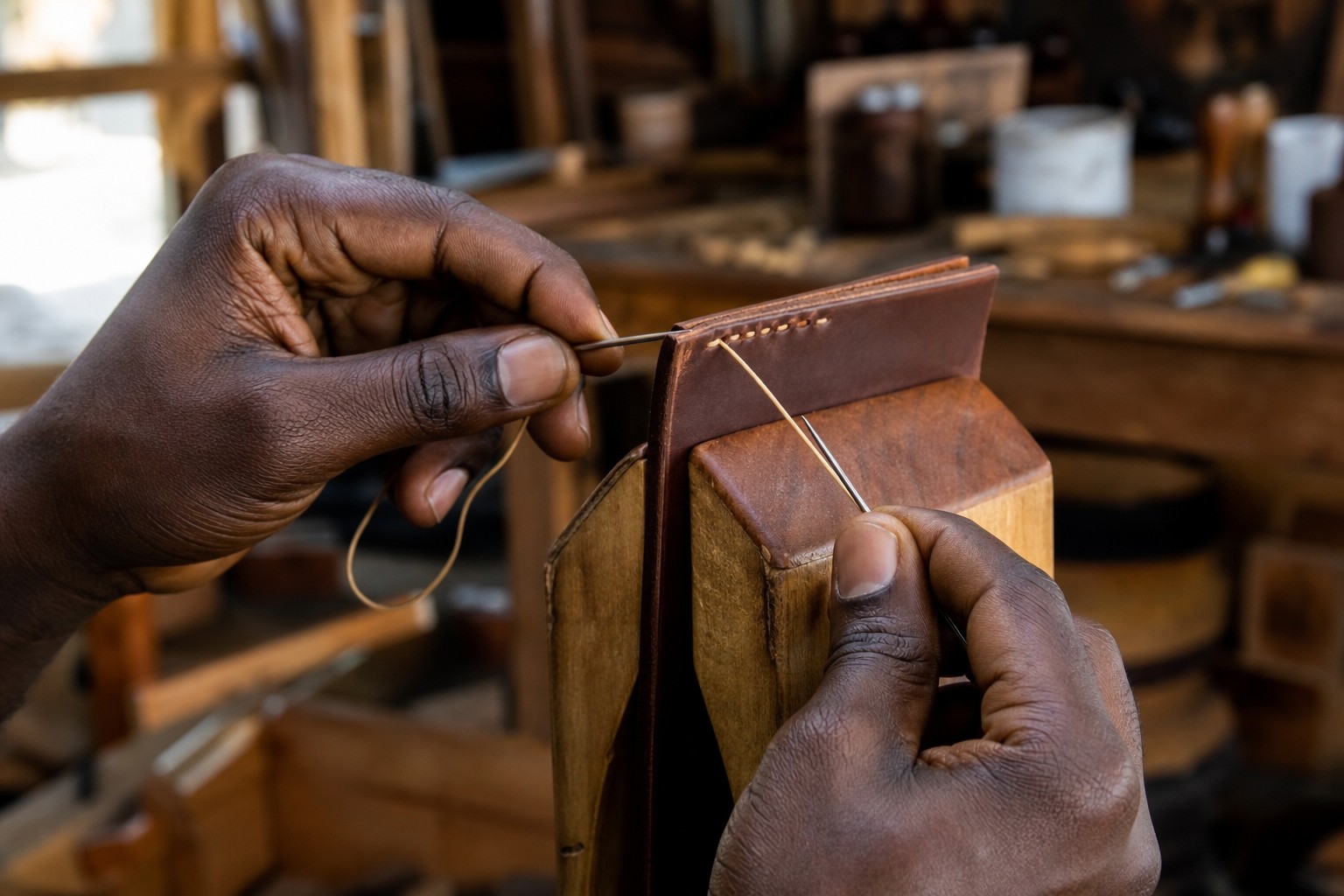
Making runs through stages this article does not teach: marking out, cutting, skiving, edge dyeing, gluing flat, pricking, stitching, finishing. The trade lies in the discipline around those acts — preparing every piece before assembling, checking every seam before closing, never fixing a cutting fault at the finishing stage.
The saddle stitch, with two needles and waxed thread, is the heart of the method: slower than the machine, it holds where the machine lets go. It is also what makes the piece repairable, because a seam made by hand can be undone and redone by the same hand years later.
The workshop has its ordinary risks: sharp tools, glues and dyes whose data sheets are read and whose fumes are ventilated, repeated gestures that strain the hands and back. The ergonomic checkpoints published by the International Labour Organization for small enterprises — working height, lighting, alternating postures — apply as they stand to a leather bench, with no heavy investment.
Designed to be repaired
This is what most clearly distinguishes a workshop piece from an industrial one: it is designed from the start to be reworked. Replaceable handles, accessible seams, removable closures. A piece that cannot be repaired without being destroyed is a piece that was decided, at the design stage, to be thrown away.
Repair is also a service in its own right, extending to pieces of other origins: re-stitching, replacing a handle or closure, conditioning, re-colouring. The craftsman examines before accepting. Some repairs would damage a piece without saving it — leather too dry, an unrecoverable lining, a tired structure — and the honest answer is to say so beforehand, even if it means refusing.
Restoring an antique or collectible object is another trade; a general leather craftsman does not claim to be its conservator.
Delivering, explaining, seeing again
The piece is handed over with an invoice describing what was done, and with simple care instructions: what the leather withstands, what it does not, how it will evolve. A client warned that their leather will darken does not turn it into a complaint; an unwarned client does.
A rework is possible for a manufacturing defect; it is not for a personalised piece matching what was approved, nor for use contrary to what was said. What always remains possible is coming back: a workshop piece is seen again years later, and that is precisely what it was designed for.
In the African context
A hide often crosses several borders before reaching the bench. Depending on the country, tanneries — artisanal or industrial — sell locally or export, and a leather workshop buys sometimes from a tannery it knows, sometimes from a dealer it knows nothing about. That difference decides what it can tell the client about provenance and tanning, that is, part of what it sells.
Hardware — thread, buckles, closures — is the second weak point, and it varies from one city to the next: often imported, sometimes of uneven quality, it decides repairability as much as the stitching does. A workshop that does not control its hardware does not control what it promises.
Transmission passes very largely through workshop apprenticeship; the International Labour Organization, in its guide on informal apprenticeship in Africa, describes its weight and the ways it can be improved. The competence of a craftsman trained that way is judged by their seams, not by a diploma.
Finally there is an economic reality specific to this trade in large cities: imported, machine-stitched bags are bought, carried for two years and thrown away, because nobody knows how or wants to repair them. A workshop that repairs — its own pieces and other people's — occupies a place imports do not take, and it is often through repair that it wins its first commissioning clients. Corporate gifts, an urban clientele seeking made-to-measure and diaspora orders come afterwards, none of them a given.
What a leather craftsman does not promise
They do not promise a colour that will never change, nor a piece that will not develop a patina, nor a repair a piece will not withstand. They do not promise a price before choosing the hide and counting the time, nor a lead time they have not written down.
They do not stand in for the tanner, nor the tailor of the Fashion sector, nor the conservator of antique objects, nor the manufacturer producing by the thousand. What they commit to is more precise: a hide shown from the back before cutting, a seam made to hold and to be redone, a quotation that names the time, and an honest answer when a repair is not worth it.