
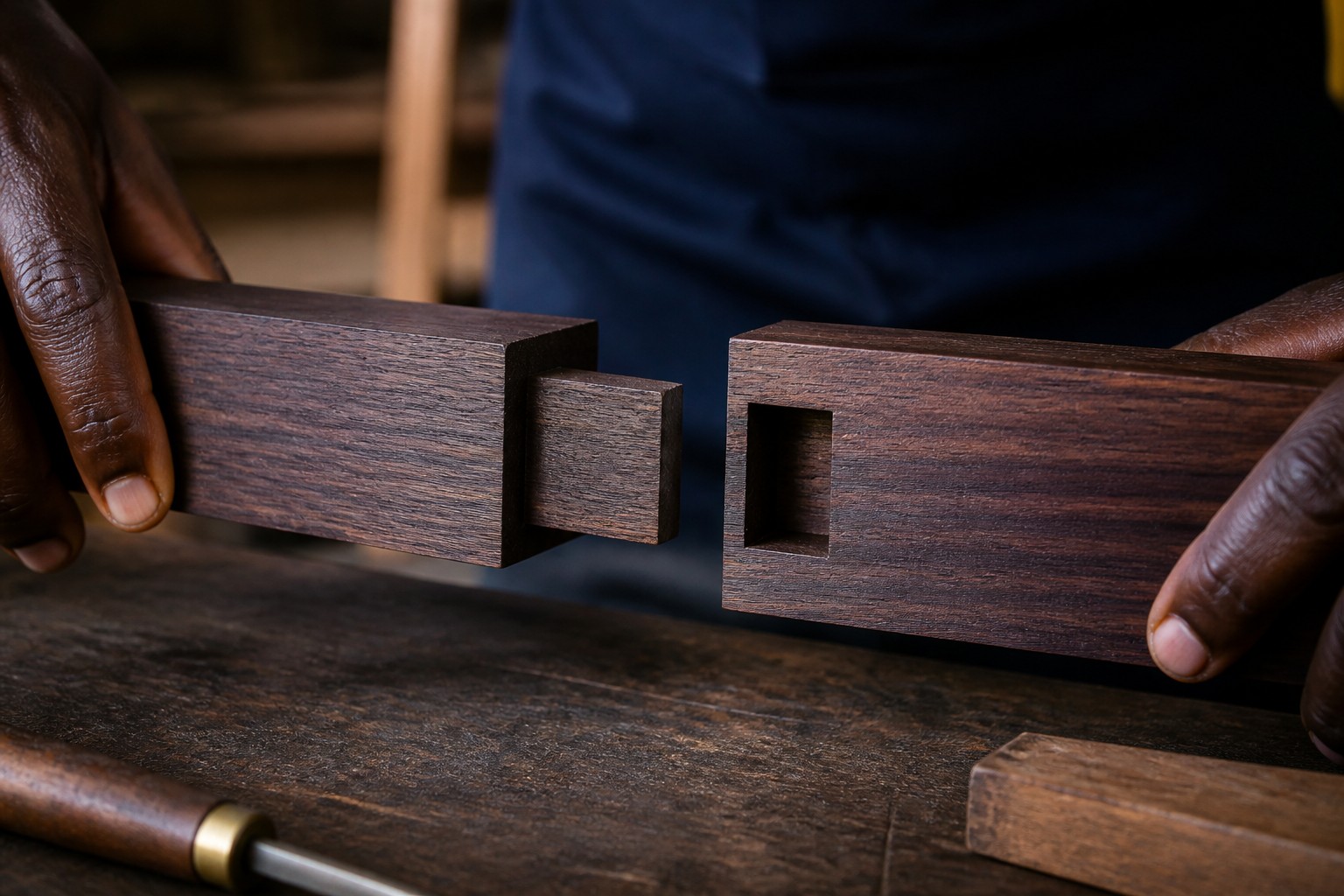
A client, in a hurry to install a sideboard before a celebration, is told that the timber is not dry enough and that delivering now would mean delivering a piece that will split. He takes it badly; the cabinetmaker holds firm. That may be the most revealing scene in the trade: what makes solid-wood furniture good is settled before a single cut is made, and a professional would rather lose a client than a reputation.
Cabinetmaker, not joiner: a boundary the client needs to know
The confusion is common and expensive for both sides. The joiner works on the building: doors, windows, fitted cupboards, fit-outs installed in the construction. The cabinetmaker makes furniture — tables, sideboards, bookcases, beds — with different joints and finishes. Both trades are legitimate; they do not answer the same order, and a client asking for a made-to-measure dressing room needs to know which of the two they are calling on.
What the art cabinetmaker sells, precisely, is a solid-wood piece designed for a space and a use, joined to last, and repairable because its joints come apart. Their client is a household ordering a table or a bookcase, a shop wanting a fit-out, a family entrusting an old piece for restoration, a decorator composing an interior.
The timber: buying, drying, measuring
Solid wood always moves a little: it swells and shrinks with humidity, and a well-designed piece allows for that. It splits, on the other hand, if it was worked too wet — and it is always the furniture that gets blamed, never the drying.
So the principle is constant: timber is dried before it is machined, and its moisture is measured rather than guessed. The time depends on the species, the thickness, the climate and the drying method; it does not copy from one workshop to another, and this article gives none. What belongs to the trade is buying the timber early enough for it to have time, and refusing a deadline that does not allow it.
Provenance is part of the purchase. The FAO, which tracks the production and trade of wood products, notes that forest management balances economic, social and environmental interests; for a workshop that means knowing where a log comes from and under what framework it was cut, and telling the client. Some species are regulated depending on the country; a professional cabinetmaker uses none whose lawful provenance they cannot establish, and checks the applicable framework before shipping a piece abroad.
The dimensioned plan: nothing is cut before it
Every order begins with a scale drawing, with every dimension, handed over and approved before the first cut. That plan fixes what client and cabinetmaker look at together: height, width, depth, position of drawers, direction of grain, species, finish. Once the timber has been cut into, it is too late to move a drawer.
The brief that precedes the plan is about space and use: where the piece will go, against which wall, with what clearance, to store what, at what height. A shop fit-out adds on-site measurement and the constraint of installation. When a client brings a photograph of a piece seen elsewhere, the cabinetmaker can draw on it; they do not copy it identically — apart from the question of rights, furniture is designed for a given space and use.
The price: timber and workshop time
The quotation follows the plan. It is made up of the timber — a large share of the price, varying with species and dimensions —, workshop time, finishing and, for a fit-out, installation. No tariff carries over between workshops; a quotation worth the name itemises what it counts instead of announcing a figure.
Terms — a deposit covering the purchase and cutting of the timber, lead time, conditions for returns — are agreed in writing when the plan is approved. The lead time runs from that deposit, never from first contact, and it allows for drying.
Joining without screws: the choice that makes it last
The difference from furniture assembled with screws and glue lies in the joints: mortise and tenon, dovetails, joints that work with the wood instead of fighting it. A screw loosens with the seasons; a well-made joint does not move. And it comes apart, which makes the piece repairable decades later.
This article teaches no joinery technique, no sizing, no machine procedure. What belongs to the trade is the order of work — cutting to size, letting the wood rest, dressing, marking out, dry-fitting before gluing what must be glued, finishing — and the check at every stage with the plan in hand.
The workshop: dust, machines, finishes
A cabinetmaking workshop concentrates ordinary and serious risks: wood dust, cutting machines, noise, finishing products. The approach to improving working conditions the International Labour Organization proposes to small enterprises rests on simple solutions: extraction and ventilation, machine guards left in place, tidiness, lighting, training of whoever works in the shop. Anything involving electricity, a machine's mechanics or a chemical treatment belongs to a qualified person and the manufacturer's instructions; none of that is passed on in writing to a reader.
One point deserves saying plainly when a workshop is a family one. The International Labour Organization distinguishes work performed by a child from child labour: what the standards target is work hazardous to health and development, work demanding too many hours, work that prevents schooling. In a wood workshop the line is concrete: machines, finishing products and heavy loads are not grey areas, and "family tradition" does not make them acceptable tasks.
Finishing, delivering, installing
The finish — oil, wax or varnish depending on the piece and its use — protects the wood and decides its future care. The client leaves with simple instructions: what the piece withstands, what it does not, how to clean it, what direct sun will do.
Delivery of a heavy piece and installation of a fit-out are done by the workshop where possible: that is when plumb is checked, drawers and doors are opened, and the piece is seen to fit where it was planned. The delivery note describes what was handed over; a photograph of the installed piece serves as reference and portfolio.
Restoring, repairing, refusing
Restoring old furniture is a service of the trade: reworking joints, replacing a part identically, re-veneering, refinishing. It starts with an examination, and sometimes with an honest answer: a restoration would cost more than the piece is worth, or would damage what it claims to save.
Restoring a collector's piece or a heritage item is another trade, with its own rules and responsibilities; a general cabinetmaker does not claim to be a heritage conservator. A rework is possible for a manufacturing defect; it is not for wood that "works" normally, nor for exposure contrary to what was recommended.
In the African context
A cabinetmaking workshop is defined here by two things before any other: the timber it can buy and the space it has to dry it. Depending on the region, timber species are abundant or regulated, come as logs or sawn, and their export follows rules a workshop checks before accepting a remote commission. Air drying, over periods the climate lengthens or shortens, ties up wood and space for months — an investment the smallest workshops cannot always carry, and which explains many a piece of furniture that splits.
Energy comes next. A workshop depends on electricity for its machines, and a cut in the middle of machining is paid for in lost wood; where the grid is unstable, the organisation of work allows for it, and the most delicate operations are done in the safe hours.
Demand, for its part, has changed with the cities. Made-to-measure furniture for a clientele that does not want an imported flat-pack, fit-outs of shops, hotels and restaurants, diaspora orders placed remotely on a dimensioned plan: all of that exists, and all of it comes with pressure on deadlines — a shop opening, a celebration, a move — that the wood ignores. A cabinetmaker who refuses to deliver before the wood is dry sometimes loses the order; one who agrees loses the piece, then the client.
What makes the workshop professional shows in the dimensioned plan approved before every order, in the timber bought in time and measured before machining, in the quotation that names the species and its provenance, and in the photograph of every piece installed — never in the floor area of the workshop.
The sideboard that was not delivered on time
The client from the opening, the one who wanted his sideboard before the celebration, received it a few weeks later — and eight years on, the piece has not loosened a millimetre. That is the only proof that counts in this trade, and it always arrives too late to convince at quotation time. Hence the importance of what precedes it: the approved dimensioned plan, the timber bought in time and measured, the quotation that names the species and its provenance.
A cabinetmaker promises neither that solid wood will never move, nor a deadline drying does not allow, nor to copy identically someone else's piece, nor a price before the plan. They leave the building to the joiner, the whole interior to the decorator, historic pieces to the heritage conservator, series to industry. What they guarantee comes apart, can be repaired and can be passed on: joints that hold because they were made to.