
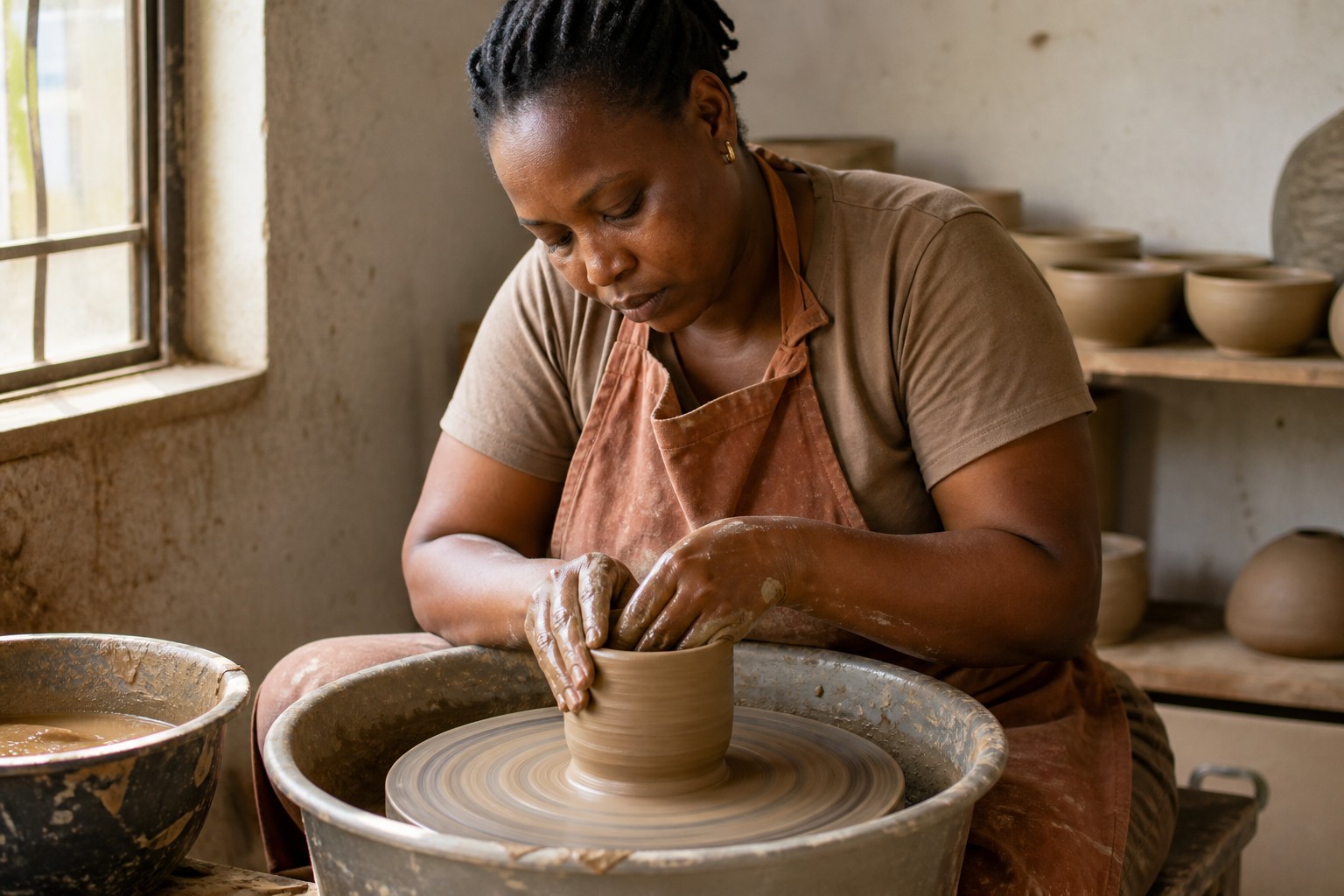
An order for thirty plates is not thrown in thirty copies. More are thrown, because between the wheel and the restaurant table the piece will go through drying, a first firing, glazing, a second firing and a check — each a stage at which it can crack, warp, or come out with a glaze that did not hold. A professional ceramist does not suffer that loss: they plan it, price it and absorb it.
A trade of several stages, none of which forgives
The client is a household buying tableware or a decorative piece, a restaurant or guesthouse ordering a made-to-measure series, a decorator looking for coherent pieces for a project. The restaurant's request is the most demanding: dozens of pieces close in form, colour and dimensions, which will have to withstand the dishwasher and the handling of service.
What the ceramist sells is a piece that has come through every stage without a flaw — and, for a series, the promise that the pieces resemble one another enough without being industrial. For tableware they also sell something invisible: the certainty that the glaze in contact with food is suited to that use.
The clay, and what is known about it before throwing
The raw material conditions everything that follows. A clay is chosen for the intended use — tableware, decorative piece, large piece — and for what the workshop's kiln can reach. Stoneware fired at high temperature gives a dense piece that does not absorb; earthenware fired lower suits other uses and scratches more easily. The principle can be stated; the temperatures depend on the clay, the glaze and the kiln, and do not transfer from one workshop to another.
Regular supply matters as much as quality: changing clay mid-series changes shrinkage on drying, colour after firing and how the glaze behaves. A ceramist receiving a new batch runs tests before committing it to an order.
The sample before the series
For every series order, a sample is made and approved: form, dimensions, glaze colour, resistance to washing. That is when the client changes their mind cheaply — a colour too pale, a rim too thin, a handle that hinders stacking. After approval, the series is launched on that reference, and the variations that remain belong to handwork: a few millimetres, a shade of colour.
For a restaurant, the sample is approved under real conditions: it is stacked, run through the dishwasher, set on the table with the intended cutlery, its rim checked against fast service. A magnificent bowl that does not stack clutters a kitchen; a plate that is too heavy tires the staff. Those constraints do not show in a photograph and reveal themselves in one evening of service.
The sample has a cost, and it is charged or deducted as agreed. What is not negotiable is its existence: launching thirty pieces without an approved reference is taking the risk of remaking thirty.
Planning for loss
Over-production is not excessive caution, it is the professional answer to a fact: some pieces will not pass the check. So the ceramist throws more than the order, and sets that margin from their experience of the clay, the form and the kiln — never from a percentage valid for everyone.
Pieces that come out flawed are not sold at a discount on the grounds that they are "almost good". A plate whose glaze has run or whose base is cracked is broken. That choice costs, and it protects two things at once: the workshop's reputation and the price of the conforming pieces.
Drying, firing, glazing: principles, not recipes
Drying is done slowly and evenly, away from draughts; a piece dried too fast cracks before it even enters the kiln. The first firing fixes the form; glazing follows; the second firing melts the glaze onto the piece. Each stage has its settings, specific to the workshop, the clay and the glaze used — this article gives none of them.
One safety point dominates all others for tableware. The World Health Organization ranks lead among the chemicals of greatest public health concern and notes the risks of exposure, particularly for children. A glaze intended for food contact must therefore be designed and verified for that use; a decorative glaze, however beautiful, does not go on a plate. The ceramist makes sure of that with the supplier and tells the client, without ever improvising a formulation.
The workshop: dust, products, heat
The kiln, powdered raw materials and glazes are the workshop's daily hazards. The International Labour Organization's convention on chemicals sets out the principle of identifying, labelling and informing about substances used at work; for a ceramist that translates into identified materials, data sheets read, suitable ventilation, respiratory protection when handling powders, and clear instructions for anyone working alongside.
Work at the wheel and loading the kiln strain the back, wrists and shoulders. The ergonomic checkpoints published by the ILO for small enterprises — working height, storage within reach, handling — apply as they stand to a ceramics workshop. None of them requires heavy investment.
Checking piece by piece, then delivering
Out of the kiln, every piece is examined: crack, glaze fault, warping, blister, unstable base. That check is individual — which is what distinguishes a workshop series from industrial production checked by batch. For a restaurant series, the pieces retained are compared with one another to verify they stack and serve together.
A series is packed piece by piece for delivery, and the delivery note states quantities, including the agreed spares. A piece broken on delivery is replaced; a piece broken in service is no longer the workshop's concern, except for a glaze or firing fault appearing in use — which the ceramist examines before concluding.
The price of a series and the price of a piece
The price is made up of material, throwing time, glazing, kiln time and checking, plus the over-production margin. A series costs more to prepare and less per piece; a single piece needs less preparation and all the attention of one object. No amount transfers from one workshop to another: the quotation details what it counts.
The difference between a unique piece and a series is not only price. A series ties up clay, shelf space and several kiln loads before it is delivered, which weighs on cash flow; it also requires keeping the glaze and form record so the order can be topped up a year later. A unique piece sells when it is finished, with no commitment to reproduce it. A workshop that takes both organises its kiln accordingly, and tells the client who is waiting.
In the African context
The kiln separates ceramics workshops far more than geography does. Depending on the country and the city it is electric, gas or wood-fired; the energy feeding it is steady or cut without notice; its cost per load ends up in the price of every plate. A cut in the middle of a firing loses an entire load, and a workshop without a backup plans its firings for the hours when the grid holds.
Then comes the clay. In some areas local clays have been worked for a long time and are known to the workshops; elsewhere clay is bought prepared, at a price and regularity that depend on the supplier. Glazes raise the most delicate question: obtaining ones whose composition is known and whose food use can be vouched for is not equally possible everywhere, and a serious workshop refuses to sell as tableware what it cannot answer for.
Production histories are many — utilitarian pottery, ceremonial pieces, recent throwing workshops on the outskirts of large cities — and none sums up the others. A workshop supplying restaurants and guesthouses today practises a trade of commissions, and the relationship with a restaurant turns on very local details: transporting a series over roads that break things, packing that has to withstand them, the spares written into the quotation, and the ability to top up the series a year later with the same glaze.
Three commitments, and what they exclude
A ceramics workshop can hold three commitments, and only those. The first: a reference approved before any series, on a sample the client has held in their hand. The second: a piece-by-piece check out of the kiln, with breakage planned, priced and absorbed by the workshop. The third: tableware whose glaze suits what will be put on it, and nothing else on a plate.
Everything beyond those three commitments is an empty promise — two strictly identical pieces, a colour reproduced identically from one glaze batch to the next, an unbreakable piece, a price before the sample, a lead time that ignores drying and firing. And what exceeds them belongs to other trades: the laboratory that certifies a glaze, the manufacturer producing by the thousand, the decorator who designs the whole table.