
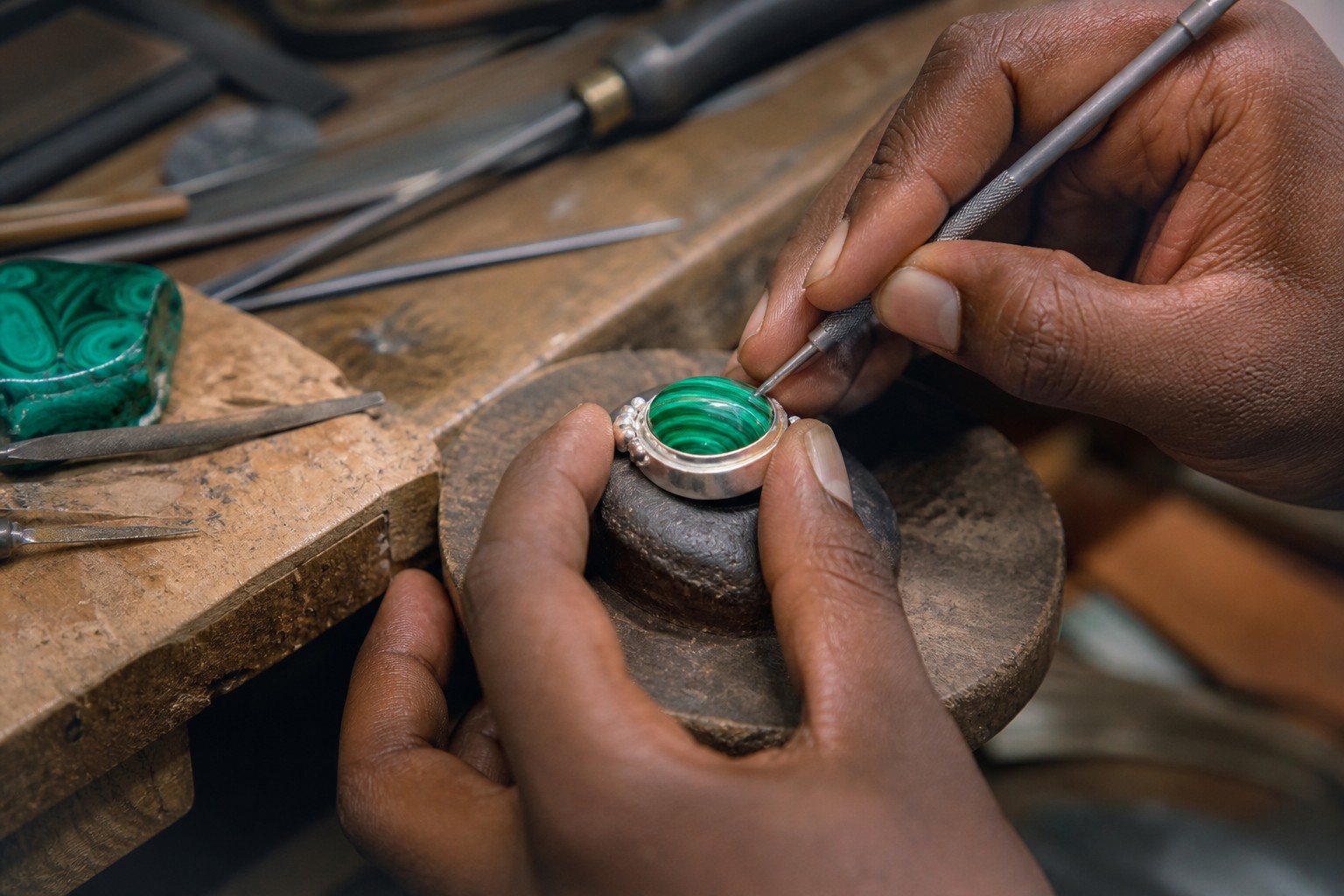
A piece of jewellery is almost never a neutral object. It comes from a person, an event, a family; it carries a weight no scale measures. And yet the scale is the jeweller's first instrument of trust: the metal handed over is weighed, described and recorded on a receipt, then weighed again on return. Everything intimate about the trade rests on that very concrete rigour.
Creating, transforming, repairing: three requests, three responsibilities
An artisan jeweller's client arrives with one of three requests. A creation: a pendant, a ring, a set designed for them. A transformation: an inherited ring melted down into two wedding bands, a stone reset on a new mount. A repair: a chain to re-solder, a ring to resize, a clasp to replace.
Those three requests do not carry the same responsibility. A creation is judged on its match with the approved drawing. A transformation commits an irreplaceable object: if the recasting fails, grandmother's ring no longer exists. A repair can weaken an old piece instead of saving it, and the jeweller must be able to say "no" before starting.
A small series for a designer boutique is a fourth case: regularity matters more than uniqueness there, without the pieces having to look industrial.
The metal weighed, described, recorded
Everything starts with a receipt. The metal brought by the client — or bought together — is weighed in front of them, described (nature, colour, condition, stones present) and recorded on a document signed by both parties. On return, the piece is weighed again in front of the client, and the weight appears on the final receipt.
That is not a formality against suspicion; it is what makes the quotation verifiable. A jewellery price always breaks down into two: the material — metal and stones — on one side, the making — the jeweller's work — on the other. Without weighing, the first part cannot be verified, and everything else becomes blind trust.
The question of provenance runs both ways. A serious jeweller knows where the metal they buy comes from and refuses to work material whose origin cannot be explained; they provide no one with a way of making an object disappear or disguising where it came from. The exact obligations — declarations, registers, hallmarks — depend on the country, and they find out about theirs.
The dimensioned drawing, the only moment to change one's mind
For a creation or a transformation, a dimensioned drawing is made and submitted to the client: form, dimensions, metal, stone, type of setting, finish. It is the only document on which both are looking at the same thing, and the only moment when changing a curve costs nothing.
Once casting is under way, there is no going back without redoing everything. The approved drawing — signed, photographed, dated — becomes the reference for the order, and the lead time runs from that approval, never from the first visit.
The price: material and making, never confused
The quotation always separates what is bought from what is made. Material follows rates that vary from day to day and market to market; this article quotes none, and an honest jeweller quotes today's, not the one they remember. Making depends on time, the complexity of the setting, engraving, polishing and the number of pieces.
Terms — a deposit covering the purchase of metal, a schedule, no return on a piece made to one person's measurements — are set down in writing when the drawing is approved. They are not assumed.
Making, setting, finishing: the trade without the instructions
Making runs through actions this article does not teach: casting, shaping, fitting, soldering, setting, polishing. The trade lies in the order of those actions, the check between each, and the refusal to set a stone on a mount that has not been verified.
Stones call for a caution of their own. A natural stone, a treated stone and a synthetic stone can look alike to the eye, and an artisan jeweller is not a laboratory: they say what they know of a stone's origin and nature, they do not certify what they cannot prove, and they refer to a gemmologist when the value at stake warrants it. A stone brought by the client is described on the receipt like the metal — colour, apparent dimensions, condition, visible inclusions — without any definitive identification being claimed.
The bench has hazards of its own — heat, finishing acids, polishing dust, splashes. They are identified, ventilated, protected against as the manufacturer indicates, and neither concentrations nor procedures are passed to anyone who has not learned them in a workshop. Tools are chosen, maintained and put away; anything involving gas or electricity belongs to a qualified person.
Refusing a repair
This may be the most professional act in the trade. An old, fine piece, weakened by years of wear, may not withstand a solder or a resizing. The jeweller examines, explains, and says before starting what they do not guarantee — even if it means refusing work they could have charged for.
That refusal builds a clientele better than any sale. A client spared the destruction of an object they cared about comes back for three orders.
What is handed over, and what is said
The piece is returned with the final receipt: weight returned, description, itemised price, and — where the country provides for it — the required marks on the metal. The client leaves with simple care instructions and honest information about what the piece will withstand: copper that develops a patina, a soft stone that scratches, a fine chain not to be worn for sport.
Follow-up is part of the service. A ring deforms over the years, a setting loosens, a chain wears at the clasp: seeing the piece again, cleaning it, checking the claws that hold a stone are things the workshop offers and the client is wise to accept. A stone lost because a setting was never checked costs more than a visit.
A rework is possible for a manufacturing defect; it is not for a piece made to one person's measurements and matching the approved drawing.
Design, mark and counterfeiting
A jeweller creates models, and those models have a value that can be protected. The World Intellectual Property Organization notes that the ornamental aspect of an object can be protected as an industrial design, and that a trademark serves to indicate a product's origin. The exact regimes depend on the country; the practical line does not move.
Drawing on a style is a trade; reproducing identically a model someone else designed, applying a hallmark or mark one has no right to apply, or selling a piece under an origin that is not its own is counterfeiting, not craftsmanship. A jeweller who signs pieces, keeps drawings and photographs work protects what they create without needing a legal department.
In the African context
The first question a jeweller asks here is not about style, it is about origin. Depending on the country and the area, metal arrives by weight from dealers, as old pieces brought by the client, or through regional supply chains whose compliance is a real issue; stones — malachite, tourmaline, other local stones — come from precise basins. A professional workshop finds out about the applicable framework before accepting material it can say nothing about, and a weighing receipt signed by both parties is the first document in that file.
The supply chains themselves have nothing in common from one city to the next: gold jewellers in specialised markets, silver and copper workshops for a neighbourhood clientele, urban designers supplying boutiques, workshops working regional stones for a clientele that wants made-to-measure rather than imported. These are wedding commissions, transformations of family pieces, repairs and small series — not "African jewellery" for visitors.
A large share of these workshops operates in the informal economy, which the International Labour Organization describes as a major component of employment in many countries. What makes them professional costs nothing: a weighing receipt for every piece entrusted, an approved drawing for every order, an invoice, and a record of where what is bought comes from. Mobile payment, where it exists, eases the deposit; it does not replace the scale. Diaspora orders, placed remotely on a dimensioned drawing and photographs, rest entirely on that rigour: a client who will only see the piece on delivery has nothing but the receipt and the drawing to decide on.
What an artisan jeweller does not promise
They do not promise to repair a piece that will not withstand it, nor to reproduce identically someone else's jewel, nor a material price valid next week. They do not promise that a soft stone will never scratch or that a metal will not develop a patina.
They do not stand in for the gemmologist who certifies a stone, nor the valuer who appraises an antique piece, nor the metal dealer. What they commit to comes down to a few verifiable acts: metal weighed in front of the client on handover and on return, a drawing approved before casting, a price broken down between material and making, and a refusal stated in advance whenever an intervention would put a piece at risk.