
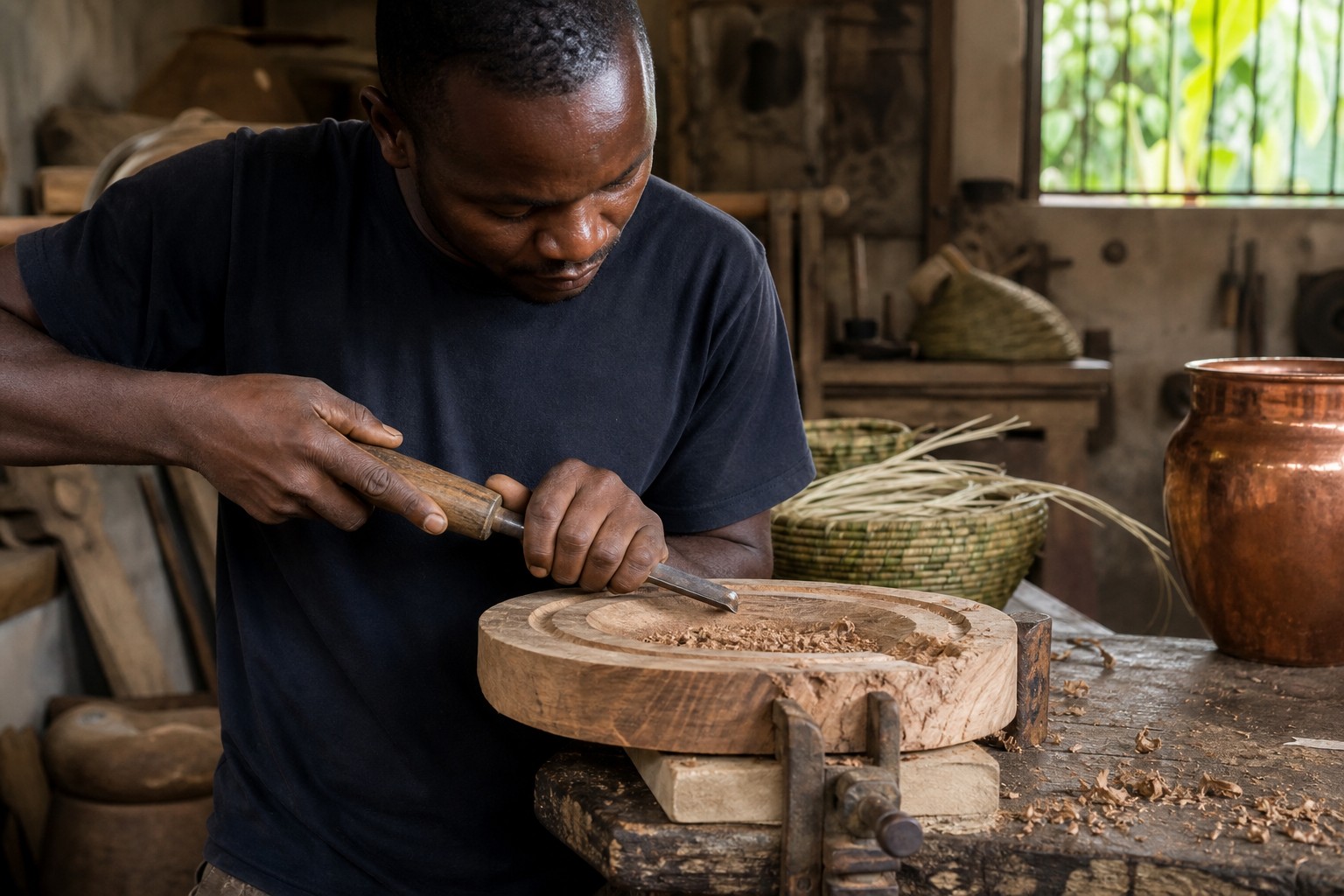
A client orders three identical lamps. The artisan accepts, and warns: they will look alike, they will not be identical. That is not an excuse prepared for a future flaw, it is the exact description of what is being sold. The whole trade rests on that initial candour: a piece carried by hand from the choice of material to the finish bears the trace of that journey, and the client must have bought it knowingly.
What an artisan sells when selling a unique piece
The client may be a household wanting a console to their measurements, a decorator composing an interior, a hotel or restaurant ordering lamps for a lobby, a company looking for a gift object. All of them buy an object; none of them buys the same thing. The household buys an object that resembles them, the decorator a piece that fits into a whole they are designing, the hotel a coherent series that is not uniform.
What the artisan sells, precisely, is a piece whose origin they can tell: which material, where it comes from, why it was chosen, how it was worked. That ability to explain is part of the value, not a commercial extra. An object nobody can account for is compared on price; an explained object is compared on something else.
Three materials, and what each one demands
Wood, copper, plant fibres: each material dictates its rules. Wood has to be dry enough before it is worked, otherwise the piece moves after delivery; the principle is constant, the time depends on the species, the thickness and the workshop's climate. Copper is worked, develops a patina and scratches; saying so in advance avoids a complaint. Fibre is prepared before it is woven, and badly prepared fibre breaks after the sale.
Provenance matters as much as quality. The FAO, which tracks the production and trade of wood products, notes that managing forests involves economic, social and environmental interests to be balanced. For a workshop that comes down to a simple question put to the supplier: where does this wood come from, and under what framework was it cut. Reclaimed wood answers that question differently — with a known history.
No material is universally better. A dense species suits a platter and weighs too much for a hanging lamp; a supple fibre makes a fine basket and a poor seat. The choice is made piece by piece, use by use, and offcuts are counted: they are part of the cost.
The order starts with a dimensioned sketch
For a made-to-measure piece, nothing is cut before a drawing with dimensions has been handed over and accepted. That sketch is not a formality: it is the only document on which client and artisan are looking at the same thing. It fixes height, width, depth, material and finish, and becomes the reference in any disagreement.
The brief that precedes the sketch is a job of listening. Where the piece will go, next to what, for what use, under what light, with what constraints of passage. An artisan who draws without asking those questions is drawing for themselves. When the order is a series, the sketch is backed by a first piece serving as reference — which the client sees before the others are started.
The price is built before the first cut
The quotation follows the sketch, never the reverse. It is made up of material, working time, finish and, depending on the case, delivery and installation. None of those items has a universal value: the same platter costs differently depending on the species, the complexity of the decoration and the finish requested.
An artisan explains the breakdown. A client who understands why a console costs what it costs accepts the price or declines knowingly; a client who does not understand compares with the market and leaves unhappy. Terms — deposit, schedule, conditions for returns — are agreed in writing before work begins, and a made-to-measure piece, made for one client and one place, is generally not returnable: that is said before, not after.
One piece at a time: the workshop as calendar
Working one piece at a time often means carrying an order from start to finish before beginning the next. That is what guarantees a piece's coherence, and it is what makes lead time a matter of trade. An artisan who announces a date commits the order of their workshop; they cannot keep it if they accept three rush jobs in between.
The real lead time depends on the material available, on any drying, on complexity, and on what is already under way. It goes in writing on the quotation. Refusing an order that is too hurried is not inflexibility: it is what protects the orders already accepted.
Making, finishing, checking
Making runs through actions this article is not meant to teach: cutting to size, shaping, assembly, finishing. What belongs to the trade, rather than to a tutorial, is how those stages are organised — preparing all the material before starting, checking every joint before finishing, letting dry what needs to dry.
Tools, hand or powered, are chosen for the use, maintained and put away; their guards stay in place. Wood dust, fumes and finishing products are ordinary occupational risks: they are identified, ventilated, protected against as the manufacturer indicates, and anything beyond one's competence is handed to a qualified person. No dose, no mixture and no machine procedure is passed on in writing to a reader who has not learned them in a workshop.
The final check is done with the sketch in hand. Dimensions, stability, finish, no sharp edge: whatever fails is reworked before delivery, never after.
Delivering, installing, taking back
A fragile or heavy piece is delivered and installed by the artisan where possible: that is when you check the object fits where it was planned, and explain its care. The delivery note or invoice states what was handed over, and a photograph of the installed piece serves as reference as much as portfolio.
A return is possible for a manufacturing defect; it is not for a variation announced in advance, nor for use contrary to what was said. Repairing an old piece is part of the trade, and sometimes the honest answer is that a repair would cost more than it is worth.
Inspiration, copying, and what an artisan signs
A client often brings a photograph: "I would like that". The artisan can draw on it; they do not reproduce identically a piece someone else designed. The World Intellectual Property Organization notes that the ornamental aspect of an object can be protected as an industrial design; the exact rules depend on the country, but the practical line is the same everywhere: drawing inspiration is a trade, copying is a risk and a fault.
Conversely, what an artisan designs belongs to them, and signing pieces, photographing work and keeping sketches are acts of professionalisation as much as of pride.
In the African context
The word "artisan" covers, depending on the city and the country, realities that share neither clientele nor organisation: neighbourhood workshops working on local commissions, workshops supplying decorators and hotels, small structures producing series for designer boutiques, workshops selling remotely to the diaspora. Reducing that to "traditional crafts" would miss the point: these are contemporary businesses, with orders, quotations and deadlines.
Supply varies just as much. Depending on the area, wood is found locally or imported, copper is a regional resource or a metal bought by weight, fibres come from a known collection basin or from a market. The cost of energy, access to reliable tooling and the quality of spare parts weigh on what a workshop can reasonably take on.
Transmission happens very largely through workshop apprenticeship. The International Labour Organization, in its guide on informal apprenticeship in Africa, describes its weight and the ways it can be improved; the competence of an artisan trained that way is not measured by a diploma, but by what they can do and explain. UNESCO's 2003 Convention also recognises the skills linked to traditional craftsmanship as a domain of intangible cultural heritage — which makes no object a "certified" product and assigns no practice to a whole country.
Outlets have widened wherever mobile payment, photography and remote ordering exist: a workshop can today deliver to a client it has never met. None of those tools guarantees a sale; they only make possible what was not. Professionalism here rests on concrete things: a dimensioned sketch before every order, an invoice, a photograph of every piece delivered, and the ability to say where the material comes from.
What an artisan does not promise
They do not promise two identical pieces, nor a lead time they have not written down, nor a price before drawing. They do not promise that a material is "ecological" or "everlasting": they say where it comes from, how it ages and how to care for it.
They do not stand in for neighbouring trades. They are not the cabinetmaker who designs solid-wood furniture with joinery, nor the basket weaver whose weaving is the whole trade, nor the decorator who designs an interior, nor the designer whose work stops at the drawing, nor the artist whose work answers no commission for use.
What they commit to is more precise: a piece matching the accepted sketch, in the material announced, delivered on the date written, and an honest answer to the question "where does this come from".