
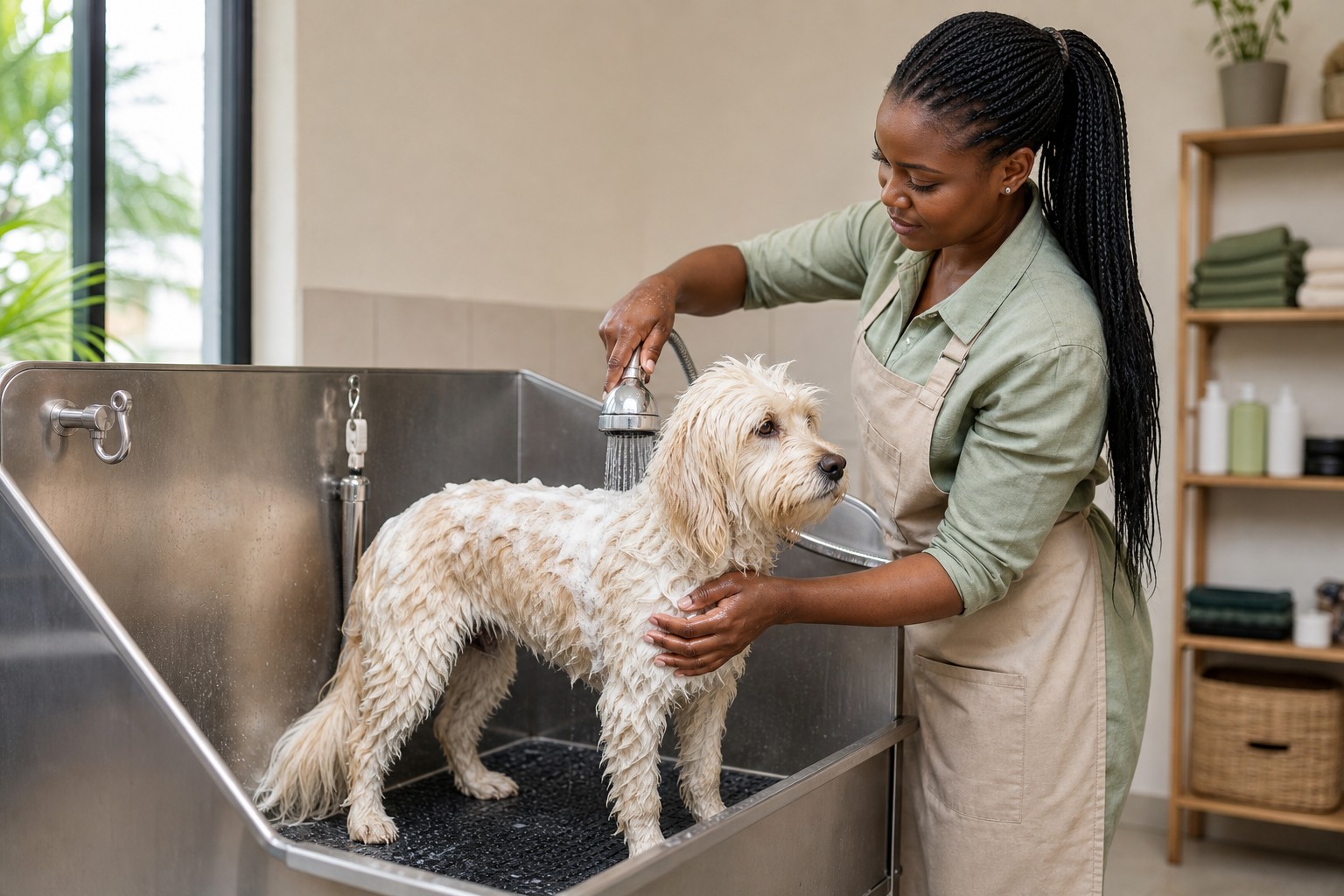
A grooming salon works with a client who orders and an animal who undergoes. That imbalance defines the trade: the service is bought by one party, performed on another, and its success is measured as much by the state of the coat as by how the animal walks back through the door next time.
What is handed over, and what comes back
The owner hands over an animal, a deadline and expectations, often framed by an image — a photograph found online, the memory of a previous cut, a breed seen elsewhere. The work starts by turning that into something achievable on this animal, with the coat it has today.
What is handed back at the end is not only a clean animal. It is also information: what was done, what could not be done, what was noticed, what was interrupted and why. A salon that returns a clipped dog without a word leaves the owner to discover a patch of redness or a reaction on their own.
Many salons ask for vaccination to be up to date: not an administrative formality but protection for the other animals seen that day. Requirements vary between countries and businesses; what matters is that the salon's rule is stated before booking, not discovered at the door.
Booking: the questions that prevent a bad session
A useful booking is not just a time slot. It collects the species, the size, the coat type, the approximate age, what has already been done elsewhere, and above all the history of how the animal behaves during grooming: is this the first time, how did it go last time, what does the animal cope badly with — the clippers, the dryer, water, having its paws or ears touched.
To that is added what the owner declares: a recent injury, an operation, a known discomfort, treatment under way, sensitive skin. This information is not collected to form a medical opinion: it exists to know what to avoid, what to adapt and what to decline.
A serious salon also says what it does not take: many work with dogs and cats and no other species, a cat is not a small dog, and a very fearful animal calls for a particular arrangement. Saying no beats discovering the dead end once the animal is on the table.
The state of the coat decides the service
This is what owners understand least and what causes most disagreements. A maintained coat is washed, dried and cut. A matted coat, whose knots have formed a tight mass against the skin, cannot always be brushed out: pulling at it means pulling at the skin, and the only reasonable outcome is sometimes to clip shorter than wanted.
That is established on arrival, shown to the owner, explained and decided with them — before starting, not afterwards. Any supplement is stated at the same moment. What makes a service vary can be identified: species, size, density and condition of the coat, time spent de-matting, the cut requested, added care, travel where there is any. No reference rate holds from one city to another.
The choice of products follows the same logic: a short coat, a long coat and a curly coat are not washed the same way, and an unsuitable product irritates. The salon chooses according to the coat and to what the owner has flagged, without turning that choice into health advice.
The session: prepare, wash, dry, finish
The order of work is stable. You brush and de-mat before wetting, because water tightens knots. You wash and rinse thoroughly, since an incomplete rinse itches more than a dirty coat. You dry, the longest stage and often the one animals like least, because of the noise and the blast. You finish with the cut, where one is planned.
Around that order comes handling: announced gestures, room left to the animal, holding without constraining, regular pauses rather than pushing through. No forced restraint, no calming product: a sedative belongs to a veterinarian, never to a salon.
The environment counts as much as technique: an animal that hears others panicking panics too. Working quietly, limiting how many animals are present, separating species are organisational choices that decide the rest. A short first session, with no cut, only to let the animal discover the place, is often the best investment in a fearful animal.
Stopping: the most important professional move
An animal in a panic is not brought under control, it gets worse. The skill lies in recognising the moment a session can no longer go on properly, stopping, calling the owner and offering a gradual restart — rather than finishing the cut because it is half done.
The risk of being bitten is part of the trade and is managed by organisation more than by force. The World Health Organization points out that an animal bite is a reason to seek medical care, even when it looks minor. For a salon that gives three rules: collect the history before accepting, do not work alone with an animal flagged as a biter without having arranged for it, and, if a bite happens, get the person treated and record the facts.
Turning work down is part of the job: an animal too stressed, a coat in a state that would make the work painful, a request that would amount to a veterinary act. A refusal that is explained is understood; a forced session is paid for in all the ones that follow.
What a groomer sees, and does not conclude
A groomer spends an hour with their hands in an animal's coat: they are well placed to notice redness, a scab, a wound, a lump under the skin, a smelly ear, a limp, weight loss, visible parasites. That observation is valuable, and it is where their role stops.
They offer no diagnosis, do not medically interpret what they see, recommend no medicine and change no treatment. What they do is more useful: they tell the owner, factually, what they found and where, and suggest seeing a veterinarian. An external antiparasitic product is applied only where the owner has asked for it or it has been prescribed, never chosen at the salon as health advice.
The same caution applies to food and to behaviour: a salon can report what it observed during the session, it does not build a feeding plan and does not conclude from a flinch that an animal has been mistreated. Behaviour is observed and described; on its own it proves no story.
The salon, the equipment and the journey
A salon takes in, one after another, animals that do not know each other: equipment hygiene is a professional question, not a matter of looking clean. World Health Organization guidance on cleaning and disinfecting surfaces comes down to a principle that transfers here: clean first, disinfect after, deal first with what is actually touched — table, bath, leads, brushes, blades and combs between animals. The detail of products belongs to the manufacturer and to trained staff, not to an article.
The same organisation also points out that some diseases pass from animals to humans. A salon has no reason to make that frightening: it draws ordinary gestures from it — washing hands between animals, covering a wound, cleaning what has been touched.
Where the salon offers collection and return, the journey is part of the service: a carrier suited to the animal, a ventilated vehicle never left in the sun, a limited duration, handover to the owner or someone they have named. What is written down — times, who may collect the animal, what to do if something happens, which veterinarian to call — prevents difficult conversations.
Finally, digital tools help without replacing: booking, reminders, a file per animal, photographs published with the owner's agreement — client details and any reported health issue staying in the file. An artificial intelligence tool can organise a schedule or draft a description; it does not see the animal and cannot judge whether a session should stop.
In the African context
Working conditions vary a great deal between countries, cities, neighbourhoods and income levels: there is no single African grooming market, and two neighbourhoods in the same city have neither the same clientele nor the same relationship with pets.
The first reality is the clientele. Depending on the city, it is made up of urban households attached to companion dogs and cats, of owners of guard dogs whose upkeep answers different expectations, and sometimes of an expatriate clientele with different habits. These demands call for neither the same services nor the same conversation.
The second is supply. Depending on the market, suitable shampoos, blades, clippers and spare parts are imported, intermittently available and expensive. Hence equipment chosen to be repairable, blades maintained rather than replaced, and the habit of not promising a service that depends on an uncertain product.
The third is water and electricity. A salon washes, rinses and dries: a cut at the wrong moment leaves an animal wet and stressed. Many businesses organise around it — a water reserve, adapted hours, drying planned another way — and that organisation is part of the service.
The fourth is access to veterinary care. Depending on the neighbourhood, the salon is sometimes the professional who sees the animal most regularly, which creates a temptation: advising beyond your scope. The opposite reflex applies — know which veterinarians can be reached, and refer.
The fifth is structuring. International Labour Organization work on the informal economy shows that a large share of service activity operates without registration or social protection. Formalising, where the local framework allows, opens access to clients who ask for an invoice, to partnerships with clinics, and to insurance for the activity. It rests on simple things: written terms, a file per animal, receipts, and a record of what was done.
What a grooming salon does not promise
It does not promise a cut identical to a photograph: the coat it has is not the one in the image. It does not promise to de-mat a felted coat without clipping. It promises no opinion on an illness, no treatment product, no sedative. It does not promise that a fearful animal will be relaxed the first time, nor that the session will run to the end.
What it can promise is verifiable: questions asked before booking, the state of the coat established and shown, a price stated before starting, handling without constraint, a stop when the animal is not coping, equipment cleaned between animals, an account of what was done and noticed — and a referral to a veterinarian as soon as the question leaves its trade.