
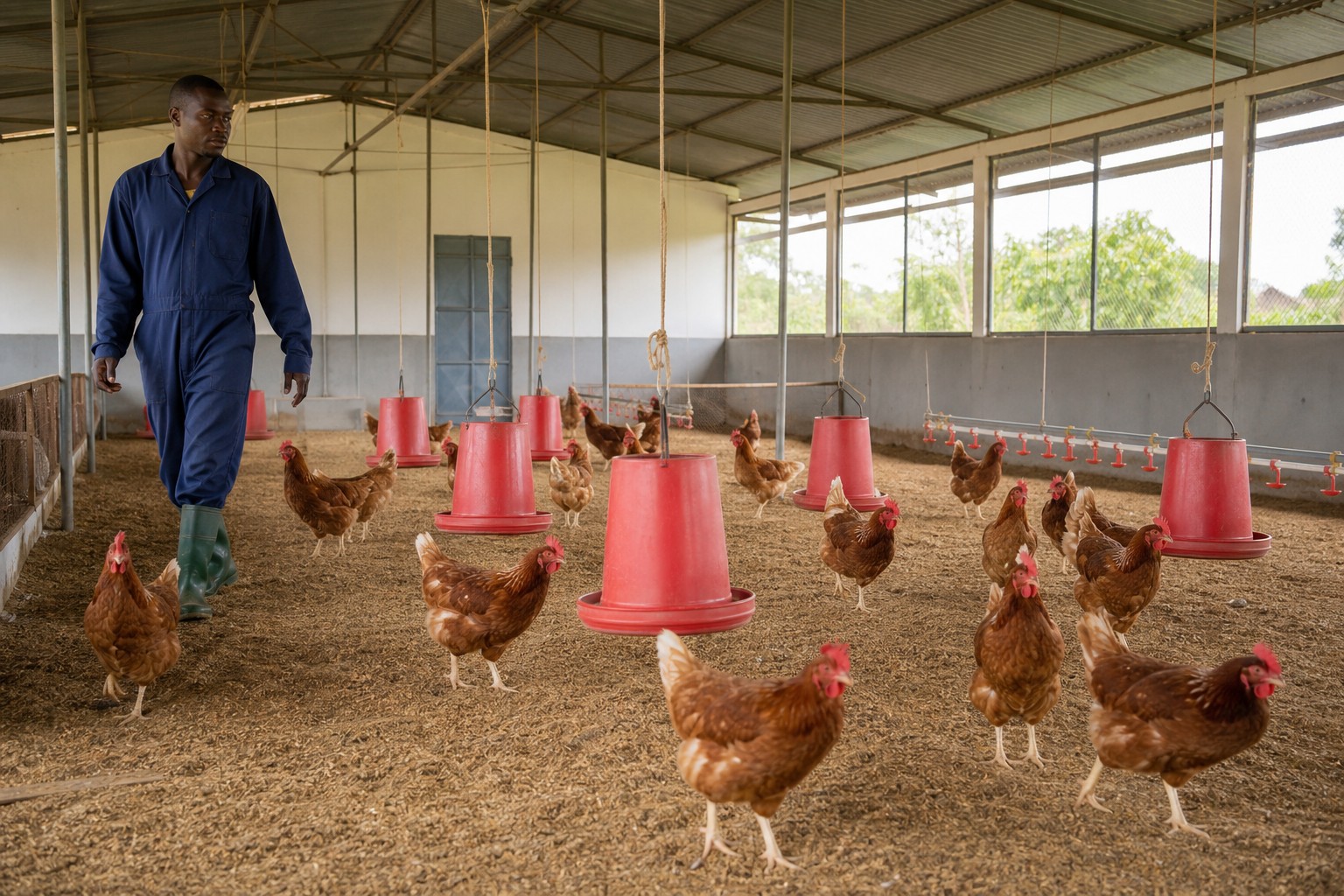
When a batch leaves the farm, there is nothing left to show. The buyer — a butcher, a restaurant, a reseller — will still have to answer their own customers about what they are selling. The whole trade sits in that gap: weeks of work survive only in the form of what was written down.
A trade judged on what can no longer be seen
Livestock farming produces live animals or products of animal origin for buyers who will resell or serve them. The client is therefore almost never the final consumer, and that changes the nature of the demand: a butcher buys consistent weights and an origin they can name; a restaurant buys even batches, because it portions; a reseller buys predictable availability.
What the farmer sells is not only the animal. It is also the information that comes with it — where it came from, what it ate, what happened to it. A professional buyer needs that information to keep their own commitments, and a farmer who cannot supply it loses part of the market without always understanding why.
The FAO points out that the livestock sector covers very diverse situations, from large integrated chains to hundreds of millions of small-scale producers and pastoralists. There is no single model: there are farms that know what they are doing and farms that do not, at every size.
The batch: a unit of time, place and responsibility
Work is organised in batches: a group of animals placed together, reared together and moved out together. That unit structures everything — preparing the buildings, ordering feed, the workload, cash flow and the predictable date of sale.
A batch begins before the animals arrive: cleaning and repairing the buildings, checking drinkers and feeders, checking ventilation, preparing bedding where there is any, securing feed and water. It ends after they leave: a sanitary break, cleaning, and a written account of what happened.
Working in cycles also allows comparison. A farmer who records results batch after batch — consumption, mortality, weight at exit, incidents — sees trends that no general impression would reveal.
Buildings, water and space
Housing decides much of the rest. A building has to protect from sun, rain and predators, stay ventilated without exposing animals to draughts, and allow genuine cleaning between batches.
Water is the resource whose absence is paid for fastest. It has to be permanently available, clean, and reachable by all the animals at once — too few drinking points create competition that penalises the weakest before anyone notices.
Stocking density does not transfer. How many animals a building can hold depends on the species, the stage, the type of building, the climate and the locally applicable rules. What is constant is the mechanism: beyond a certain point, overcrowding degrades conditions, increases health problems and pushes towards more treatment. A farmer who stocks lighter is not being philanthropic; they are avoiding an expensive chain of consequences.
Feed: knowing what you are giving
Feed is often the largest cost, and it directly determines what the animal will become. Making part of the ration on site, where possible, means knowing what is in it; buying it ready-made means finding out about the supplier.
Either way the same requirements hold: knowing where the raw materials come from, checking their condition on arrival, storing them dry and away from pests, rotating stock, and setting aside any suspect batch rather than "using it up". The FAO devotes an entire platform to feed safety, a reminder that ration quality is a health issue and not only an economic one.
This article gives no ration, no formula, no calculation by weight and no recommended supplement. Requirements depend on the species, the stage, the production system and the materials available locally; they are settled with an animal nutrition professional or a competent technical service, not with a general text.
Watching every day, and knowing what you may not conclude
The daily round is the central act of the trade. You look at whether animals eat and drink normally, how they spread out in the building, whether they are calm or restless, whether the bedding or floor is changing, whether one individual keeps apart. Those observations only mean something compared with yesterday's, which means writing them down.
Faced with an abnormality, a farmer who is not a veterinarian has legitimate and clearly bounded moves: separating according to appropriate procedures, tightening hygiene precautions, suspending certain operations, documenting what is observed, and contacting a competent veterinary professional.
What they do not do is just as clear. They do not diagnose, do not prescribe, do not choose a medicine, do not set a dose and do not build a treatment schedule. Those acts belong to the veterinarian, and going around them exposes the animals, the farm and the buyer.
One point deserves understanding rather than enduring. The World Health Organization notes that antimicrobial resistance is rising and that inappropriate use contributes to it. For a farm that becomes a simple rule: treatments follow a veterinary decision, they are recorded, and the withdrawal periods given are observed before any sale or consumption. That is what protects the buyer, and in the end the whole sector.
The register, and why it is worth more than a word
The batch register is the document that turns practice into evidence. It records placement dates, the origin of the animals, the feeds used and their batch numbers, veterinary interventions, mortality, incidents and the date of exit.
Its value lies in its continuity: a register filled in the same day is worth something, a register reconstructed after the fact is worth nothing. It is also what allows a problem noticed downstream to be traced back to a period, a feed batch or a supplier — something no memory can do.
The World Organisation for Animal Health publishes a terrestrial animal health code that serves as the international reference on animal health and welfare; the concrete obligations, though, come from the law of the country where the farm is established. A farmer finds out about their own framework: required registers, declarations, and conditions of transport and sale differ from one country to another.
Biosecurity: what comes in, what goes out, who moves around
Biosecurity is not administrative vocabulary, it is an organisation. It means limiting and ordering movement: controlling who enters the buildings, keeping dedicated footwear or clothing, avoiding going from young animals to older ones in the same round, cleaning shared equipment, keeping pests out and observing a sanitary break between batches.
It has a commercial reason as much as a health one: buyer visits are useful — a buyer who comes to look buys better — but they are arranged, with the usual precautions, rather than happening at random.
Selling: weighing, quoting, batches and the cold chain
Selling calls for the same rigour as rearing. Weighing in front of the buyer, a properly identified batch, a quotation announced for the period and a document handed over on delivery are enough to build a lasting relationship.
Prices follow the market and the cost of feed; they are set neither in advance nor universally, and no income can be announced as secured. What can be controlled is regularity and honest presentation.
One boundary deserves stating. Selling a live animal, having it slaughtered, and processing it are three distinct activities, subject to different rules depending on the country — slaughter under authorised conditions, cold chain, suitable premises. A farm that crosses one of those steps enters another trade and takes on its obligations, not merely its revenue.
In the African context
Talking about "African livestock farming" has no working meaning. A poultry unit on the edge of a capital city and a herd moved across hundreds of kilometres of dry country share neither calendar, nor buyers, nor risks. The FAO makes the same point: the sector runs from integrated chains to hundreds of millions of small-scale producers and pastoralists.
One variable nonetheless dominates many situations: feed. Its cost and availability, particularly for protein-rich materials, govern the margin and shift with seasons, harvests and market rates. A farmer who does not know what a batch cost them finds out too late that they worked at a loss.
Then comes a gradient of access. Depending on the distance to a town, reaching a veterinarian, having a sample analysed or finding a spare part is either routine or an expedition. That gradient decides what it is reasonable to attempt: running tight batches far from any technical support is a gamble, not a strategy.
The cold chain, finally, governs the form of the sale more than the production itself. Where it exists and the electricity is steady, selling slaughtered and packed opens access to restaurants, shops and caterers. Elsewhere, selling live remains the safer option, and pretending otherwise invites losses nobody recovers.
These contexts do share one thing, more modest: everywhere, a professional buyer prefers a supplier whose origin they can name and whose batches hold no surprises. That is exactly what a register makes possible, whatever the size of the unit.
What a livestock farm does not promise
It does not promise a yield, an exit weight or a survival rate. Those results depend on the species, the animals placed, the feed, the climate, the housing, the management and health events that no management removes entirely.
It does not promise a price or an income: feed cost and the market decide. Nor does it promise a quantity it will not have — announcing a volume you cannot deliver costs more, in the end, than telling the truth a week ahead.
Finally, a livestock farmer stands in for no neighbouring trade: not the veterinarian, who diagnoses and prescribes, not the animal nutritionist, not the slaughterer, not the butcher, not the processor. What they can commit to takes few words: animals properly housed and fed, observations made every day, and a register the buyer can read.