
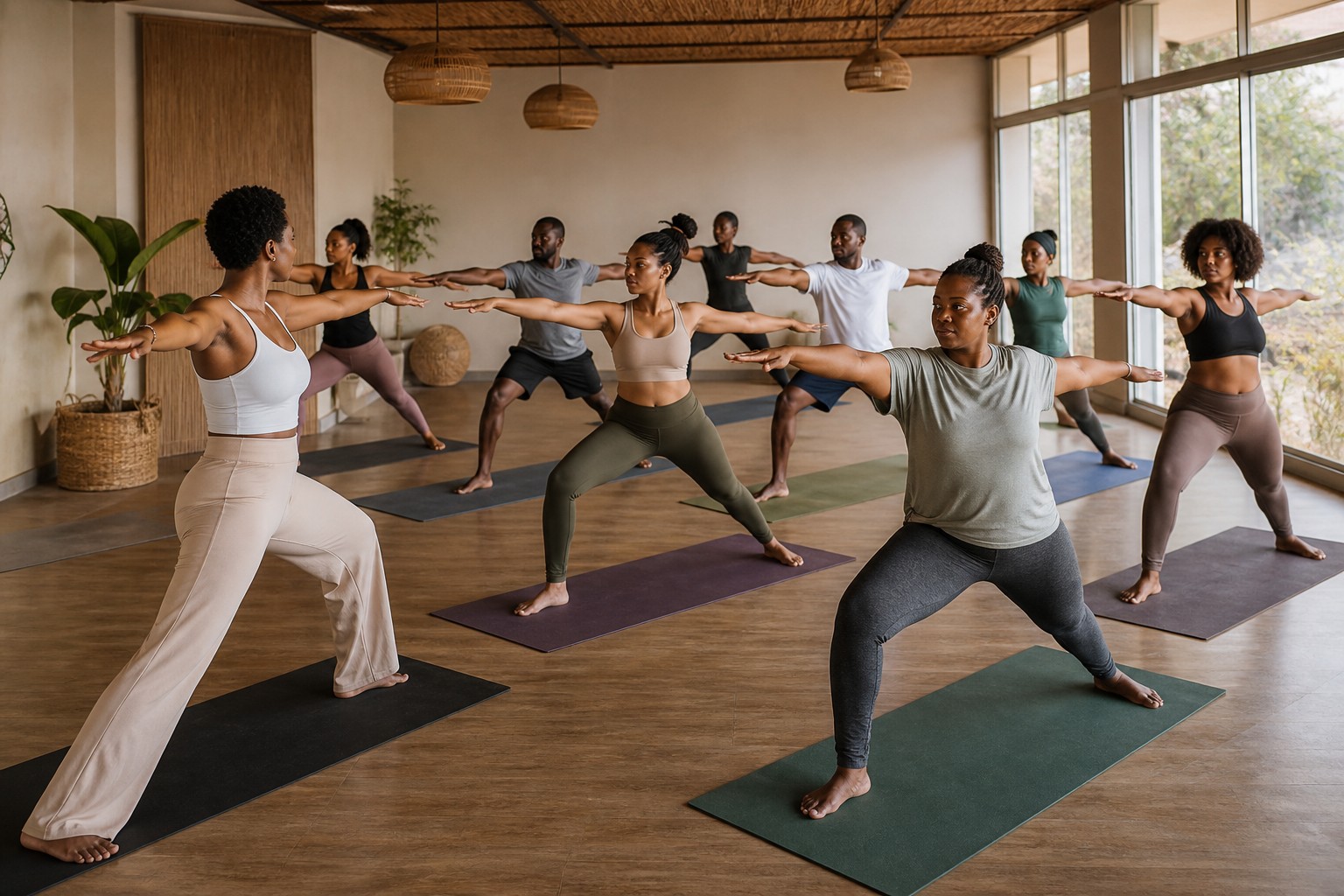
A yoga class is imagined as a sequence of postures. From the trade's point of view it is first an organisation: a space, an hour that holds, a group small enough for everyone to be seen, equipment available, and a teacher able to offer something else to the person the first proposal does not suit. The rest — the atmosphere, the calm — follows from that organisation rather than preceding it.
A studio, a teacher, a class: what is being sold
Three things sit under the same name. The studio is a place: it opens, it heats or ventilates, it tidies, it cleans, it keeps a schedule. The teacher is a skill: they design a session, adapt it to whoever turned up that day, and watch. The class is the product: a length, a stated level, a style of practice, a number of places.
The distinction is not theoretical. A studio hiring self-employed teachers and a teacher renting a slot in a studio have neither the same obligations, nor the same income, nor the same relationship with students. What has to be clear to the student is who answers for what: for taking payment, for a cancelled class, for the state of the equipment, for replacing an absent teacher.
The formats sold differ too: a regular group class, a one-to-one session, a one-off workshop, a session run for a company or an association. Each calls for different preparation and is not billed the same way.
The first class, and the sentence heard most often
"I'm not flexible enough." By far the most common sentence at a studio's door, and it rests on a misunderstanding: flexibility is a possible result of the practice, not a condition of entry. A studio that cannot answer that sentence loses half the people who might have started.
In practice, the welcome means asking about experience — including "none" — what the person is looking for, and the constraints they declare: known pain, operations, a medical condition being followed, pregnancy where relevant. That collection is not there to judge; it is there to know which variants to offer and when to refer on.
It also serves to put the person in the right class. A complete beginner in a fast session spends the hour watching everyone else; they do not come back. Stating a class's real level honestly beats a schedule promising that everything suits everyone.
Adapting rather than grading
The heart of the trade rests on a simple idea: a posture is not a mark. Every proposal exists in several forms — with a support, with a prop, with reduced range, or replaced by something else. The teacher's job is to give those variants at the same time as the main proposal, not to keep them for those who fail.
That holds for everyone. A stiff body, a tired body, an older body, a body just out of surgery, a body carrying a pregnancy, a body living with a disability: none is a special case, and none is to be commented on. You ask what is possible, you listen to the answer, you offer accordingly.
One rule protects everybody: nobody should be trying to look like their neighbour on the next mat. A teacher who installs the opposite idea manufactures injuries and drop-outs.
What yoga is not
This is the most important boundary of the trade, because the surrounding talk crosses it constantly.
A yoga studio offers physical activity and a quiet hour. It provides neither care, nor treatment, nor psychotherapy. It does not take charge of a condition, does not stand in for any medical follow-up, and passes no judgement on a pain that has set in. A teacher who claims otherwise has left their scope, whatever their intentions.
The World Health Organization points out, in its mental health fact sheet, that mental health belongs to care systems and trained professionals. A physical practice can sit alongside everyday life; it is not a course of treatment, and presenting a class as an answer to a disorder would be both false and dangerous.
The practical rule is simple: when someone describes a pain that is settling in, feeling unwell, a worry about their health, or a situation beyond what a class can hold, the teacher stops, adapts, or refers to a health professional. They do not offer reassurance in place of someone whose job that is.
Adjusting a posture: asking before touching
Yoga is one of the few practices where touch is part of ordinary teaching. It therefore has to be framed explicitly.
A teacher says at the start of the class that they may offer an adjustment, explains what that involves, and gives a simple way to decline — a word, a gesture, a card placed on the mat. Declining needs no justification and changes nothing about the rest of the class. An adjustment is announced as it happens, kept to what was announced, and stopped the moment it is refused.
That framework protects the student, but it protects the teacher too: it makes explicit what would otherwise stay implicit. No familiarity, no remark about a body, no photograph taken during a class without agreement: these are house rules, set once and applied to everyone.
Loaned equipment, the space and the group
A studio usually lends what is needed to practise: mats, blocks, straps, bolsters, blankets. That equipment is shared, which means cleaning it between classes, checking it, and withdrawing anything that slips or tears. Lending equipment is not a neutral choice: it is what allows someone to come without buying anything.
The space counts as much: a floor that does not slip, real ventilation, light that can be lowered, storage that nobody has to step over. Group size is decided by the space available and by the teacher's ability to see everyone — not by the occupancy hoped for. No number holds everywhere: what holds everywhere is that a class where nobody is seen has stopped being a class.
Passes, schedule and the life of a studio
What makes a price vary is identifiable: length, group or one-to-one, the place, travel, equipment made available, preparation for a particular workshop, renting a space. No reference rate exists, and a multi-class pass does not compare with a single session.
What has to be written down comes to a few lines: how long a pass is valid, what happens if the studio cancels a class, if a booked place goes unused, if a teacher changes. Cancellation and refund rules depend on the local framework: the studio states its own rather than invoking a universal custom.
The rest is ordinary organisation: a stable schedule, reminders, a way to sign up other than online, a student file kept with restraint — a declared health constraint is sensitive data, and has no business circulating. Digital tools help hold a schedule and send reminders; they do not fill a class. An artificial intelligence tool can draft an intake questionnaire or sort requests, but it watches nobody practise and does not know which variant to offer to whom.
In the African context
Conditions vary a great deal between countries, cities, social settings and income levels: there is no single African way of practising yoga, and two studios in the same city do not address the same public.
The first reality is where the practice sits in the local offer. Depending on the city, yoga happens in a dedicated studio, in a multipurpose room rented by the hour, in a hotel, in a company, in an association or outdoors. The dedicated studio is not the norm everywhere, and many teachers start by renting a slot somewhere else.
The second is the public. Depending on the market, students are people looking for a gentle activity, company employees, people sent by word of mouth, sometimes visitors passing through. Perceptions weigh: in some settings yoga is seen as reserved for one milieu or one gender, and much of a studio's work consists in disproving that through its welcome rather than through argument.
The third is the cost of entry. Imported equipment weighs on the initial investment, and the rent of a quiet space in a city weighs more still. Lending equipment then becomes a commercial decision as much as a convenience: it lowers the barrier for those who cannot buy a mat.
The fourth is training. Depending on the country, teaching certifications exist, overlap, or are not recognised, and nothing is harmonised. Qualification is therefore shown through the way you teach, through references, and through the ability to say what you do not do.
The fifth is the opportunity, and it meets a public policy. The World Health Organization's global action plan on physical activity calls for multiplying the occasions people have to move, particularly for those who move little. Practices that are accessible, light on equipment and workable in a modest space have an obvious place there — provided they are offered without jargon, without promises and without intimidation.
What a yoga studio does not promise
It promises no bodily transformation, no timeframe, no measurable result. It does not promise flexibility, which depends on too many things. It promises neither serenity nor recovered sleep: a pleasant practice is not a treatment. It passes judgement neither on a pain, nor on an illness, nor on psychological follow-up, and it refers to a health professional when the situation calls for it.
What it can promise is verifiable: a class that starts and ends when it said it would, a level stated honestly, a variant for every proposal, an adjustment asked for before it is made, clean equipment in good condition, a space where you can be seen without being exposed, and written terms.