
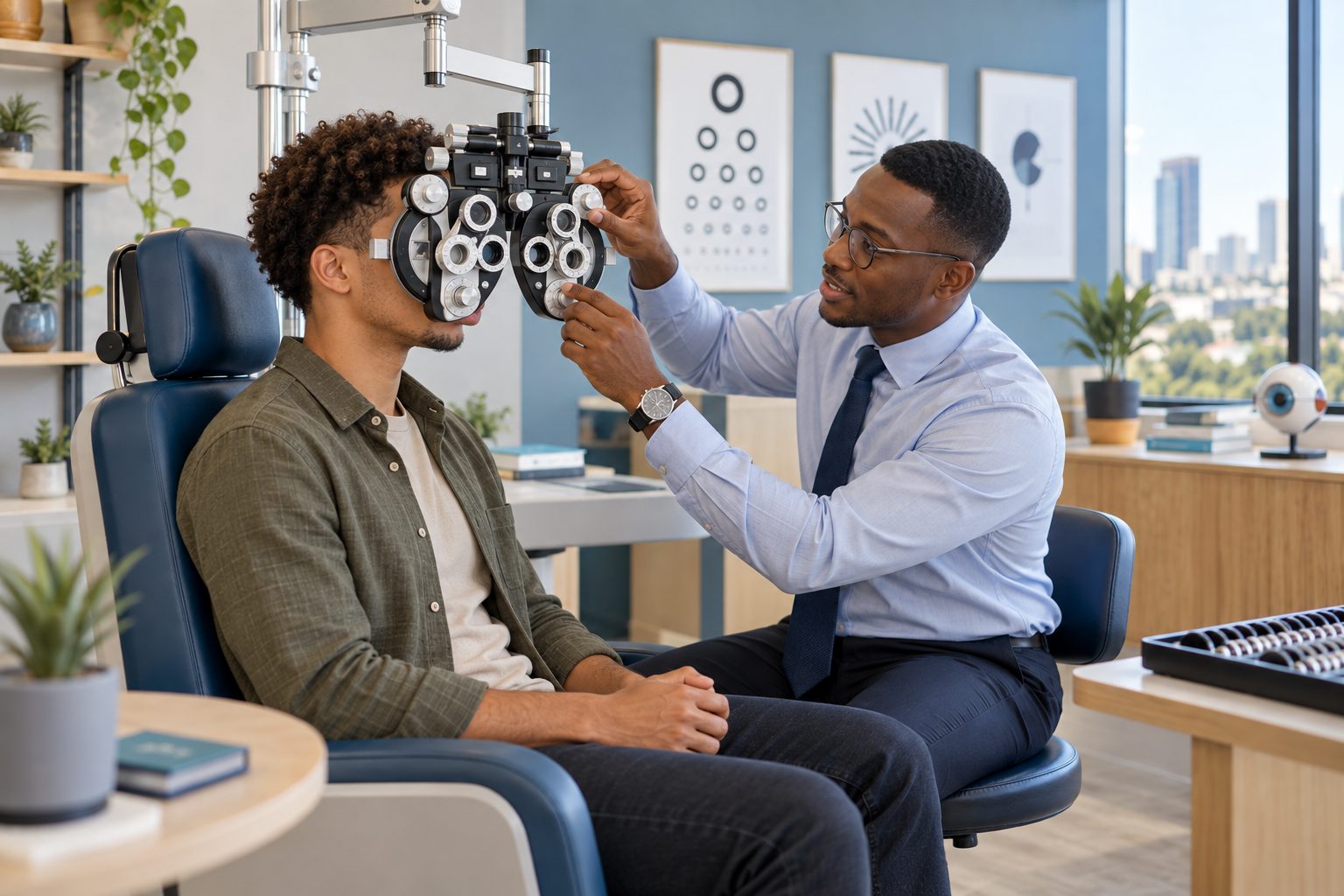
The optometry practice is the least understood of the eye-care professions, because it sits between two others everyone recognises: the physician who treats and the optician who sells. The World Council of Optometry defines optometry as an autonomous, educated and regulated healthcare profession whose practitioners are primary providers of eye and vision care. In practice, what the word covers depends on the country: where the profession is recognised, the optometrist performs a full vision examination, screens for anomalies and prescribes a correction; where it is not, or only partly, their field is limited to measurement and advice. An honest practice begins by saying in which framework it operates.
What an optometric examination contains
The examination starts with a conversation: reason for the visit, discomfort felt, visual and general history, glasses or lenses already worn, occupation and working distances. Then come the measurements: distance and near visual acuity, refraction — objective with an instrument, subjective with the phoropter and the letters the patient reads —, vision with both eyes together, balance of the eye muscles, sometimes intraocular pressure and observation of the eye with the instruments the practice owns. The optometrist compares each result with what the patient describes and with their previous measurements when available.
This examination has a purpose: to say whether vision can be improved by a correction, which one, and whether something observed must be seen by a physician. Its purpose is not to name a disease. An optometrist who finds a raised pressure, an opacity, an abnormal fundus or a loss of vision that correction does not explain notes what they saw and refers — they do not conclude.
What the document handed to the patient says
The patient leaves the practice with something in writing, and what it contains depends on the legal framework. In countries where the optometrist is entitled to prescribe, it is an optical prescription: it states the correction for each eye, the type of lenses advised, sometimes the working distance, and any optical store can make it up. Elsewhere, it is a measurement report, which must be validated or completed by a recognised prescriber before it becomes a prescription. In every case the document carries the date, the practitioner’s name and the measurements themselves, so that another professional can read them again.
The practice tells the patient clearly which of the two documents it is handing over. Presenting a report as a prescription, in a country where the law does not allow it, exposes the patient to being refused their lenses, and the practice to prosecution.
When the optometrist refers to a physician
Referral is not an admission of helplessness; it is an act of the trade, and one of the most useful. Any pain, any persistent redness, any sudden loss of vision or one unexplained by refraction, any recent double vision, any anomaly observed during the examination, any patient with a general illness known to affect the eye — diabetes, hypertension — is sent to an ophthalmologist or a hospital department, with a letter summarising what was measured and observed. WHO’s World report on vision insists on integrated eye care, where each level knows what it does and whom it sends to: in that scheme, the optometry practice is the level that sees many people and spots what must go higher.
A serious optometrist therefore knows, in their city, the ophthalmologists and departments they refer to, and does not hold on to a patient who should be elsewhere for the sake of selling them a pair of glasses.
Contact lenses, children’s vision, low vision: the services that require their own training
Beyond refraction, some practices offer contact-lens fitting, children’s vision examinations, the retraining of certain visual functions or support for people whose vision remains poor despite every correction. Each of these services demands its own training, equipment and, often, regulatory framework. A practice that offers them can say where its competence comes from; a practice that does not offer them refers to those who master them. Contact-lens fitting in particular does not come down to selling a box: it involves trials, tolerance checks, hygiene education and follow-up.
The practice and the optical store: two trades, sometimes under one roof
In many cities the optometrist works in an optical store or owns one. Nothing forbids it where the law allows, but it creates a situation the patient must understand: the person measuring their sight has an interest in their buying glasses. The practice that handles this with integrity hands over a prescription or a report usable elsewhere, does not make the examination conditional on a purchase, and separates the act of measurement from the sale of equipment on its invoice. The patient remains free to have their correction made wherever they wish.
Conversely, the optometrist is neither the dispensing optician — they do not mount lenses or fit frames, unless they also practise that trade — nor the ophthalmologist, who alone diagnoses and treats diseases of the eye. Three trades, three responsibilities, and the best proof of a practice’s competence is being able to say which one is its own.
How the practice earns its living
The practice charges for the examination — per act, at a fee announced before the consultation — and, where it offers them, for specialised services billed separately: contact-lens fitting, a child’s vision assessment, follow-up. Where the act is covered by an insurer or a public scheme, the practice states what remains payable by the patient. It publishes no fee presented as that of “optometry” in general: the price depends on the practice, the examination performed, the place and the patient’s cover.
A practice that lives from the examination, not from sales, has every interest in accurate measurements and relevant referrals: it is its reputation with the optical stores that make up its prescriptions, and with the physicians who receive its patients, that fills its diary.
Equipment, hygiene, records
A phoropter, a chart projector or screen, an autorefractor, a tonometer where measuring pressure is permitted, a slit lamp to observe the eye: the equipment of an optometry practice is that of measurement, and it must be calibrated. Instruments in contact with the face are disinfected between two patients; acuity charts are displayed at the intended distance and under the intended lighting, otherwise the measurement is wrong. The patient’s file keeps successive measurements, which makes it possible to see a trend — and it is often the trend, more than a single value, that justifies a referral.
In the African context
Two practices of equal competence, on either side of a border, do not hand over the same piece of paper. From one country of the continent to the next, optometry is sometimes a fully recognised health profession, with university training, a professional body and the right to prescribe, sometimes a tolerated activity without status, sometimes unknown to the law. It is the legal recognition of the profession that governs everything else: the optometrist must know their framework and explain it to their patients — what their document is worth, what they may measure, where they must stop.
Numbers weigh too. WHO records a shortage of eye-care professionals and very uneven coverage of refractive errors; its SPECS 2030 initiative aims to extend access to quality refraction services. In countries where ophthalmologists are scarce, the optometrist is often the first — sometimes the only — trained person a patient with poor sight meets. That gives them a considerable screening role, and a responsibility: to spot, among hundreds of requests for glasses, the cataract, the glaucoma or the retinopathy that must be sent higher, and to know where to send it.
Training too varies: schools of optometry exist in some countries of the continent and not in others, and practitioners trained abroad return with skills that local law does not always recognise. A practice that displays its training, its framework and its limits does a service to the whole profession, which in many countries is being built at the same time as its status.
A day at the practice
In the morning, a schoolgirl whose teacher finds her too close to the board: measurement, simple correction, prescription or report depending on the country, explanation to the parents. Then a middle-aged man who can no longer read the paper: presbyopia, advice on the type of lenses, referral to the optical store of his choice. Around midday, a diabetic patient who came “for glasses”: refraction does not explain everything she describes, observation shows something, a letter for the ophthalmologist, an appointment made before she leaves the practice. In the afternoon, a contact-lens wearer for his check, a teenager worried about a red eye who will not be measured but referred the same day.
Four measurements, one urgent referral, two different documents: that is an optometry practice that knows its trade.