
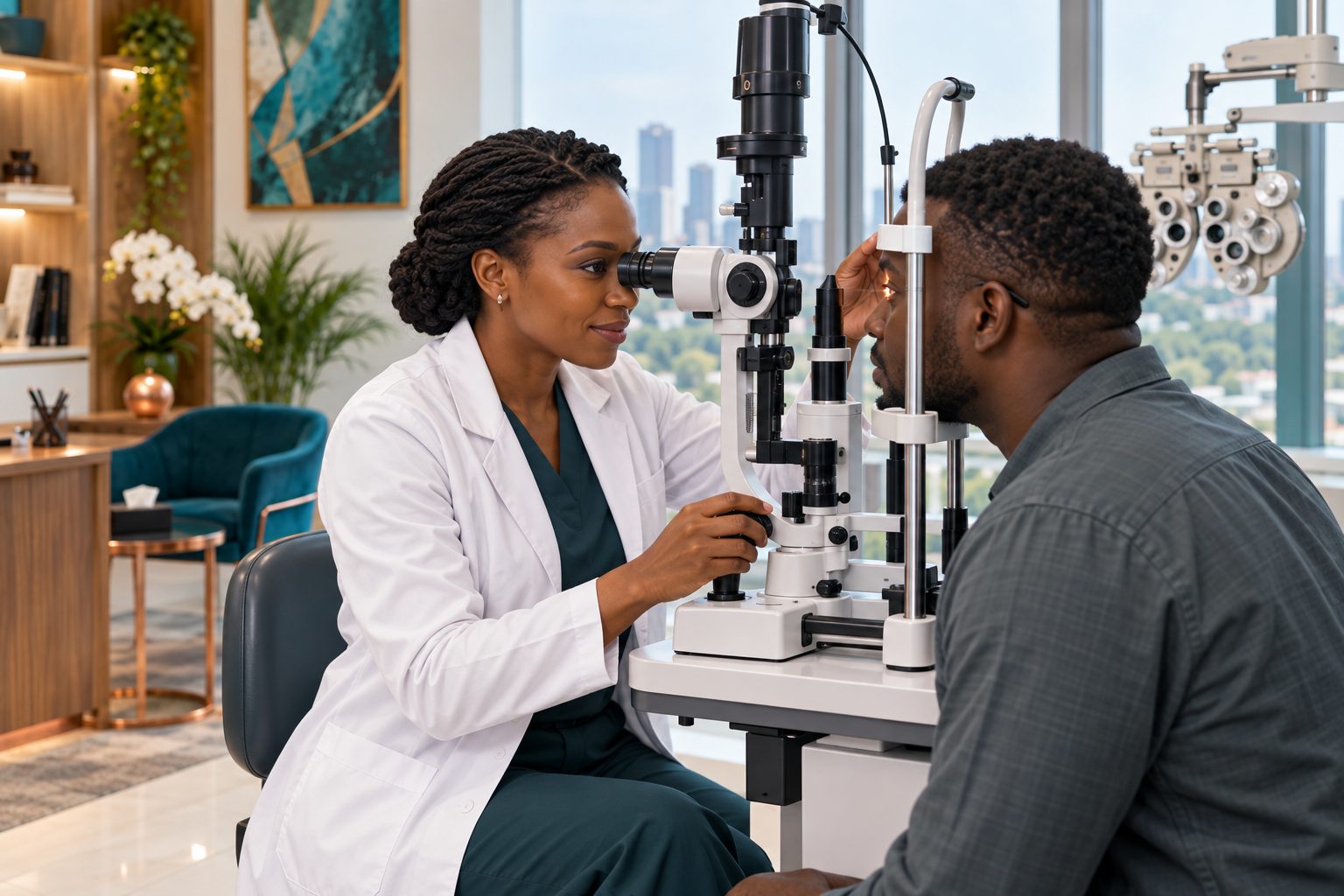
A patient whose sight is getting worse generally does not know whether they need glasses, an examination or a treatment. That is what the ophthalmology practice is there to determine. The ophthalmologist is a physician: the consultation ends in a diagnosis, and that diagnosis decides what follows — a simple optical correction, a treatment, monitoring, a surgical procedure or referral to another service. Everything the practice organises around it, from booking to the written report, serves that medical decision.
What an ophthalmology practice takes on
The reason for coming is almost always a symptom or a worry: reduced vision, a red eye, pain, discomfort in bright light, a child squinting, an adult who can no longer read close up, a general illness known to affect the eye. Added to these are check-ups without symptoms, requested by another health professional or by the patient, and the follow-up of people already under treatment.
The practice answers these requests through the medical consultation and through the examinations its equipment allows. Measuring sight and refraction is part of it, but only one element of the examination: the ophthalmologist also looks at the surface of the eye, the back of the eye, the pressure inside the eye where indicated, and relates every finding to the patient’s history. According to WHO, the leading causes of vision impairment worldwide are uncorrected refractive errors and cataract — the first is often a matter of a pair of glasses, the second of surgery. Telling one from the other, and detecting what sometimes hides behind an ordinary loss of vision, is the heart of the act.
A patient’s path, from reception to the written report
Booking fixes the reason for the visit, the age and, where possible, the useful history: diabetes, hypertension, current treatment, glasses already worn. On arrival, reception checks identity, collects documents — earlier prescriptions, test results, a colleague’s letter — and warns the patient about what is going to happen, especially if drops that dilate the pupil are to be used: they blur vision for several hours and rule out driving home.
The consultation itself unfolds in several stages whose order depends on the reason for the visit: history taking, measuring visual acuity, refraction, slit-lamp examination, further tests if the practice’s equipment allows, otherwise a request for tests to be done elsewhere. It ends with an explanation to the patient — what was found, what it means, what is proposed — and with a written document: a prescription for corrective lenses, a treatment prescription, a test request, a referral letter or the date of the next check. A well-organised practice hands over that document at every consultation, even when the conclusion is “all is well, come back in a year”: it is what lets the patient know where they stand and lets the next professional pick up the thread.
Diagnosing, treating, operating: what only the physician does
The boundary between the ophthalmology practice and the other eye-care professions comes down to one thing: the medical decision. The optometrist measures vision and screens; the optician executes a prescription and makes the equipment; the ophthalmologist is the only one of the four who diagnoses a disease, prescribes a medicinal treatment, decides on a procedure and performs it when they are a surgeon. This division is not a matter of prestige: it protects the patient. A red eye may be a harmless conjunctivitis or an emergency threatening sight; only a medical consultation tells the two apart.
The practice is also where the decision is taken not to act. Not every loss of vision calls for surgery, not every visual defect in a child calls for glasses, and a serious practice explains why it proposes to wait as clearly as it would explain why it proposes to intervene. What it does not do either: promise an outcome. Cataract surgery has excellent chances of giving back useful vision, but the practice presents its expected benefits and its risks, not a guarantee.
The equipment and its upkeep
An ophthalmology practice can be recognised by its technical platform: slit lamp, refractor, tonometer, ophthalmoscope, sometimes imaging devices for the retina or the optic nerve, visual field, a biometer before surgery. These devices are medical devices: they must be maintained, calibrated and disinfected between two patients, and the practice knows which ones it owns, which it shares with a neighbouring facility and which require sending the patient elsewhere.
That candour about equipment is part of quality. A practice without an imaging device says so and requests the test outside; one that claims to do everything on site with a limited platform takes a risk with the patient. WHO’s World report on vision stresses the integration of eye care into health systems: in concrete terms, a practice works within a network of laboratories, imaging services, operating theatres and colleagues in other specialties, and it knows the paths through that network.
Prescription, referral, follow-up
Three documents leave an ophthalmology practice, and the patient has every interest in knowing which one they hold. The optical prescription states what the lenses must correct; it is handed to the patient, who freely chooses the optician who will make them up — the practice sells no glasses and steers no one towards a shop. The treatment prescription and the test request are the physician’s and engage their responsibility. The referral letter, finally, sends the patient to a colleague, a hospital department or another professional with the useful elements.
Follow-up is the invisible part of the trade. Glaucoma, diabetic retinopathy, age-related degeneration are monitored over years; a child treated for amblyopia is seen again at precise intervals. The practice therefore keeps a file per patient, reminds them of check-ups, and can retrieve the history of measurements to compare. A patient who moves to another city must be able to leave with a copy of their file.
What a consultation costs, and what is not included
The consultation fee is the physician’s, set within the country’s framework — agreed tariff, free tariff, cover by an insurer or a mutual fund when the patient has one. The practice announces it before the consultation, together with what is not included: further tests done elsewhere, technical acts billed separately, surgery, medicines, and of course glasses, which belong to the optician. A written estimate precedes any scheduled surgical procedure.
The practice quotes no amount on a website or leaflet that would suggest a universal tariff: fees depend on the practitioner, the place, the act and the patient’s cover. What it can say is how the price is made up and when it is communicated.
Hygiene, confidentiality and dignity
A practice touches eyes all day long. Disinfecting the devices in contact with the face, washing hands between two patients, using single-dose drops whenever possible, managing clinical waste are not matters of tidiness: they are measures that prevent passing an infection from one patient to the next. The confidentiality of medical records binds the practice as it binds any health facility, and the way a patient who can barely see is received — guided, told what is about to be done, never left alone in a corridor — says a great deal about the quality of a team.
In the African context
In many countries of the continent, one ophthalmologist serves a population that elsewhere several practitioners would share. WHO’s World report on vision points to a shortage of trained eye-care professionals and to strong inequalities in coverage; the IAPB Vision Atlas lets those gaps be read country by country. In many African cities, the ophthalmology practice is therefore a scarce resource, called upon for everything — from reading glasses to emergencies — and its organisation determines how many people it can actually treat.
That scarcity has a direct consequence for the trade: the ophthalmologist cannot do alone what elsewhere several professions share. They rely on nurses and technicians trained in measurements and screening, delegate what can be delegated, reserve their consultation for diagnosis and decisions, and work with the optometrists and opticians of their city rather than in competition with them. Screening and cataract surgery campaigns, often run with non-governmental organisations or public hospitals, are part of their activity as much as the practice itself.
Then there is cause. WHO notes that in low-income countries a large majority of people who need glasses do not have access to them, and that access to cataract surgery remains very unequal. The practice that knows how to point towards an affordable pair of glasses or a surgery programme renders a service its consultation alone would not. In that context, a well-run practice is often the one that knows the price of lenses in town, the dates of campaigns and the hospital departments that operate — and tells its patients.
What to bring to the first appointment
A patient coming for the first time saves time by bringing their old glasses, earlier prescriptions, the list of current treatments, recent test results and, for a child, the health record. They plan not to drive home if dilation is possible, and to leave with a written document — prescription, letter or check-up date.
They know, on walking in, what they have come for: not glasses, not a measurement, but a medical answer to a question about their sight. That answer, and the way it is explained, is what makes the value of an ophthalmology practice.