
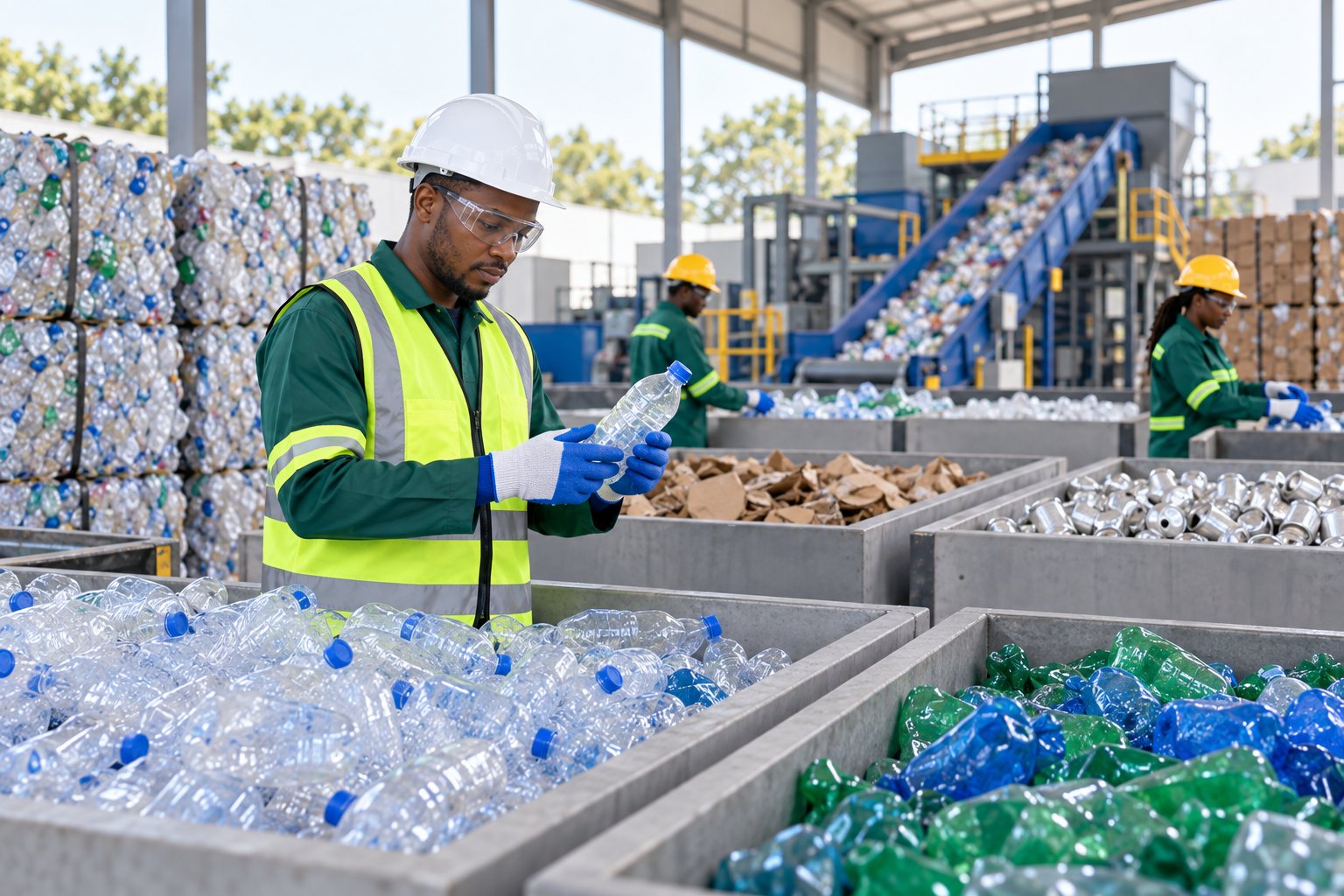
A recycling business lives on the gap between what the material costs it — collection, transport, sorting, cleaning, shredding, compacting, storage — and what the final buyer pays for it: a foundry for metals, an extruder or pellet maker for plastics, a paper mill for cardboard, a glassworks for glass, a refiner for used oils. Those prices move, follow world markets, depend on the quality and quantity delivered, and vary enormously according to whether the buyer is thirty kilometres away or across an ocean. The recycler who does not know their outlets before collecting piles up mountains of unsaleable material; the one who knows them sorts exactly what their buyers want, to the quality they pay for.
The material: what sells, what is given away, what costs
Not all materials have the same value. Metals — aluminium, copper, brass, steel — sell almost everywhere and travel well; that is where many businesses start. Plastics depend on the type: PET bottles and HDPE containers have buyers; light, dirty, mixed films and bags almost none. Cardboard and paper are worth something if dry and clean, nothing if wet. Glass is heavy, sharp and poorly paid: it is only worth recovering near a glassworks. Organic waste — most of the weight of household waste — is composted or digested, with local outlets (agriculture, gardens) rather than a materials market.
The recycler therefore draws up, for each stream, a sheet: who buys, at what quality (cleanliness, sorting by type and colour, bale density, moisture), at what price, in what minimum quantity, with what transport. That sheet decides what they collect, and what they politely decline at the gate.
Collection: the cost nobody sees
Going to fetch material costs more than sorting it. The recycler organises collection around concentrated sources — companies, markets, hotels, building sites, printers, workshops — rather than door to door, whose cost per kilo is very high. They install dedicated containers at their suppliers, train them in sorting at source, and call according to a schedule that fills their vehicles. Collection from households often goes through drop-off points, purchase by weight or partnerships with the independent collectors who already cover the neighbourhoods.
Sorting and preparation: where the value is made
A badly sorted material sells at the price of its worst component. Sorting separates by type, colour and quality; cleaning removes labels, caps, food residues; shredding, compacting or baling reduce volume and ease transport; storage sheltered from rain and sun preserves quality. Each of these operations has a cost in labour, energy and equipment, and the recycler undertakes them only if the buyer pays for them: shredding a plastic the buyer wants in bales is losing money.
Quality control before dispatch — a bale opened at random, a sample checked, a weight compared with the delivery note — avoids the refusal of a whole load on arrival, and the return transport that goes with it.
Hazardous waste: what one does not process oneself
Some streams are not materials like the others. Lead-acid batteries contain a toxic metal and acid; their recovery, transport and recycling are governed by the Basel Convention and by the national laws that transpose it, and their artisanal processing — breaking batteries, smelting lead in the open — has poisoned whole neighbourhoods. Waste electrical and electronic equipment contains precious metals but also lead, mercury, cadmium and flame retardants; the World Health Organization documents the effects of its informal recovery — cable burning, acid baths — on the children and adults who work in it. Used oils, solvents, medical waste, burnt tyres fall into the same category.
A responsible recycler collects these streams if authorised, stores them under safe conditions, and hands them over to licensed channels; they do not process them themselves without the necessary facilities, protections and permits. That refusal is part of their professionalism, and they say so to their clients.
People: protection, registration, dignity
Sorting is manual, exposed work: cuts, punctures, dust, odours, heavy loads, contact with soiled materials, heat. Gloves, footwear, masks, up-to-date vaccinations, water and soap available, breaks, and a workstation organised to avoid bending all day are the minimum. A business that registers its sorters, pays them regularly and protects them keeps a team that knows the materials — and that knowledge is its capital.
The contract and the proof
The recycler also sells a service to companies that must prove what they did with their waste: a consignment note stating the material, weight, date and destination. That document has value for a client subject to regulatory obligations or a responsibility policy, and it justifies a service price on top of the material price. A recycler who cannot say where the waste they collected went is selling only a removal, and their client will discover it on the day an inspector asks for the paperwork.
In the African context
The basic fact, on the continent, is that waste management is largely carried out by people nobody hired: pickers on dumps, cart collectors in neighbourhoods, women sorting at markets, scrap dealers, repairers. UN-Habitat estimates that in many cities a substantial share of solid waste is not collected at all, and that what is recycled is recycled first of all thanks to this informal sector. A recycling business that sets up therefore does not start from nothing: it enters a chain that already exists, with its prices, its territories and its intermediaries.
That imposes a strategic choice. Competing with informal pickers on collection is almost always a losing game — they are more numerous, more mobile and live on margins the business cannot sustain. Working with them — supplying them with bags and scales, buying at a stable, displayed price, training them in sorting, offering them a drop-off point — builds a regular supply and improves their income and safety. The International Labour Organization insists on this gradual transition from the informal economy to protected forms of work; in recycling, it happens through supply contracts, waste-picker cooperatives and protective equipment, not through exclusion.
The second point is that of outlets: the industries able to absorb recycled material — plastic extrusion, paper mills, glassworks, foundries, oil refining — exist in some countries and not in others. Where they are missing, sorted material has to be exported, with the transport costs, permits and price fluctuations that implies; plastic bales piling up for lack of a buyer in the yards of recycling businesses are a common sight. The recycler looks first for local outlets, however modest — bricks and paving from recycled plastic, pellets for moulding workshops, compost for market gardeners, scrap for artisanal foundries —, and collects at scale only what they know they can sell.
Electronic waste and batteries deserve separate attention: volumes are growing fast with household equipment and second-hand imports, and their artisanal recovery — documented by the WHO and by the Basel Convention — is one of the continent’s most serious sources of exposure to lead and heavy metals. A recycling business cannot ignore these streams, but it must not process them without facilities or permits; licensed channels are developing, and the recycler who routes this waste to them provides a real service.
The institutional framework is evolving: bans on plastic bags in many countries, extended producer responsibility schemes in preparation, municipal collection contracts open to private operators, donor-funded projects. These frameworks create markets — and reporting and compliance expectations the business must be able to meet with documents.
Creating a recycling business
The project starts with a material and a buyer — not with a machine. A fenced, covered plot, a vehicle, a scale, bags and bins, protective equipment, an operating permit and insurance are enough to start on metals or cardboard; the baler, the shredder and the washing line come when volume and buyers justify them. A recycler who buys a pelletising line before having a customer for the pellets puts the business in danger.
The business’s website should list the materials accepted and refused, the take-back conditions (cleanliness, sorting, minimum quantity), the prices or the pricing principle, the services for companies (containers, scheduled collection, consignment notes), and what becomes of the materials. A business client who reads “we do not process batteries; we collect them and hand them to a licensed operator” understands they are dealing with a professional.
The empty yard
The best sign of health in a recycling business is not a yard full of material — it is a yard that empties regularly. A recycler was showing a visitor his neat stacks of PET bales, ready to go. “When do they leave?” “Thursday, like every two weeks.” That is the sentence that distinguishes a recycling business from a waste dump.