
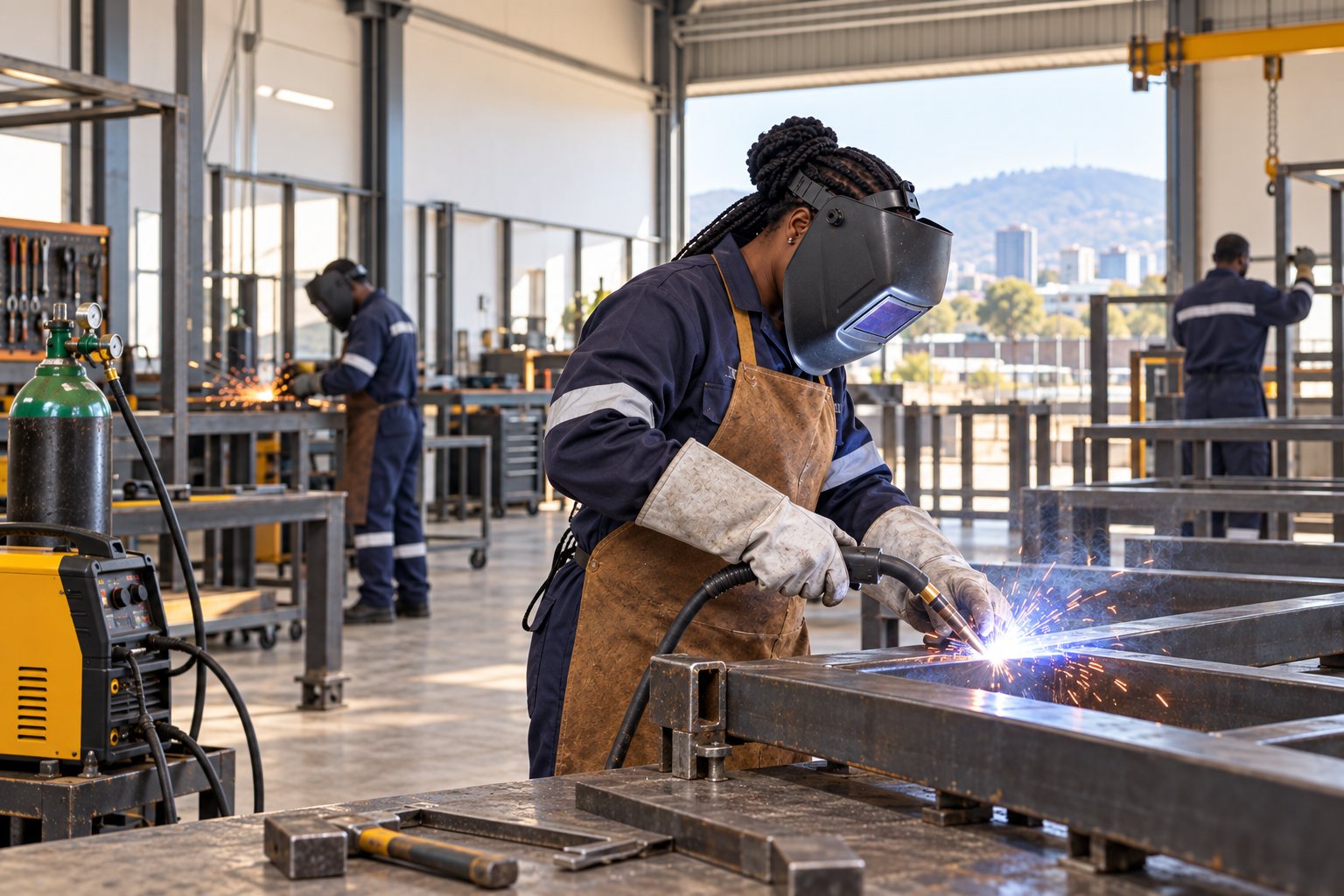
A customer comes in with a dimension and an idea — a gate, a window grille, a staircase, a mezzanine, a trailer, a broken machine part — and leaves, days or weeks later, with a steel object that must hold for years, often outdoors, often loaded, sometimes with people on it. In between, the welding and metalwork workshop has measured, drawn, chosen the metal, cut, assembled, welded, ground, protected and fitted. From taking measurements to fitting, every stage decides what the work will carry; that is the order in which the trade should be looked at.
Measuring and drawing
Every job begins with a visit or a survey: the real dimensions of the opening, the plumb of the walls, the nature of the support the work will be fixed to, the direction of opening, clearance, constraints of the place. The metalworker then draws — by hand or on software — what they are going to make, with sections, joints and fixings, and has the drawing approved by the customer before cutting the first profile. A piece made to a measurement taken over the phone is a piece that does not fit.
The survey also serves to understand the use. A gate that opens fifty times a day in an apartment block is not designed like that of a house; a shop grille raised and lowered every morning wears at the rails and hinges, not at the bars; a terrace railing will receive children who climb. The metalworker asks these questions before drawing, because they decide sections, joints and fixings far more than looks do.
The drawing also fixes what the work must do: close, resist a push, carry a floor, support a rolling load. That is when the workshop says whether the request falls within its know-how or requires an engineer’s study.
The metal, the profile, the process
Mild steel, galvanised steel, stainless, aluminium: each metal has its uses, its price, its resistance to corrosion and its welding requirements. The choice of sections — tube, angle, flat bar, sheet — depends on the expected load, and the welding process on the metal and thickness: coated electrode, semi-automatic under gas, inert-gas arc for stainless and aluminium. The workshop knows the origin and quality of its steel — a salvaged profile does not have the properties of a new one, and telling the customer so is part of the estimate.
The process also conditions equipment and training: welding aluminium or stainless cleanly cannot be improvised with the set used for mild steel, and a workshop that accepts everything without distinction delivers fragile welds where it should not.
Welding: the gesture, the preparation, the check
A weld holds by its preparation as much as by the gesture: clean parts, bevelled when the thickness requires it, correctly positioned and tacked before the full bead; the set adjusted correctly; a regular bead, without lack of fusion or inclusions. After welding come the visual check — a porous, cracked or undersized bead is visible to the trained eye —, grinding where appearance requires it, and the test: a railing is pushed, a gate is operated, a staircase is loaded before it leaves.
The workshop does not hide a doubtful weld under a coat of filler and paint. A redone bead costs an hour; a bead that gives way costs an accident — and the customer will only see the difference the day the piece is loaded.
Workshop safety: fumes, arc, grinder
Welding exposes to metal fumes, arc radiation, spatter, noise, pressurised gases and fire risks; grinding and cutting add dust and discs that shatter. The ILO recalls that a safe and healthy working environment is a fundamental principle and right, and its Convention No. 170 frames the use of chemicals at work — welding fumes and treatment products are among them. In a workshop, that means ventilation or fume extraction, suitable masks, goggles and gloves, gas cylinders secured and closed, an isolated grinding station, an accessible extinguisher and apprentices who do not weld without a mask “to go faster”. The ILO’s WISE programme shows that a small enterprise can improve these conditions with simple means; that is precisely the case of a metalwork workshop.
Protecting against corrosion
Unprotected steel rusts, and rusts fast in humid or saline climates. Protection — brushing or pickling, primer, finishing paint, galvanising where accessible — is part of the work and appears on the estimate with its nature. The workshop explains what each protection gives and what upkeep it needs, and does not announce a “lifetime” duration: paint needs touching up, galvanising lasts longer but costs more, and the use of the place decides.
Fitting: the site after the workshop
Fitting a gate, sealing in a railing, fixing a staircase, assembling a frame on site: fitting takes the workshop onto a worksite, with its own risks — work at height, handling heavy parts, welding near flammable materials, working alongside other trades. The ILO code of practice on safety and health in construction applies as soon as the workshop works on a site: protecting people below, scaffolding, lifting instructions. The metalworker prepares the fitting like the fabrication: lifting means, fixings suited to the support, chemical or mechanical anchors depending on the wall, final check with the customer.
The estimate: what it says and what it does not
The estimate describes the work — dimensions, metal, sections, assembly, protection, fitting or not —, attaches the approved drawing, and separates material, fabrication, treatment and fitting. It states the lead time, the payment terms — a deposit for material is common, and the workshop says what it is for — and what is not included: making good the wall, the electrics of a motorised gate, the finishing paint if done by someone else. The price depends on the metal price, complexity and location; the workshop announces no “price per metre” valid for everything.
The estimate also says what the workshop guarantees: conformity with the drawing, the strength of the joints, the protection applied — and what it does not guarantee: the strength of a support it did not build, a load the customer did not declare.
Fabricating is not sizing
A metalworker fabricates and assembles; they do not calculate a load-bearing structure. A mezzanine that will receive the public, a warehouse frame, a balcony, an external staircase of several flights require sizing by an engineer or a design office, which the workshop executes but does not replace. Likewise, they are neither a locksmith in the sense of access security, nor an electrician for a gate motor, nor a coachbuilder — even if they repair a trailer. A workshop that agrees to “make it hold” what it cannot size takes on liability on ground that is not its own, and puts people in danger.
In the African context
The fact that weighs most on this trade on the continent is the place of steel in everyday construction: doors, window grilles, gates, railings, roof frames, sheds, kiosks, furniture — the metalwork shop is present on almost every site, and often the only structural trade after the mason. That place gives it a large volume of work and a responsibility other trades do not always have: many of the pieces it makes carry people, without an engineer having been consulted.
Raw material is the other variable. Profiles come from imports or local mills, quality varies from batch to batch, and salvage — profiles from demolition, container sheet, scrap — is a common and legitimate source, provided one knows what one is welding. The metalworker who distinguishes new steel from salvaged steel on the estimate, and who refuses to put a rusted profile in a load-bearing piece, does work the customer will not see but will benefit from.
Then there is health, more exposed than elsewhere: workshops open onto the street, welding without a mask, grinding without goggles, very young apprentices, fumes breathed all day. The ILO recalls that safety at work is a fundamental right; on many pavements of the continent, it begins with a welding mask and a pair of goggles, bought before the next welding set.
What a metalworker refuses to weld
A structure that will receive the public without a study. A profile whose inside condition they do not know. A repair on a safety part — hitch, axle, chassis — whose steel they do not know. A piece they will not be able to fit properly on the intended support. An order without an approved drawing, on a measurement taken over the phone. A job without a mask, because the customer is in a hurry.
Each of these refusals has an immediate cost and a deferred benefit: the piece the workshop delivered still holds, years later, the day someone leans on it.