
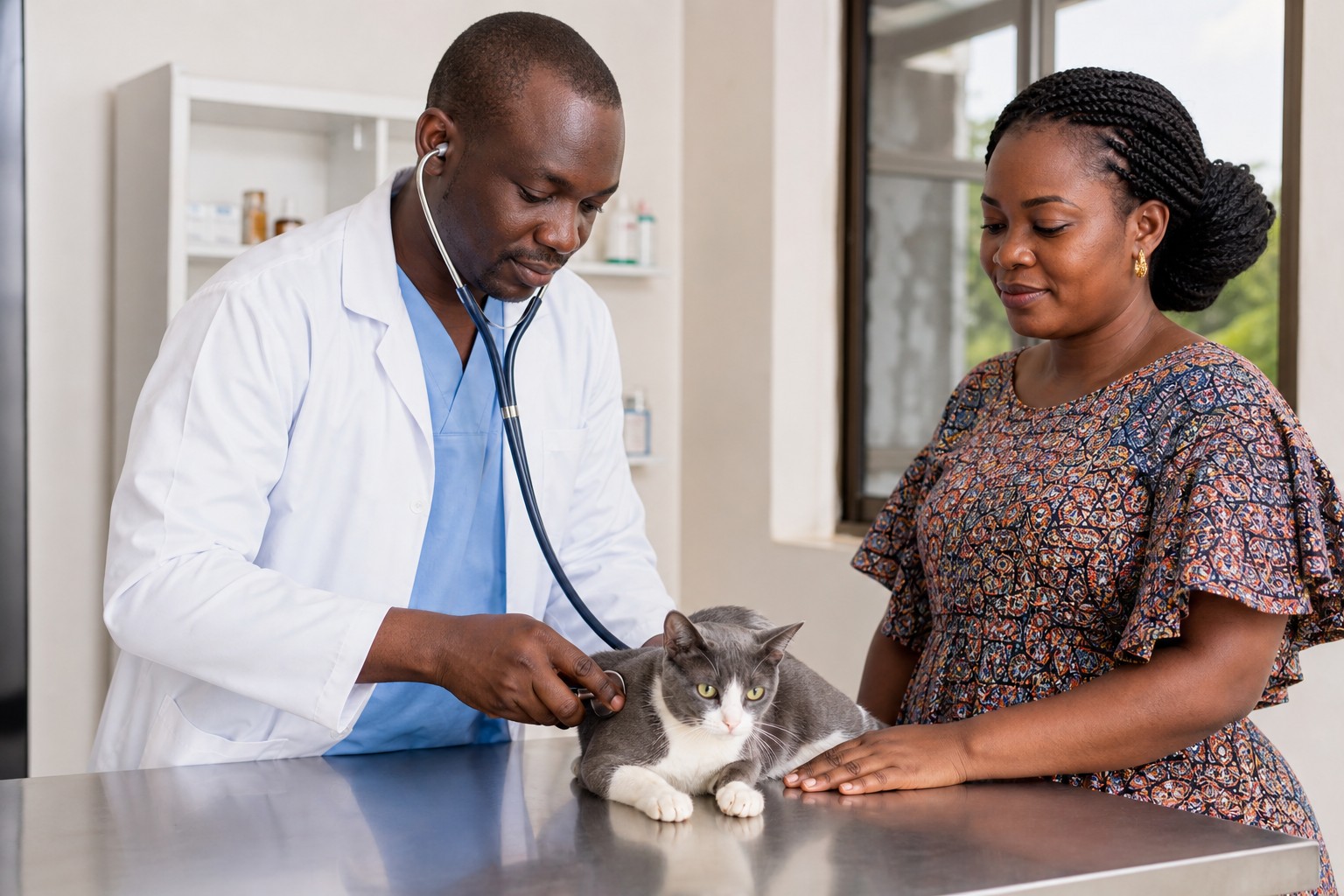
In a veterinary consulting room, the one describing the symptoms is never the one feeling them. That particularity organises everything else: how questions are asked, how the animal is examined, how a cost is announced, and how you say something cannot be done here.
Three parties, only one of whom speaks
The client is the person who books, decides, authorises and pays. The patient is the animal. The two are not the same, and a practitioner who forgets it makes decisions on false information.
The owner brings an account: since when, how often, what has changed in appetite, drinking, activity, behaviour. That account is valuable and partial. It is approximately dated, filtered through worry and sometimes guilt, and it covers only the moments when the person was there.
The animal, for its part, does not complain the way a human does: many species mask discomfort, and the absence of complaint does not mean the absence of pain. Clinical work consists in setting what is described against what is observed, without lending the animal human intentions and without dismissing the owner's account, which remains the only source on what happened at home.
Finally, a clinic is not only a place of individual care: the Food and Agriculture Organization of the United Nations situates animal health within a "One Health" approach linking human health, animal health and the environment. A neighbourhood veterinarian is an ordinary link in that chain.
The waiting room, and an order that is not first-come
A clinic takes two flows: booked appointments and emergencies that give no notice. Reconciling them requires a rule that is displayed and held to: emergencies are seen by severity, not by arrival time. That rule has to be said on the telephone and repeated in the waiting room, otherwise it is experienced as unfairness.
Triage therefore starts with the call. Species, approximate age, reason, how long it has been going on, and a few elements that move a request into the urgent column — an injury, difficulty breathing, an animal that can no longer stand, a bite, exposure to something toxic. Reception's job is not to settle what the animal has, but to know who has to be seen now.
The waiting room is itself a problem to solve. Species that fear each other, sick animals and animals in for a vaccination all cross paths there. Separating flows where possible, keeping cats in carriers, avoiding contact between strangers: these are matters of organisation, not theoretical precautions.
The consultation: what is told, what is observed
The examination follows an order the practitioner does not vary with mood: general condition, mucous membranes, temperature, palpation, listening to the chest, then the system the visit is about. That regularity is what turns up things nobody was looking for.
Then comes the explanation. It is the part clients remember, and often the part that gets rushed: saying what you think, saying what you are not certain of, saying what a further test would add, and saying what it would cost. An owner who has understood follows instructions; an owner who merely heard a Latin word comes back too late.
The international standards of the World Organisation for Animal Health, gathered in its terrestrial animal health code, cover animal welfare and the responsibilities of veterinary services among other things. At the scale of one clinic that translates into concrete things: handling without roughness, taking pain seriously, letting an animal avoid being physically held when an alternative exists, and recording what was done.
The quote before the act, the record afterwards
Money is the leading cause of conflict in a clinic, and almost always for the same reason: an invoice discovered after the fact. Giving an order of magnitude before acting, having anything beyond the plan approved, warning as soon as things change: that is professional practice before commercial policy.
What makes the amount vary can be identified and explained: the species and size of the animal, the nature of the act, its length, anaesthesia or not, further tests, consumables, hospitalisation, urgency and the hour. No reference rate exists from one country or city to another, and comparing two quotes means comparing what is in them.
What is handed over afterwards counts as much: an understandable report, instructions written rather than dictated at the door, the record updated, the date of the next reminder where there is one. The clinic also keeps a file — identity, history, procedures, the owner's details — which is kept and not passed around. Digital tools help hold all that together; they replace neither the examination nor the decision. An artificial intelligence tool can draft a reminder or sort requests, but it examines nobody and can neither establish what the animal has nor guarantee that it is well.
Surgery, pain and hospitalisation
A planned procedure starts the day before, with instructions given to the owner and a check on what was understood. On the day, the animal is admitted, examined again, prepared; the procedure takes place; recovery is watched, because that is a risky moment; discharge comes with written instructions and a point of contact if something goes wrong.
Three requirements run through that chain. The first is pain management, planned before the act and continued after it. The second is hygiene: sterilised instruments, single-use material where that is intended, the theatre cleaned between procedures. The third is traceability: who did what, when, with what.
Hospitalisation, even for a day, adds obligations of its own: water, cleanliness, temperature, quiet, checks at regular intervals, and someone reachable. An animal hospitalised without anyone looking in on it is not hospitalised, it is stored.
Medicines are not over-the-counter goods
This is the point on which a clinic has to be firmest, and the one most often contradicted by market practice.
A veterinary medicine is dispensed after an examination, for an identified animal, with a duration and instructions. It is not recommended over the telephone, not reused from one animal to another because they "have the same thing", and not continued because some is left: leftover treatment is not a reserve.
The World Health Organization has long warned about antimicrobial resistance, driven in part by unnecessary or incomplete use — in humans as in animals. A clinic plays its part very concretely: by not dispensing when it is not indicated, by explaining why duration matters, and by refusing to sell on demand. That refusal is one of the hardest things to hold to, and one of the most useful.
This article deliberately gives no product name, no dose, no frequency and no course of action: those depend on the animal, its condition, its weight, the country and the prescription that concerns it.
What is not treated here: species, means, referral
A clinic takes some species and not others. Dogs and cats are the core of many urban practices; birds and small mammals call for specific skills and equipment; farm animals and horses often belong to other practitioners. Saying what you take saves an owner from crossing a city for nothing.
Wildlife is a case apart. An injured wild animal, or a protected species, is not kept, not bought and not treated on a hunch: depending on the country, authorised services and facilities exist, and that is where to turn. A clinic can stabilise and refer; it has no business housing what requires a particular authorisation.
Finally, a practice has technical limits. Imaging, a laboratory, an overnight service are not everywhere. Recognising that a case exceeds your means and referring to a better-equipped colleague is not an admission of weakness: it is what clients most often cite when they explain why they trust a clinic.
In the African context
Conditions vary a great deal between countries, cities, neighbourhoods and income levels: there is no single African veterinary medicine, and two neighbourhoods in the same city have neither the same density of pets nor the same access to care.
The first reality is where practitioners are. Depending on the country, veterinarians concentrate in the larger cities, while whole areas depend on a public animal health service, community animal health workers, or occasional visits. That changes the nature of the work: neighbourhood consultation on one side, rounds and prioritisation on the other.
The second is the availability of means. Depending on the market, the supply of consumables, of vaccines needing a cold chain, and of spare parts for equipment governs what a clinic can promise. Continuity of electricity weighs directly on storage and on planned surgery.
The third is rabies, which remains a public health issue in several countries. The World Health Organization points out that the disease is preventable through dog vaccination and that what follows a bite is an urgent matter for human healthcare. For a clinic that means a clear position: taking part in campaigns where they exist, informing without dramatising, and sending anyone who has been bitten straight to a human health service.
The fourth is cost for the owner. Depending on income, a quote can decide the outcome of a case. That means ranking what is indispensable, explaining the options rather than imposing one, and accepting that an owner may knowingly choose partial care.
The fifth is professional structuring. Depending on the country, practice is framed by a professional body, a ministry or a veterinary authority with differing requirements — registration, premises, clinical waste, records. Complying is what durably separates a clinic from a shop selling products.
What a veterinary clinic does not promise
It does not promise recovery, nor a timeframe, nor the same outcome another animal had. It does not promise an immediate diagnosis: some situations call for tests, for time, sometimes for a second look. It does not promise to dispense a medicine without having seen the animal, nor to extend a treatment on request. It does not promise to treat every species, or every case, with the means it has.
What it can promise is verifiable: an announced order of priority, an examination conducted in the same order for everyone, an explanation that can be understood, a cost stated before the act, pain taken seriously, written instructions, a file kept — and saying, when that is the case, that the best thing to do is to go elsewhere.