
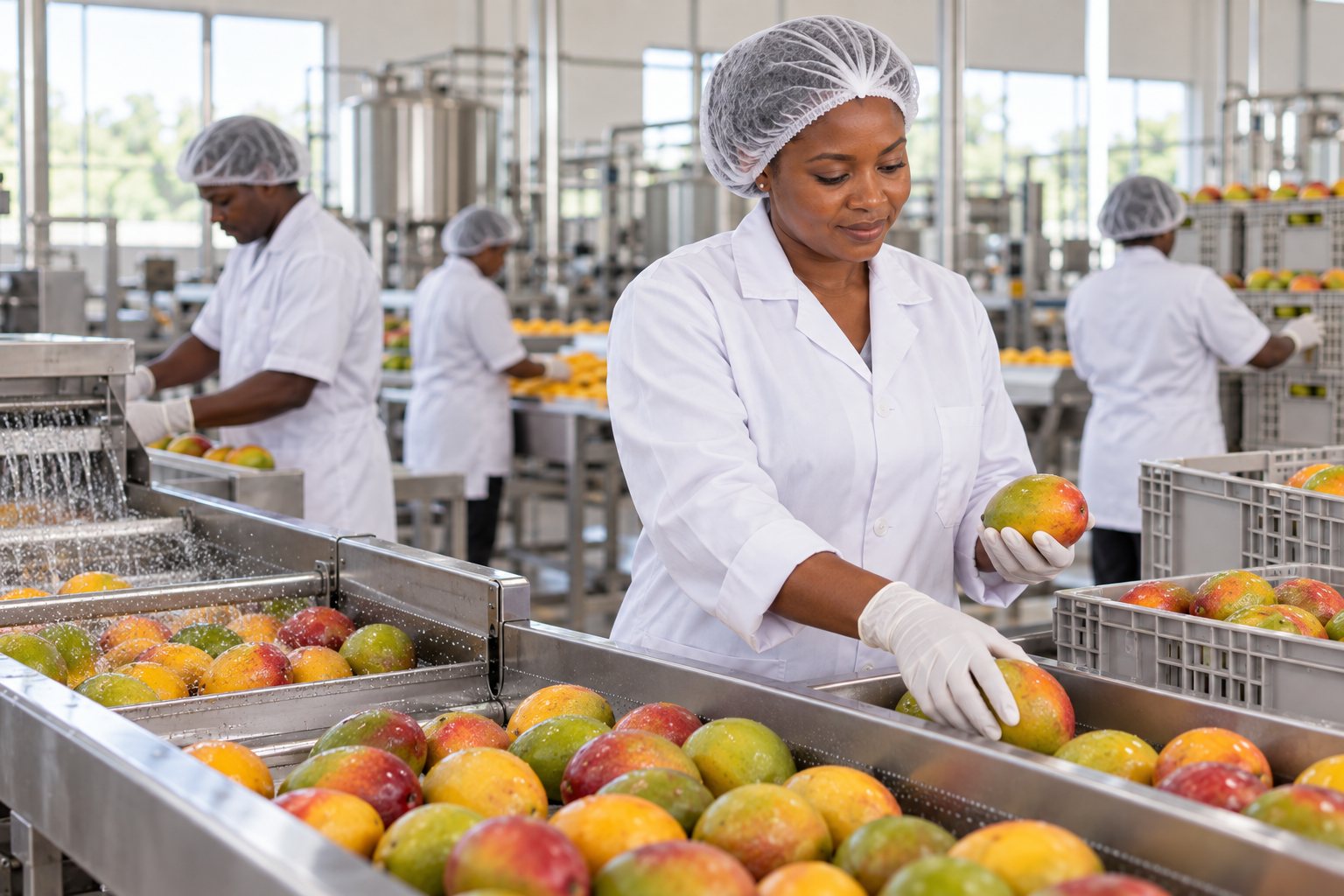
The food processor buys a perishable raw material and sells a product that keeps: juices and nectars, dried fruit, jams, flours and semolina, tomato purée, oils, peanut butter, dairy products, smoked or dried fish, condiments, ready meals. In between there is a process — a sequence of operations at precise temperatures, durations, acidities, moisture levels — and it is that process that decides whether the product will keep for three days or twelve months, and whether it will be wholesome or not. The know-how is not in the recipe, which everyone knows; it is in controlling, every day, the parameters that make the recipe safe.
The raw material: refuse before you process
No process rescues a defective raw material. Bruised fruit, mouldy groundnuts, milk already sour, tomatoes picked too late, badly kept fish bring into the workshop micro-organisms, toxins and defects that processing sometimes masks without removing. Intake inspection — appearance, smell, ripeness, temperature, moisture, absence of mould, cleanliness of containers — is the first operation of the process, and the only one where it is still possible to say no.
That requires a specification for suppliers: accepted varieties, ripeness stage, time between harvest and delivery, transport conditions, clean containers. And a relationship that holds: the grower who knows their mangoes will be refused if they arrive crushed learns to pick and transport them differently. The Food and Agriculture Organization of the United Nations estimates that a significant share of the food produced is lost between field and consumer; a well-supplied processing unit reduces those losses, but it must not become the outlet for damaged unsold produce.
The process and its critical points
Every process has a few points where everything is decided. For juice pasteurisation, it is the temperature-time combination and the rapid cooling that follows; for fruit drying, the final moisture content and protection against insects and dust; for jam, the sugar content and acidity, which prevent mould; for a canned product, sterilisation and the seal of the container; for peanut butter, the quality of the kernels and control of aflatoxins, those invisible and dangerous mould toxins; for a dairy product, the cold chain and hygiene from milking to packaging.
The method that consists in identifying these points, setting a measurable limit for each, monitoring it and recording what is done when it is exceeded has a name — hazard analysis and critical control points — and it is the foundation of the standards of the Codex Alimentarius, the joint FAO/WHO international reference for food safety. It is not reserved for large factories: a five-person unit can apply it with a thermometer, a scale, a refractometer, a notebook and consistency.
Hygiene: the five keys, every day
Even before critical points, there is basic hygiene, which the World Health Organization sums up in five keys: cleanliness (of hands, surfaces, utensils), separation of raw and cooked, thorough cooking, keeping food at safe temperatures, and use of safe water and raw materials. In a workshop, that becomes rules written down and posted: clean clothing, hand washing at the entrance, separate areas for intake, preparation, cooking and packaging, cleaning and disinfection at the end of the day, control of insects and rodents, tested water.
The WHO recalls that unsafe food causes hundreds of millions of cases of illness worldwide every year. A contaminated batch of juice cannot be seen with the naked eye; it can be seen in the queue at a health centre.
Packaging and containers
The best product deteriorates in bad packaging. The processor chooses a container suited to the product and the process — glass, food-grade plastic, multilayer pouch, metal can —, clean, sealed airtight, and compatible with the storage method. A container reused without validated cleaning, a cap that does not seal, a pouch that lets moisture through cancel the work of the whole workshop. Packaging is done in a clean area, immediately after the last step that makes the product safe, to limit recontamination.
The label: what the customer has the right to know
The label is not decoration. It says what the product contains — the list of ingredients in descending order, the allergens —, the net weight or volume, the name and address of the manufacturer, the batch number, the durability date, the storage conditions and, where relevant, the instructions for use. National labelling rules vary but largely follow Codex principles. A product without a batch number cannot be recalled if there is a problem; a product without an ingredient list endangers people with allergies; an invented date is a lie that can make people ill.
The label is also where claims live. “Natural”, “preservative-free”, “organic”, “artisanal” have a precise meaning in many regulations, and a processor who uses them without being able to prove them faces penalties and loses customers’ trust at the first inspection.
Traceability and recall
Every batch made must be traceable to its raw materials, its production date, the parameters recorded that day and the customers delivered. That is not red tape: it is what makes it possible, if a batch causes a problem, to withdraw it quickly and to withdraw only that one. A processor without traceability must, in the event of an alert, withdraw their entire production — or withdraw nothing, and hope.
Authorisation and inspections
A processing unit falls under health authorisations — registration, approval, inspection of the workshop, product analyses — whose arrangements depend on the country and the type of product. The processor obtains them before selling, not after the first problem. They have their products analysed by a laboratory at regular intervals, and keep the results. Those analyses cost money; they cost less than a recalled batch or a hospitalised customer.
In the African context
The starting point of the trade on the continent is the paradox of losses: abundant harvests in season, lost for lack of preservation, and imports of processed products — tomato concentrate, juices, flours, milk powder — sometimes made from raw materials the country itself produces. Local processing answers that paradox, and that is why agricultural policies and development programmes support it: it stabilises growers’ income, reduces post-harvest losses and creates jobs, often for women, outside the cities.
The reality on the ground is that of small units — a few people, a workshop attached to a home, simple equipment: solar or gas dryers, cooking pots, presses, mills, artisanal pasteurisers — selling at markets, in neighbourhood shops and increasingly online. Moving from that scale to a small business that supplies supermarkets or exports runs into three precise obstacles: regular supply of raw material of constant quality, access to suitable packaging at a reasonable price, and health compliance, which requires premises, analyses and documentation the family unit does not have.
Energy and water weigh on every process: a pasteurisation interrupted by a power cut, a dryer that does not finish its cycle because of rainy-season humidity, untested borehole water used to wash fruit are daily hazards. Solutions exist — improved solar dryers, shared cold chain, water treatment, seasonal planning — but they presuppose that the processor knows where their critical points are.
Aflatoxins in groundnuts, maize and spices deserve a separate mention: invisible, resistant to cooking, they are a documented public health problem in several regions of the continent, and the groundnut or flour processor who does not sort, does not dry properly and does not have their batches analysed puts a dangerous product on the market without knowing it. Hand-sorting mouldy kernels, rapid drying and dry storage are simple actions that change everything.
The market is changing fast: an urban middle class wants local products, packaged, labelled, with a brand; supermarkets and online sales platforms open outlets but require regularity, compliant labelling and sometimes certification. Women, the large majority in artisanal processing, are also those with the least easy access to credit for equipment and to technical training; groups and cooperatives partly offset that imbalance by pooling a compliant workshop, packaging and a brand.
Creating a processing unit
The project starts with a product and a raw material available locally, in sufficient quantity and at a price that leaves a margin; then with a written process, tested on a small scale, with its critical points identified; then with premises designed for forward flow — from dirty to clean, from intake to dispatch —, with tested water, washable surfaces and separate areas. Then come the authorisations, the first analyses, the packaging and the label, and only then sales.
The unit’s website should show the product, say where the raw material comes from and how it is processed, present the authorisations obtained and the analyses carried out, and state the storage conditions clearly. A customer who reads “pasteurised at 85 °C for 10 minutes, hot-filled, keep refrigerated after opening” knows what they are buying; a customer who reads “100 % natural” does not learn anything.
The notebook that remains when the season is over
A hibiscus juice processor noted, for each cooking, the temperature reached, the duration, the pH and the batch number, in a school exercise book. When a supermarket asked her, two years later, to prove control of her process in order to list her, she brought the notebook. She was listed. The process was the same as her neighbours’; the difference was that she could prove it.