
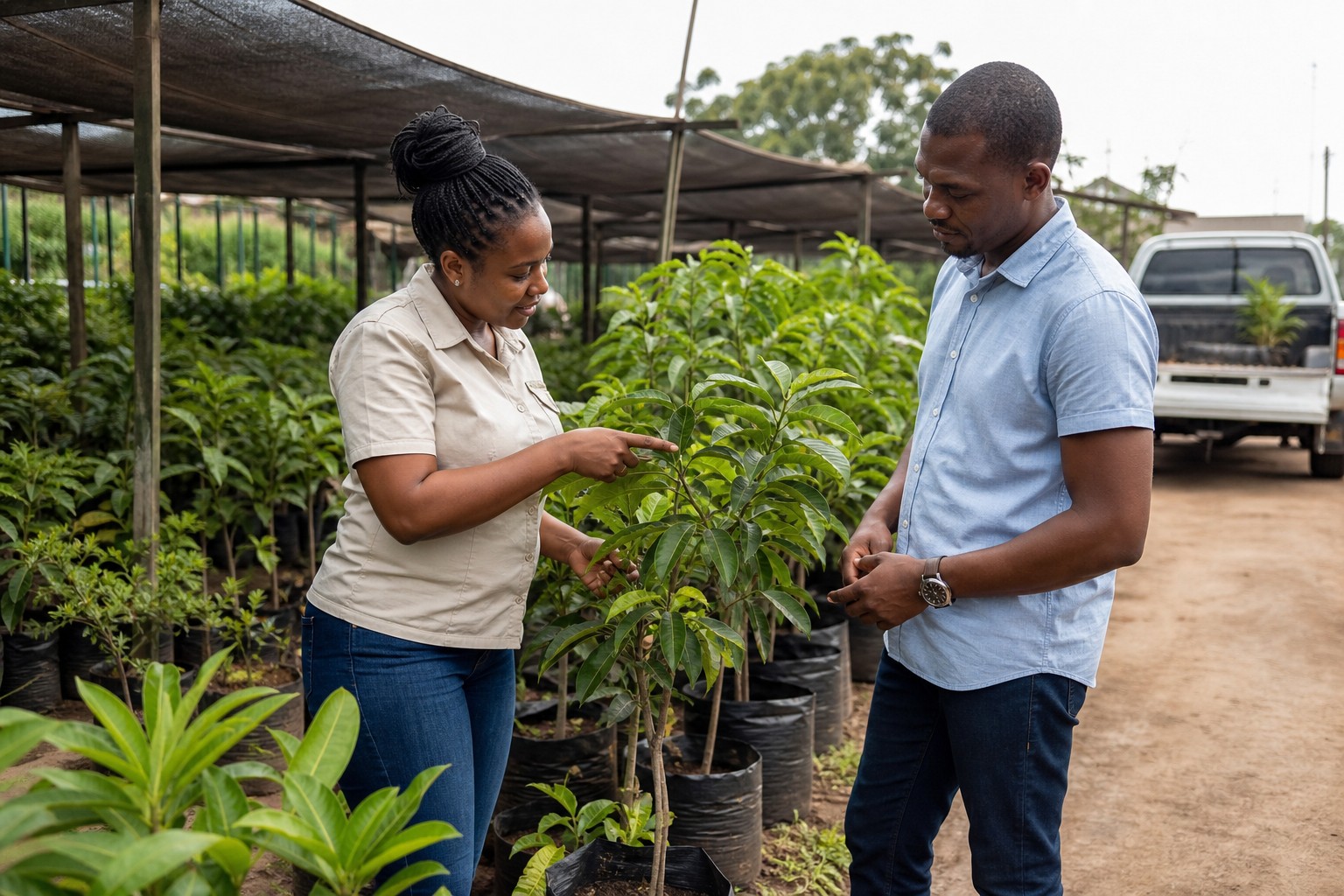
A plant is sold in minutes and judged over years. In between there is a planting hole dug by someone else, soil the nursery never saw, and watering it will not control. That gap explains almost everything in this trade: how plants are raised, how advice is given, and how a guarantee is worded.
What a nursery grower actually produces
A nursery does not resell plants, it produces them. Sowing, cuttings, grafting, successive pottings-on, hardening off: each of those stages leaves a lasting mark on the tree, visible long after the sale.
The client may be a household planting a few trees, a landscaper composing a scheme, or a company or authority ordering by the hundred. Each buys something different: the household mainly buys advice and the certainty that what they plant is what they were told; the professional buys uniformity, reliable labelling and availability they can plan around.
What the nursery really sells, then, is a plant that matches its description — exact species and variety, stated age, a properly formed root system — together with the information needed to plant it in the right place.
Time: the constraint that organises the whole trade
A grafted fruit tree spends months in the nursery before being offered. That duration is not a commercial detail: it means what is sold today was decided long ago, and what is decided today will not sell for several seasons.
The practical consequence is constant planning: estimating what the market will want, growing species that will not all sell at the same rate, accepting that space, water and labour stay tied up for a long time, and absorbing the loss of a batch that does not hold.
It is also what makes haste expensive. A plant brought out too early, insufficiently formed or badly hardened off, will still be sold, but the failure will show at the customer's place — and it is the nursery that will be held responsible.
Where the plant material comes from, and why it is traced
A plant starts as a seed, a cutting or a scion, and the origin of that material commits everything else. A serious nursery knows where what it propagates comes from, records the species and variety, and carries that information through to the label handed to the customer.
This is not only a commercial matter. The International Plant Protection Convention, hosted by the FAO, sets international phytosanitary standards intended to limit the spread of pests through trade in plants. Plants and seeds are precisely one of the pathways concerned: bringing in plant material without respecting the applicable rules risks bringing in something else with it.
The conditions for importing, moving and inspecting plant material belong to each country and its plant health authorities. This article describes no way around them. A professional contacts the competent service before bringing material in, rather than after.
The International Treaty on Plant Genetic Resources for Food and Agriculture is a reminder of why varietal diversity matters: it is a collective insurance policy. For a nursery that translates concretely into refusing to shrink the catalogue to the two or three most requested varieties, and being able to offer something else when the customer's conditions require it.
Raising a plant: from propagation to hardening off
The work runs through stages that cannot be caught up later. Propagation first — sowing, cuttings or grafting depending on the species and the aim. Grafting in particular reproduces a variety faithfully and shortens the wait before production compared with a plant grown from a stone; the exact time depends on the species, the rootstock and the conditions, and is not promised.
Then come successive pottings-on, whose main issue is the root system. A root left cramped too long circles, and that circling cannot be corrected after planting: it is one of the commonest defects, and one of the least visible at the moment of purchase.
Hardening off ends the cycle. A plant raised under shade must be gradually exposed to real conditions before sale, failing which it will suffer a shock at planting. Durations and methods depend on the species, the season and the local climate; the principle is constant.
Substrate, water and shade
A nursery is a production site in its own right, with its own resources and constraints. The substrate has to hold water without suffocating roots, stay stable for months and introduce no health problems. Its composition depends on locally available materials and on the species grown: there is no universal mix.
Water sets the rhythm of the work. It has to be available and of a quality compatible with young plants, applied without excess — root asphyxiation kills more nursery plants than drought does. Requirements vary with the species, the stage, the container, the season and the shading, which rules out any transferable watering calendar.
The destination soil matters as much as the growing substrate. The FAO's Global Soil Partnership points out that soil erosion and degradation remain major threats: a grower who asks a customer about the nature of the ground, its drainage and its exposure is not being fussy, they are avoiding selling a plant that is already doomed.
Advising sometimes means refusing a sale
This is the least visible and most decisive part of the trade. Before selling, a professional asks where the plant will go: what kind of soil, what exposure, how much room in height and spread it will eventually need, what access to water in the first months, what use is expected.
Those questions sometimes lead to a different proposal from the original request, and sometimes to a refusal. Selling someone a species that will not hold in their conditions pays once and costs lastingly: the customer will come back to complain, or will not come back at all.
Advice stops at its own domain, however. A nursery informs on the choice of species, its place and its routine care; it does not design a complete scheme, which belongs to the landscaper, does not replace the farmer who will run a productive planting, and does not stand in for the competent services on a plant health problem it cannot identify.
How far the establishment guarantee goes
An establishment guarantee is a limited promise, and its value lies precisely in its limits. A nursery controls what it produced: the identity of the plant, its apparent health, the quality of its rooting, its hardening off. It does not control the planting hole, the quality of the receiving soil, the watering of the first weeks, trampling or animals.
Hence a distinction serious professionals set out in advance: what can be guaranteed when the nursery plants the tree itself is not what can be guaranteed on a plant taken away. Saying so clearly before the sale avoids a dispute nobody wins.
What is always owed, on the other hand, depends on no commercial guarantee: a plant matching what was announced, in good apparent condition on departure, and accurate information about what it will require.
Selling, delivering, and what follows
Labelling is the first commercial act: species, variety, rootstock where there is one, date. It is what allows a landscaper to justify a composition and a household to know what they are planting.
Delivery is a moment of real risk. A plant carried without protection from road wind dries out within a few kilometres; a badly wedged plant breaks. Wedging, protecting the foliage, avoiding long waits in full sun and delivering in a fit state to plant are part of the service.
Price depends on the species, the age of the plant, the container, the grafting work and the growing time tied up. No tariff carries from one nursery to another, and a cheap plant raised too fast often costs more than the one you hesitated to buy.
In the African context
Growing conditions vary enormously between areas: humid plains where water is not short and dry zones where every watering counts, highlands with cool nights and saline coastlines, outskirts of large cities where ornamental demand is strong and rural regions where demand is mainly for fruit trees and useful species.
Outlets differ accordingly. In some peri-urban areas most of the business comes from private landscaping and property projects; in others from planting programmes, farms, or households wanting productive trees. The FAO, through its Action Against Desertification initiative, supports restoration of degraded drylands, notably in the Sahel but also in North Africa, the Horn of Africa and Southern Africa — contexts that share neither species nor calendars.
Material constraints look more alike: access to water and its cost, availability of containers and substrate, transport on tracks that damage plants, and the difficulty of tying up cash during the growing months. Planting periods depend on local rainfall patterns, which are anything but uniform from one country or region to another.
What separates one nursery from another is therefore not surface area but memory. Knowing which batch a plant came from, which variety, grafted when and on what rootstock, means having written those things down as they happened. A small operation that did so sells an identifiable tree; a large one that did not sells an anonymous tree, and finds out the day a customer comes back.
What a nursery does not promise
It does not promise that every plant will take, nor a date of first production, nor a volume of fruit. Those results depend on the soil, the climate, the water, the planting and the care, most of which are beyond it.
Nor does it promise that a given species is the best: the choice is made according to conditions and purpose, never in the abstract. It announces no reference tariff, and it does not guarantee that a planted tree will pay.
Finally it stands in for neither the landscaper, nor the farmer, nor the competent plant health service. What it commits to is narrower and verifiable: a plant that is genuinely what it says, raised without shortcuts, handed over with the information it needs to be given its chance.