
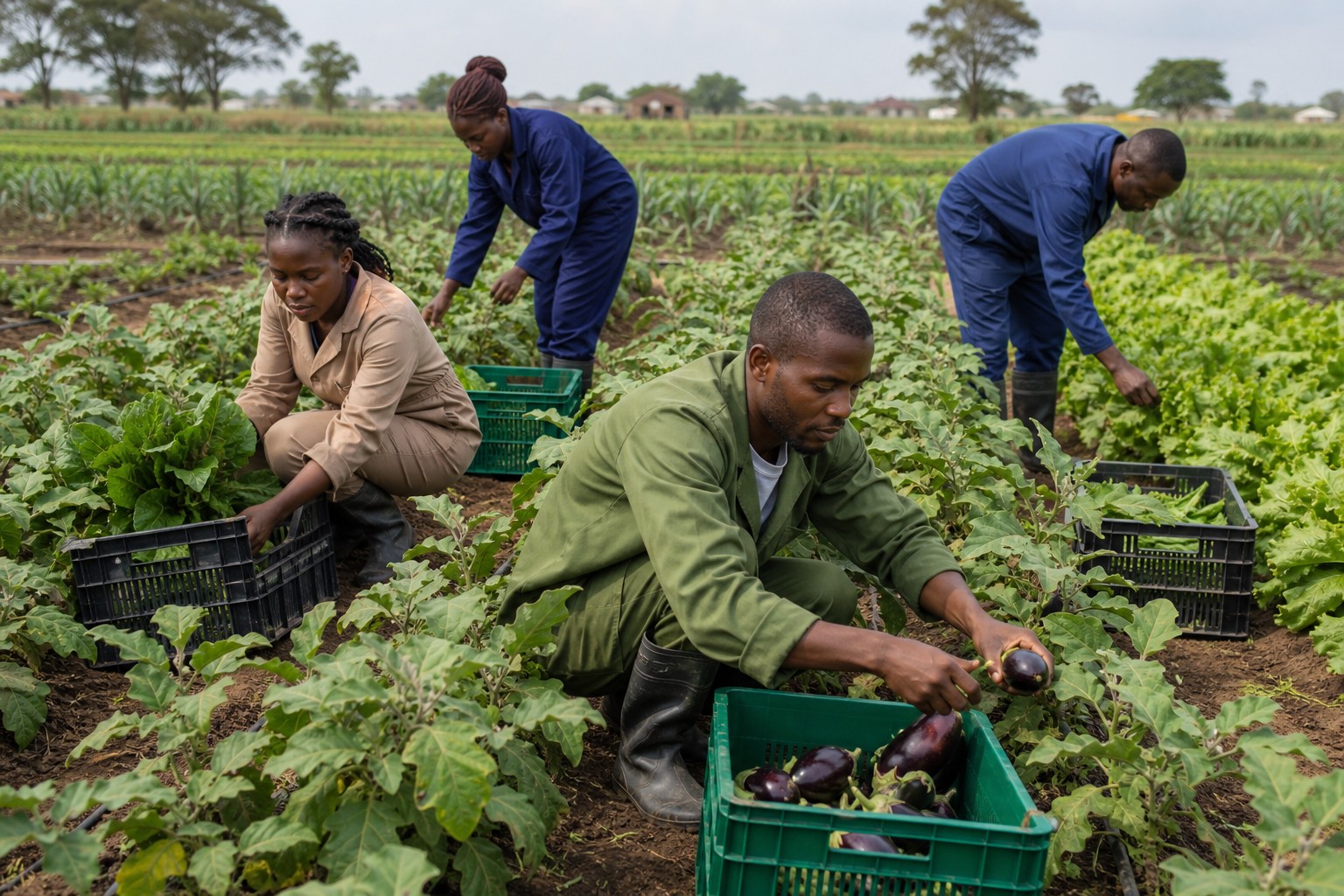
A chef building next month's menu relies on what a grower has announced. At that moment the goods are still in the ground. That is this trade's constraint: selling future availability, on a production exposed to rain, pests and the calendar. The rest — planning, monitoring, sorting, logistics — exists to narrow the gap between what was promised and what arrives.
What a farm actually sells
The client may be a restaurant, a shop, a reseller, a processor or a household, and each buys something different: regularity and freshness for whoever serves the same dish all week, volume and even grading for a reseller, raw material that matches what it can handle for a processor.
So a farm does not simply sell "vegetables": it sells a quantity, on a date, in a given condition, with reliable information about what comes next. Perceived quality often owes less to the variety than to the delay — produce harvested and delivered the same day does not behave in a kitchen like produce left two days in a crate.
An order starts with a precise conversation: which products, what volumes, how often, delivered where. A grower who commits without checking their planting plan will have to buy elsewhere to fill the order — a different business, and a deception if it goes unsaid.
The planting plan, or how to promise availability
Planning is the core of the trade: deciding what to plant, where, when, and above all in staggered batches. Sowing a whole crop at once produces an unmanageable glut followed by weeks of nothing.
That calendar cannot be copied. Dates, successions and durations depend on the crop, the variety, the soil, the local climate, the season, access to water, the production system and the agronomic guidance of the area. There is no universal farming calendar: a farm builds its own from its own records, year after year.
Alongside planning comes rotation: not bringing the same crop back to the same place indefinitely. That is not a posture, it is what protects the capacity to produce tomorrow.
The plot: what you know about it before deciding
A grower tries to know their ground before committing a season to it: repeated observation — where water sits after heavy rain, where it runs off, which areas dry out first — and the plot's history, meaning what was grown there, what was applied, what went wrong.
Depending on the case, a soil analysis is available and can be interpreted locally. The FAO's Global Soil Partnership points out that soil erosion and degradation remain major threats and that sustainable practices spread slowly. Fertility is not an inexhaustible stock: inputs are reasoned from the soil and the crop, never from a recipe.
You also need to know on what basis you occupy the land: ownership, lease, concession, recognised occupation, customary right — the regimes differ from one country to another. What is constant is the value of knowing who uses the plot, for how long, under which agreements, and within which boundaries. Investing in soil you may leave within a year is not the same decision.
Water, and what it constrains
Water often decides the rest. The FAO notes that water scarcity and climate variability are constraining agricultural production in many regions and increasing risks to livelihoods.
For a farm, that becomes material questions: where the water comes from, whether it is available all year, whether its quality suits, how it is stored and distributed, what it costs, and what happens when the pump fails on a hot day.
Actual needs do not transfer: they depend on the crop, its stage, the soil, the climate, the season and the irrigation system. A volume or a frequency copied from elsewhere means nothing. And drainage counts as much as supply: a plot that does not drain after heavy rain loses its crop as surely as a dry one.
Monitoring without diagnosing, treating without improvising
Monitoring is daily work: walking the plots, comparing with last week, noting what changes. In front of a symptom, the first professional reflex is not to treat but to identify the problem correctly.
That caution has a precise reason. Yellow leaves do not mean one particular disease: the same appearance can come from too much water, from too little, from a deficiency, from a pest or from root damage. Concluding too fast means acting against what is not there, spending money, sometimes making things worse. A grower documents, compares, and calls on a technician, an extension service or a laboratory when observation is not enough.
Where a treatment is considered, it follows a framework that is not left to individual judgement. The FAO's International Code of Conduct on Pesticide Management sets out the principle of reducing risk across the product's whole life cycle. In practice: only products authorised in the country and for the use concerned, following the label, wearing the equipment specified, keeping people and animals away, protecting water points, storing under lock, dealing with empty containers, recording what was done.
This article gives no product, no dose, no mixture and no frequency: those depend on local registration, on the crop and on the situation, and are read on the label of the authorised product, not in a general text.
Harvest, sorting, and the clock that starts
Harvest starts a countdown: the goods degrade, and a large share of the value is decided within hours. Sorting begins in the plot — setting aside what is damaged stops a spoiled item from affecting others in transit.
The FAO devotes an entire technical platform to measuring and reducing food loss and waste, which says enough about how marginal the subject is not. The means are often simple: clean crates that do not crush, shade rather than full sun while goods wait, decent ventilation, storage protected from pests, rotation of batches, transport that does not lengthen the delay.
Then there is hygiene, because the produce is going onto a plate. The Codex Alimentarius, developed by the FAO and the WHO, publishes codes of practice including general principles of food hygiene that begin at primary production: clean water where washing happens, clean hands and containers, separation between food and chemicals, no transport in an uncleaned vehicle, traceability of batches. Growing is not processing: as soon as a farm cooks, dries commercially, packages industrially or sells prepared produce at retail, it enters another activity.
The people who do the work
A farm rests on people: a few permanent staff, seasonal workers at the peaks. Organising them is part of the trade — allocating tasks, naming who supervises, explaining before letting someone loose, providing boots, gloves and protection where there is a risk, counting days worked and handing over proof of payment.
The applicable rules — working hours, pay, registration, social protection — belong to the law of the country where the farm is established. No labour rule holds across a whole continent: a grower finds out about their own framework.
One point deserves saying plainly. The International Labour Organization notes that not all work performed by children is child labour: international standards target work hazardous to a child's health and development, work demanding too many hours, work performed by children who are too young, and work that interferes with schooling. On a farm the line is concrete: machinery, chemicals, heavy loads and long hours are not grey areas. Calling a dangerous task family help does not make it acceptable.
Selling a harvest: quoting, delivering, proving
Selling deserves the same seriousness as growing: identifying buyers, understanding their criteria — grading, regularity, presentation, timing —, announcing expected volumes without guaranteeing them, agreeing a price for the period, delivering, leaving a record.
Prices are not decreed: they depend on the product, the season, how abundant it is, the distance to market and the quality delivered. No tariff, no margin, no income holds elsewhere. What can be professionalised is the form: a detailed delivery note, an invoice or receipt, tracked payments, an honest count of unsold goods and losses.
One point of vocabulary, finally. Using few inputs, composting and rotating plots are defensible practices; they do not make a production "organic" in the sense of a certification, whose definitions and certifying bodies depend on markets. Describing what you do without claiming a label you do not hold is more honest, and often more convincing.
In the African context
There is no single African agriculture but very different situations depending on the area: irrigated schemes and rain-fed cropping, peri-urban holdings supplying a large city and basins far from any road, intensive market gardening and extensive food crops, family structures and commercial businesses employing dozens of people.
That diversity dictates different constraints. In some peri-urban areas the main issue is land pressure; elsewhere it is distance to market, the state of the tracks in the rainy season, or the absence of a cold chain that decides what it is reasonable to grow. Depending on the country, access to authorised inputs, to extension advice and to finance matched to a crop cycle varies widely.
The opportunities are just as real and as unevenly spread: growing urban demand for fresh, regular produce, restaurants and shops looking for reliable suppliers, mobile payment easing collection in some markets, weather information reachable by phone in a growing number of countries, grouping of growers where cooperatives exist — their status belonging to each country's law.
Professionalism is not measured by size. A small farm that keeps a plot notebook, separates business money from household money, files its input invoices, records its actual yields and issues a delivery note is sounder than a large one that knows neither what it produced nor what it spent.
What a farm does not promise
It does not promise a yield. A harvest depends on the variety, the soil, the year's weather, water, practices, pests, diseases and what is lost after cutting; announcing a tonnage as a fact is a mistake.
It promises no price, no income, no guarantee that a crop will pay: that depends on the market and the year. Nor does it promise availability it will not have — saying "there will be none this week" beats quietly topping up with goods bought elsewhere.
Finally, it stands in for no neighbouring trade: not the processor, not the retailer, not the veterinarian, not the technician who identifies a plant health problem, not the legal adviser on a land question. What it can commit to is narrower and more useful: saying what will be available, delivering what was announced, and showing where it came from.