
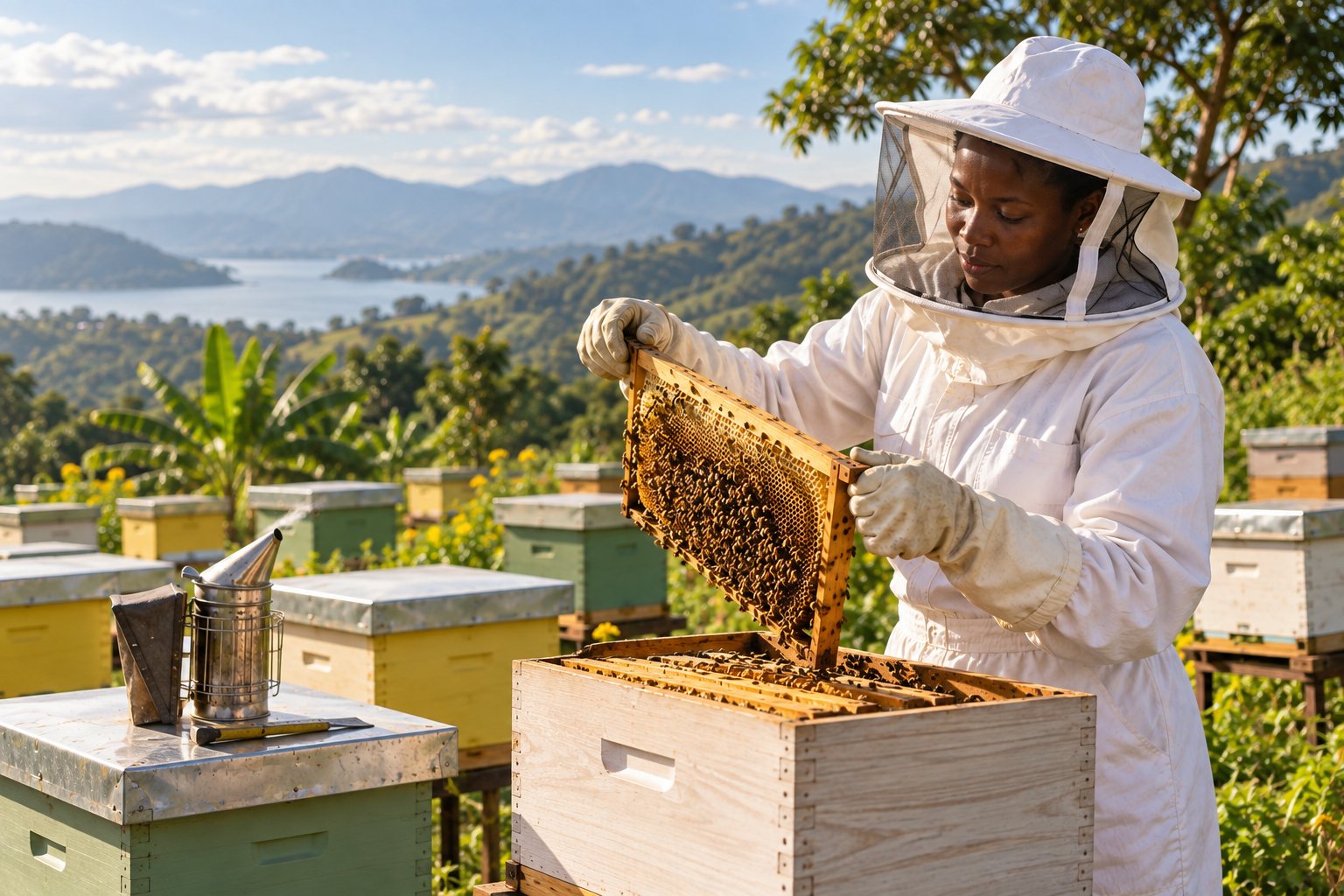
Honey is one of the few foods that can be sold just as it comes from nature: it is not cooked, not blended, not preserved with anything other than itself. That is also what makes it fragile in the hands of those who handle it. Heated too much, it loses its aromas and enzymes; harvested too early, it ferments; stored in a doubtful container, it takes on the taste of the container; stretched, it becomes a fraud. The professional beekeeper is the one who knows the colony well enough to let it work, and the harvest chain well enough not to waste its work.
The apiary: a site before hives
The first choice is the place. A colony needs flowers in quantity and diversity within a few kilometres, water nearby, shelter from wind and scorching sun, and relative quiet — away from paths, animals and agricultural spraying. The floral resource decides the harvest: an apiary placed in the middle of sprayed fields or in an area with no dry-season flowering will not produce, whatever the quality of the hives. The beekeeper observes for a whole year what flowers and when, before installing colonies.
The type of hive comes next: traditional hives of hollowed logs, straw or clay; top-bar hives, known as Kenyan hives, easy to build locally; movable-frame hives, more expensive, which allow precise inspection and extraction by centrifuge. None is “the right one” in itself: the choice depends on budget, skills, the extraction equipment available and the target market. The FAO document on beekeeping and sustainable livelihoods insists on this point: beekeeping is an activity accessible with little capital, provided one chooses a technique suited to what one has.
The colony: watch, do not interfere
A strong colony is recognised by its population, the regularity of its brood, the presence of a laying queen, its stores and its calm. The beekeeper visits the hives at regular intervals — more often during the honey flow, less in lean periods —, opens for as short a time as possible, looks at what needs to be seen and closes. They watch for enemies: wax moth, ants, small hive beetle, birds, and the parasites specific to each zone; they check that the colony has enough to eat in the dry season and that it does not swarm for lack of space.
The golden rule is not to treat what has not been diagnosed. A product poured into a hive “just in case” ends up in the honey. Treatments, when necessary and authorised, are done outside the harvest period, with products intended for beekeeping, respecting withdrawal periods before harvest.
The harvest: the right moment, not the earliest
Honey is ripe when the bees have capped the cells — when they have covered with wax the honey whose moisture content they have brought below the threshold that prevents fermentation. Harvesting a frame where most cells are uncapped means harvesting a honey too moist, which will ferment in the jar. A beekeeper without a refractometer relies on capping and on a simple test: a frame shaken horizontally must not let drops fall.
The harvest is done in calm weather, with a well-managed smoker — cool white smoke, not flames or materials that leave tastes. The frames or bars of capped honey are taken and the colony is left its brood and a sufficient store; a hive emptied entirely at the end of the season starves or absconds. That is the first difference between the beekeeper and the honey hunter.
Extraction: the clean chain
From hive to jar, honey goes through extraction — by centrifuge for frames, by pressing or draining for bars and combs — then coarse filtering that removes wax and debris, settling that lets bubbles and the last impurities rise, and packaging. At every step the rule is the same: clean equipment, in stainless steel or food-grade plastic, never iron or galvanised metal that oxidises; no water added; no heating beyond what is needed to make it flow; no smoke, fuel or soap nearby.
Honey absorbs moisture from the air and odours. A closed, dry extraction room, protected from robbing bees and insects, with washable surfaces and access to clean water, is the condition of a honey that keeps.
Packaging, label and purity
Honey is packed in clean, dry, hermetically sealed jars, in glass or food-grade plastic — never in bottles that have contained something else, whose smell lingers. The label states the product name, the botanical origin if known and verifiable, the net weight, the producer’s name and address, the batch number and the date. The Codex Alimentarius standard for honey sets out what the word designates: a natural product to which nothing is added and from which nothing is removed, with limits on water and sugar content that make it possible to detect adulteration.
This point is central to the credibility of the trade: a honey to which sugar, syrup or water has been added is no longer honey, and the customer who bought it once does not come back. The honest beekeeper can have their batches analysed to prove compliance; they make it a selling point.
Other products and pollination
The hive does not only produce honey: wax, pollen, propolis and swarms have a market. Wax, in particular, is turned into candles, cosmetics and foundation sheets for other beekeepers. And the colony provides a service the beekeeper almost never invoices: pollination of the surrounding crops. The FAO documents the importance of pollinators for a major share of food crops; an apiary set up near an orchard or fields of legumes increases the neighbour’s yields, which can be negotiated.
What the beekeeper does not control
They do not control the rain, the flowering or the year’s harvest: a prolonged dry season or rain during the honey flow reduces production and there is nothing they can do about it. They do not control the spraying of neighbouring fields. They cannot promise a colour, a taste or a quantity from one year to the next. And they must not lend honey virtues it does not have: honey is a food, sweet, pleasant, that keeps; it is not a medicine, and producers who sell it as such deceive their customers and do the trade a disservice.
In the African context
Beekeeping is, over much of the continent, an ancient activity practised with traditional hives — hollowed logs, woven baskets, pottery — hung in trees, and a harvest that often amounts to gathering: smoke, take everything, the colony leaves. That system produces abundant honey in wooded savannah and forest zones, but irregular in quality, often mixed with wax, brood and smoke, and sold in bulk at low prices to collectors. The transition to beekeeping that keeps the colony, harvests capped honey and packs it cleanly is the main lever for income, and it depends less on expensive hives than on actions: leaving honey for the colony, harvesting at the right time, extracting cleanly.
The African bee itself imposes its rules: more defensive than its European cousins, more inclined to swarm and to abscond when disturbed, it requires short visits, full protective equipment, a well-managed smoker and sites away from homes and paths. It is also remarkably resistant to certain diseases, and the continent’s beekeeper treats less than counterparts elsewhere — an advantage to preserve by not introducing unnecessary products.
The calendar is that of dry and wet seasons rather than four seasons: honey flows follow the flowering of trees — acacias, shea, eucalyptus, mango, citrus, mangroves depending on the zone — and the beekeeper who knows their local calendar knows when to harvest and when to feed. Bush fires, deforestation and the spread of sprayed crops reduce the resource in many regions; the FAO and agricultural services warn of the effects of pesticides on pollinators, and the beekeeper has a direct interest in talking with neighbouring farmers about spraying periods and products.
The market, for its part, is twofold: a substantial local and regional market, where honey is sold in reused bottles at markets and along roads, and a demanding urban and export market — labelled jars, analysed batches, traceability, sometimes organic certification — that pays better but requires an organisation the isolated producer does not have. Cooperatives and collection centres that pool a clean honey house, jars, a label and analyses allow hundreds of small beekeepers to reach that second market. Wax, long thrown away or burnt, also finds an outlet there.
As for training, it still comes largely through development projects, agricultural services and learning from experienced beekeepers; short courses teaching top-bar hive management, clean extraction and packaging make a measurable difference to income, because they act exactly where quality is lost.
Starting an apiary
A few hives, a suit, a smoker, a hive tool, a place that flowers and a year of observation: that is the starting point. One starts small, learns on one’s own colonies, and buys extraction equipment only once the first harvest is secured — or shares it with others. Support and training from agricultural services and projects exist in most countries; they are useful if one first has a site and time.
The beekeeper’s website should say where the honey comes from — the area, the flowerings, the type of hives —, how it is harvested and packed, and what it is: an unheated, unblended honey, with its batch number. Urban customers wary of cut honey look for exactly that information, and pay for the trust it creates.
The jar that crystallises
A customer brings back a jar, complaining: the honey has “gone off”, it has become solid and pale. The beekeeper explains that crystallisation is the sign of an unheated, uncut honey — that it is syrup that stays liquid indefinitely. The customer leaves with the jar, and comes back the following month to buy three. Selling honey also means explaining what real honey does.